

LINSHANG LS117 optical density meter upgraded version
SE LS117
LS117

LinShang LS117 Optical density MeterSPEC
LinShang LS117 Optical density MeterDetails
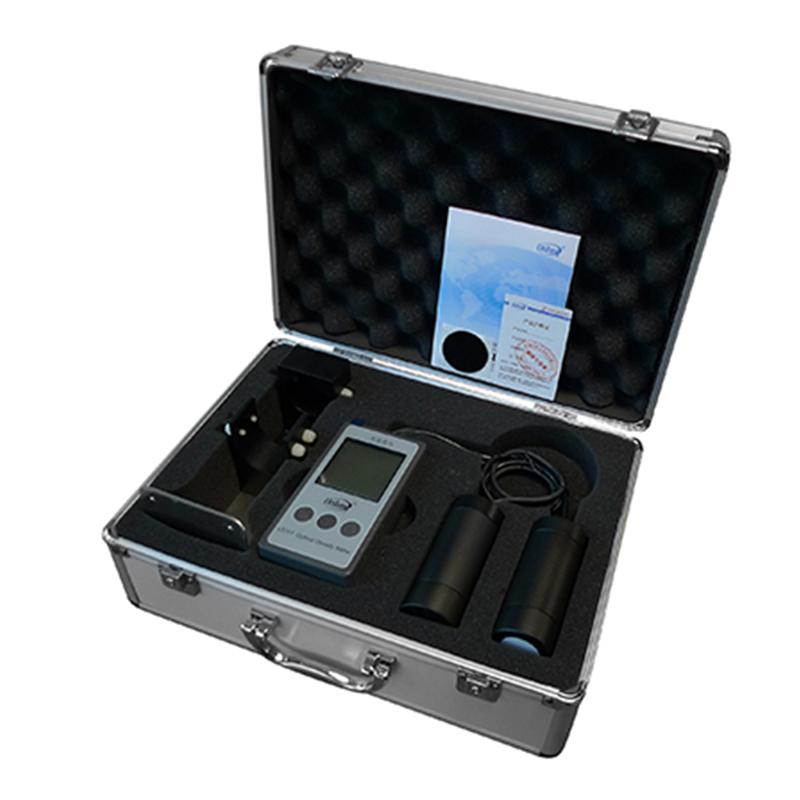
LinShang LS117 Optical density MeterPacking list

- SKU
- NB002143
- Light transmitance measurement Accuracy
- ±1%(0% --- 50%)±2%(50% --- 100%)
- Light transmitance resolution
- 0.0005%(0% --- 10%)0.005%(10% --- 100%)
- Density Measurement range
- 0.000 OD --- 6.000 OD
- Density measurement Accuracy
- ±0.02(0 --- 2.00 OD)±2%(2.00 --- 6.00 OD)
- Optical Density Resolution
- 0.001 OD(0 --- 2.00 OD)0.01 OD(2.00 --- 4.00 OD)0.1 OD(4.00 --- 6.00 OD)
- Optical hole size
- 2mm
- Peak wavelength of visible light
- 380~760nm
- Weight
- Technologies 576g (without battery)
- Power
- 4 * AAA alkalinity dry battery
- display
- 240 * 160 dot matrix LCD
- Host size
- 148*76*26mm

Introduction
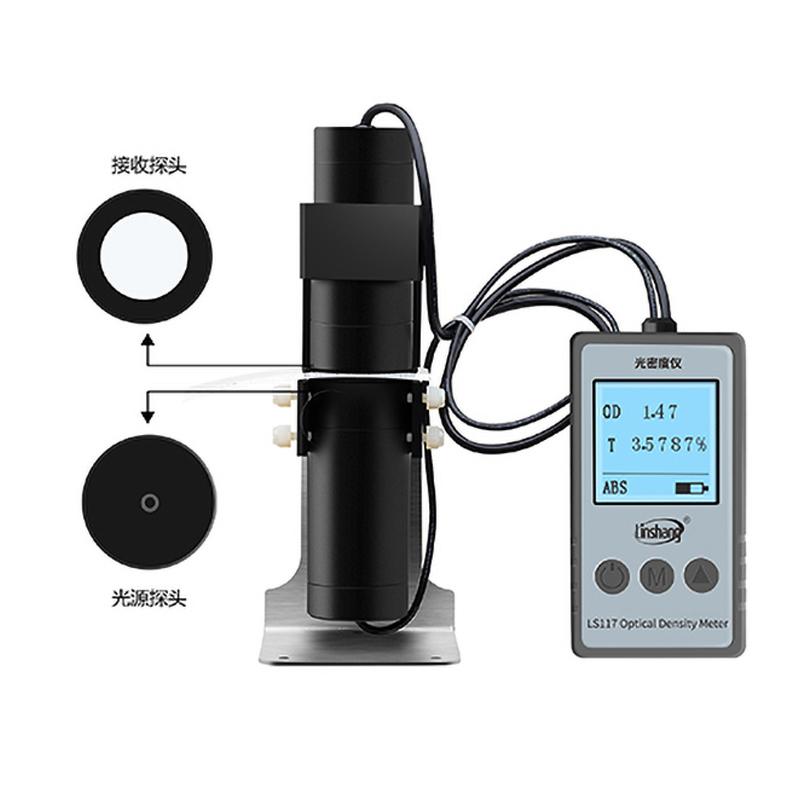
The light source of the LS117 densitometer adopts the principle of diffuse transmission measurement. It is an advanced translucent material light transmittance meter with the effect of an integrating sphere. The light source conforms to the CIE photopic function standard, which can ensure that it passes the inspection of the Institute of Metrology. The instrument is suitable for the light transmittance and optical density test of milky white diffusion plate, zirconia, aluminized film, X-ray film, foggy, frosted glass and other materials.
Relevant optical knowledge science: Optical density is optical density, abbreviated as OD, which means the light-shielding ability of materials. It is commonly referred to as absorbance, and the national standard is called optical density. It refers to the logarithm of the ratio of incident light to transmitted light or the logarithm of the reciprocal of light transmittance. The calculation formula is: OD=lg (incident light/transmitted light) or OD=lg (1/light transmittance).
Features of LS117 light transmittance test instrument
1. High precision and wide measurement range, the optical density value can be measured to 6 OD.
2. The light transmittance and optical density can be tested at the same time, and directly displayed on the screen.
3. The light source of the optical density meter adopts the principle of diffuse transmission, which meets the test requirements of milky white and foggy materials. And the light source conforms to the CIE photopic function standard, ensuring that it passes the national measurement.
4. The optical density meter is equipped with a fixed base and a bracket. There are two measurement methods: either the fixed base can be used for testing, or the probe can be taken down to test larger-sized materials.
- 1GB/T 3830-2024《Calendered film and sheet from flexible polyvinyl chloride》
- 2QB/T 5855-2023《Test for light transmittance of colored glass》
- 3GB/T 10002.1-2023《Unplasticized poly (vinyl chloride) (PVC-U) pipes for water supply》
- 4GB/T 13519-2016《Polyethylene heat-shrinkable film for packaging applications》