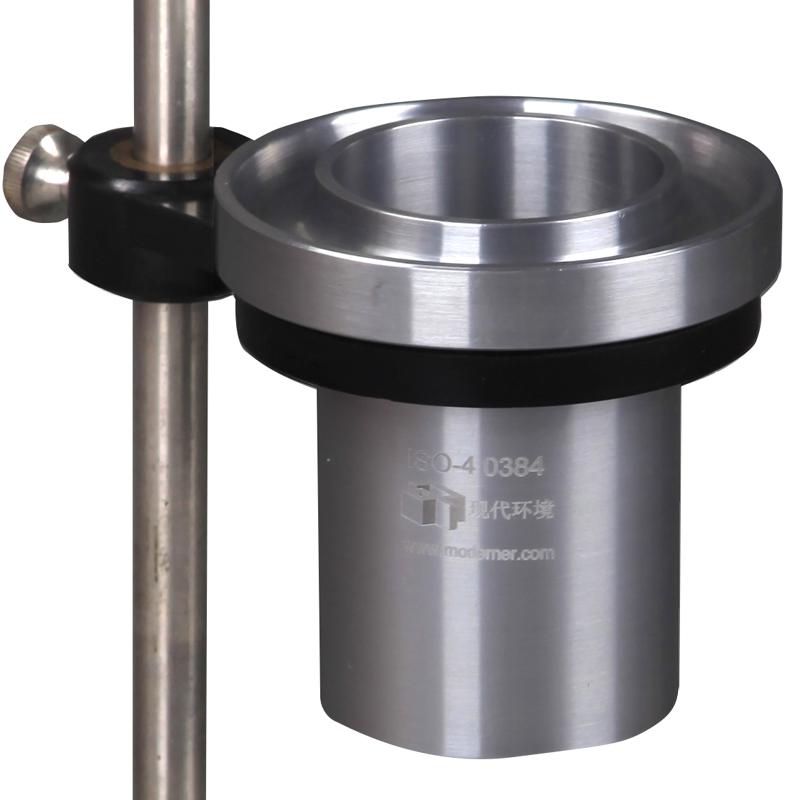

 ISO-3
ISO-3

-
 JINGKELIAN QNB No.3 ISO Flow Cup outflow time 30s ≤ t ≤ 100s diameter 3.0mm$ 139.00SE
 -
 TRUIT TR 1008/4 ISO Viscosity Cup φ4.0mm$ 126.00SE
 -
 TRUIT TR 1008/3 ISO Viscosity Cup φ3.0mm$ 126.00SE
 -
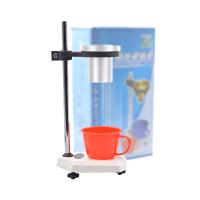 YONGLIDA QNB-ISO-3 ISO Flow Cup (including bracket) viscosity range: 7~ 42cst$ 165.00SE
 -
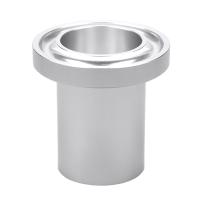 YONGLIDA QNB-3 No. Outflow Viscosity Cup 3mm aperture Measurement range 7~ 14cSt$ 142.00SE





Moderner ISO-3 ISO Flow CupSPEC
Moderner ISO-3 ISO Flow CupDetails
Moderner ISO-3 ISO Flow CupPacking list

- SKU
- NB021791
- Viscosity range
- 7~40cSt
- outflow time
- 30~100s
- Flow hole diameter
- 3mm
- Cup body material
- Aluminum anode oxidation
- Filter material
- Brass
- Applicable standard
- ISO 2431
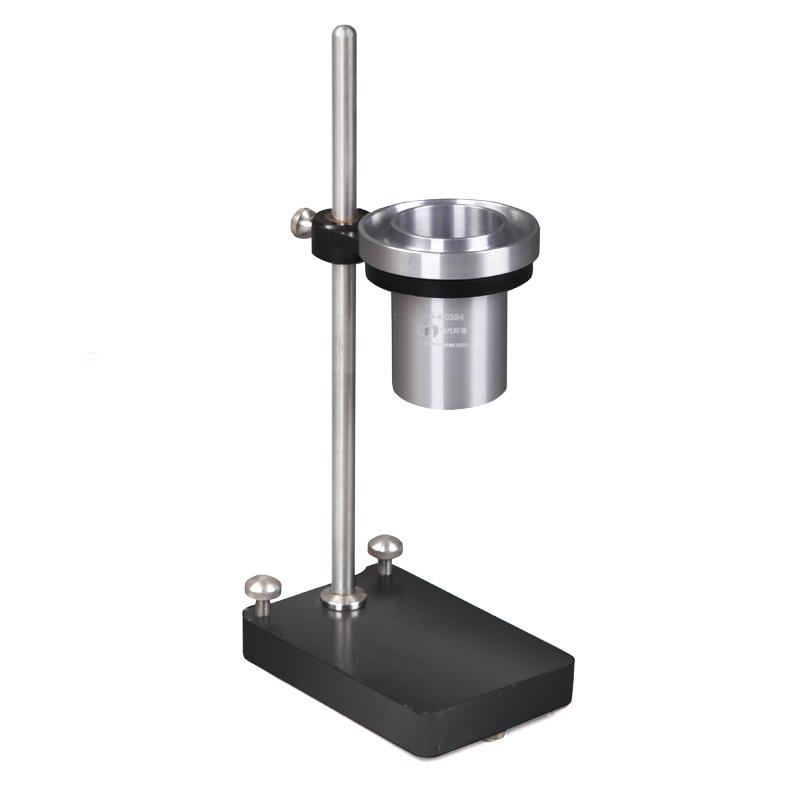
The ISO outFlow Cup is used to determine the outflow time of paints with Newtonian or near-Newtonian fluids. The range of kinematic viscosity suitable for testing samples is 7-685mm2/s. The ISO outFlow Cup conforms to the national standard GB/T6753.4 Paint and varnish Use the outFlow Cup to measure the outflow time.
Test Range
| cup number | Kinematic Viscosity Test Range | calculation method |
| ISO-3 | 7~40mm2/s | v=0.443t-200/t |
| ISO-4 | 35~135mm2/s | v=1.37t-200/t |
| ISO-5 | 100~300mm2/s | v=3.28t-220/t |
| ISO-6 | 220~685mm2/s | v=6.9t-570/t |
In the formula: v——kinematic viscosity mm2/s
t——Outflow time s (measured value should be within 30~100s)
preliminary test
1. Choose a certain label outFlow Cup, so that the sample outflow time in the cup is within 30-100s.
2. Before each measurement, wipe the outFlow Cup with a silk cloth dipped in solvent and dry it. The leak nozzle should be clean when observing the light.
3. Adjust the level screw to make the end surface of the outFlow Cup level. in no airflow.
Use and maintenance
1. Place a container under the outFlow Cup, block the outflow hole with your hands, and slowly fill the outFlow Cup with the sample to avoid air bubbles. When the sample is filled with a convex surface and begins to overflow, use a straight-edged scraper or a flat glass plate to slide and push it along the upper edge to scrape off air bubbles and excess samples. Release the finger to allow the sample to flow, that is, start the stopwatch, and stop the stopwatch when the sample flow is interrupted for the first time. The total time that the sample flows out of the outFlow Cup is the outflow time of the sample. The difference between the two measured values should be less than 4% of the average value.
2. If the calibrated cup is used as a standard cup, it should be multiplied by a correction factor (k) value to correct the outflow time deviation.
3. The temperature of the sample is 25°C±0.5°C during the measurement, and it should be measured in a constant temperature room. If the test is not carried out in a constant temperature room, a thermometer should be placed in the sample stream, and the temperature shown should be kept the same as the temperature before the outflow. more than 0.5°C.
4. After the test, the outFlow Cup should be wiped clean with solvent and coated with anti-rust oil. Do not use any sharp and hard metal objects when wiping to prevent scratching the surface.
- 1GB/T 33374-2016《Ultraviolet curable coatings—Determination of volatile content》
- 2GB/T 1727-2021《General methods for preparation of coating films》
- 3ASTM D5125-2020《Standard Test Method for Viscosity of Paints and Related Materials by ISO Flow Cups》
- 4ISO 2431-2016《Paints and varnishes — Determination of flow time by use of Flow Cups》
- 5JJG 743-2018《Flow Cup Viscometers》
- 6ASTM D5125-2020《Viscosity Determination of Coatings and Related Materials by ISO Flow Cup》
- 7ISO 2431-2019《Paints and varnishes flow time with Flow Cup》
- 8JJG 743-1991《Viscometer Flow Cup verification》
- 9GB/T 22235-2008《Determination of liquid viscosity》
- 10GB 1727-1992《Paint film general preparatory method》