
TQC VF9600 MFFT10 minimum film forming temperature (MFFT) Tester -10~80 ℃
SE VF9600

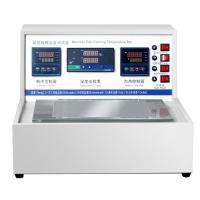
TQC sheen VF9600 Minimum film forming temperature (MFFT) TesterSPEC
TQC sheen VF9600 Minimum film forming temperature (MFFT) TesterDetails
TQC sheen VF9600 Minimum film forming temperature (MFFT) TesterPacking list

- SKU
- NB022290
- Layered plate Operating temperature range
- -10~80℃
- Temperature measurement point
- 10 point
- Temperature layer
- MAX Maximum 20 K
- Dimensions
- 800*350*320mm
- Test strip size
- 500x180mm
- Power supply Voltage
- 230V,50Hz,1.5KW
- Weight
- 50kg

Introduction
Temperature gradient plates are used to determine the minimum film-forming temperature test.
The minimum film-forming temperature is the lowest temperature at which an emulsion, latex, or adhesive coalesces uniformly when applied to the substrate as a film.
Knowing the MFFT temperature allows formulators to create products that cure correctly under the desired application conditions. The instrument can also be used to define white point/glass transition temperatures for dispersed materials, synthetic resins, enamels, etc., as well as blocking and stacking capabilities for coated paper, foils, prints......
The TQC MFFT TEST is a precision test instrument with a metal platen of ground hard chrome for the deposition of samples. By heating and cooling the platen, any variable temperature gradient in the range of -30 to +250°C can be created and remains constant for any given time. The platen is equipped with 10 or 20 evenly spaced temperature sensors. The temperature is controlled via an integrated digital controller, with a digital display and measuring point selector covering the entire range. To define an MFFT, the sample should be applied to the platen using a Film Applicator and protected from environmental conditions by a transparent cover. Creates a stream of dry air to prevent condensation and ensure repeatability. To determine the blocking capacity, the specimen on the platen is weighed with a defined load to simulate the stacking capacity. The TQC MFFT TEST complies with the following standards: acc.
Meets standards
DIN ISO 2115 - DIN 53366 - ASTM D 2354 - ASTM D 1465 - ISO 2115 - ISO / DIS 4622.
Product display

- 1Tester for film-forming process, physical drying, chemical curing, and minimum film-forming temperature of coatings
- 2Minimum film forming temperature (MFFT): from theory to practice
- 1HG/T 4448-2012《Textile dyeing and finishing auxiliaries.Determination of minimum film-forming temperature of polymer emulsion》
- 2GB/T 20623-2006《Emulsions for architectural coatings》
- 3GB/T 9267-2008《Emulsions for coatings and polymer dispersions for coatings and plastics - Determination of white point temperature and minimum film-forming temperature》
- 4GB/T 11175-2002《Testing methods for synthetic resin emulsions》
- 5ISO 2115-1996《Plastics - Polymer Dispersions - Determination Of White Point Temperature And Minimum Film-Forming Temperature》
- 6GB/T 9267-1988《Determination of emulsion minimum film forming temperature (MFFT) for latex paints》