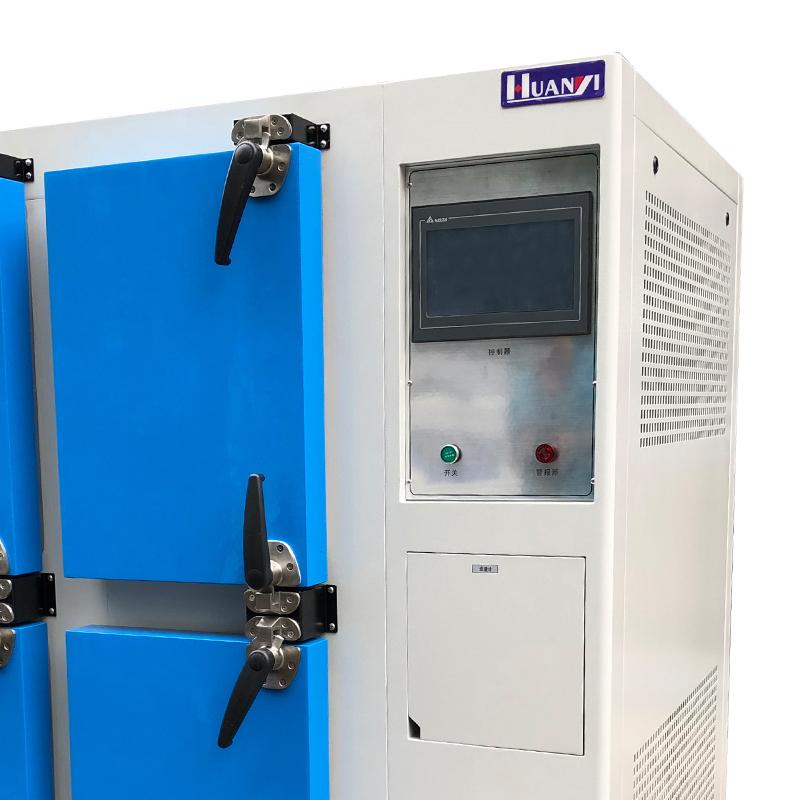
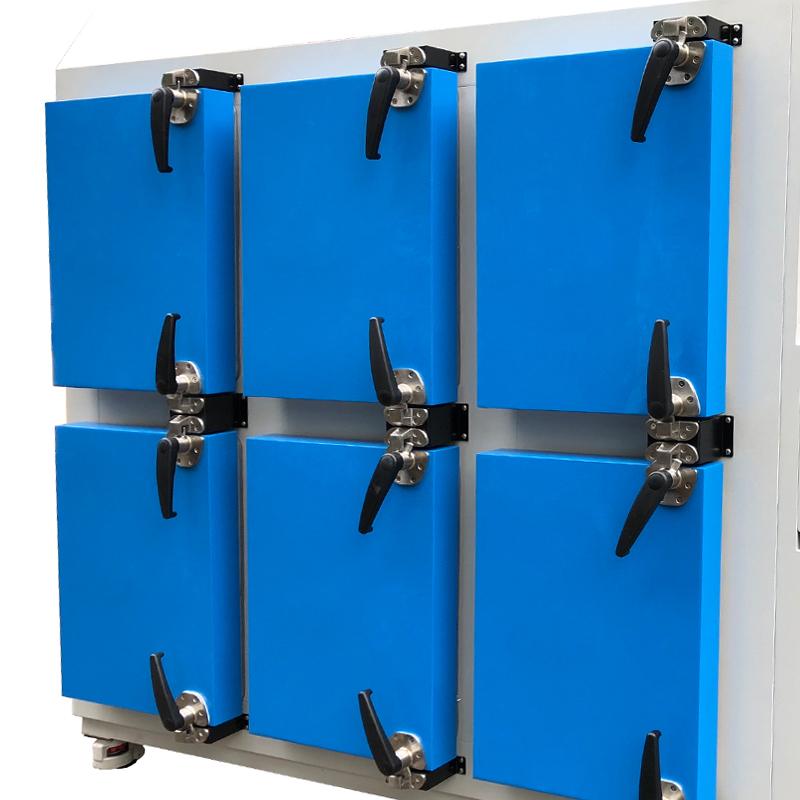

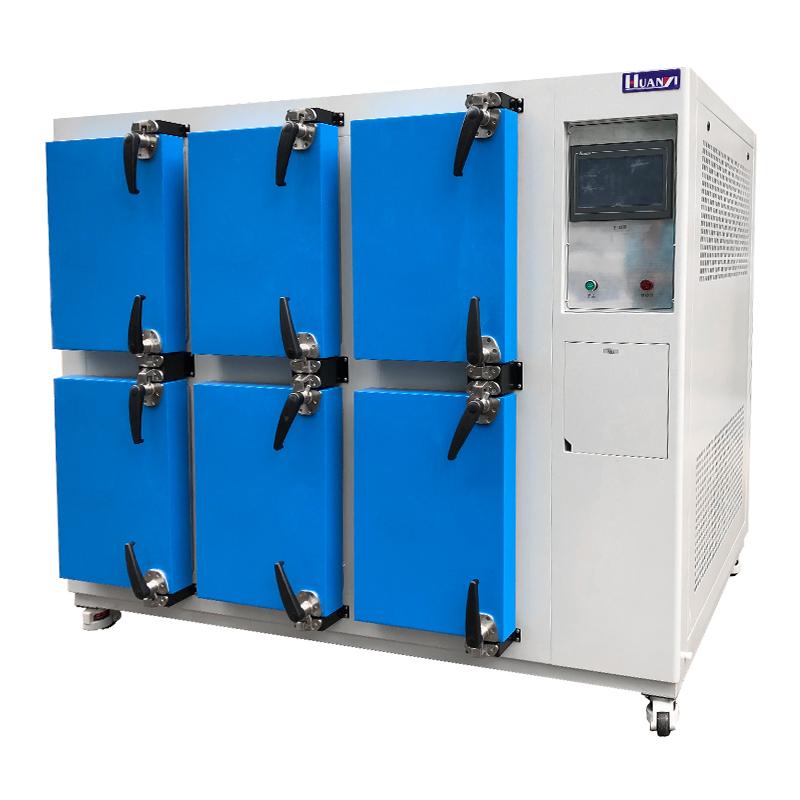
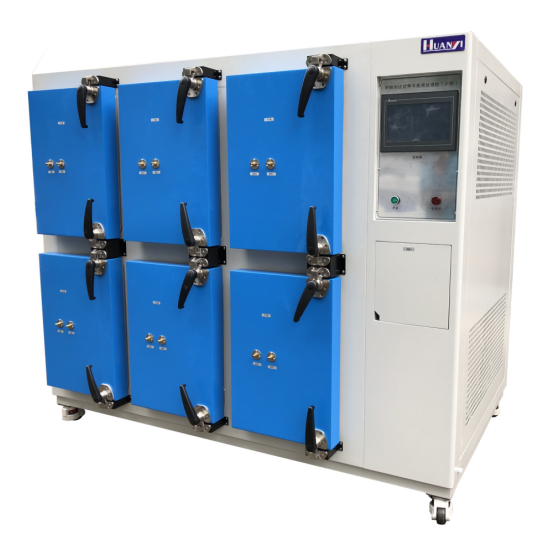
Ring instrument HYV-60-6 VOC equilibrating chamber 6 barrel type
SE HYV-60-6

huangyi HYV-60-6 VOC equilibrating tank (6 barrels)SPEC
huangyi HYV-60-6 VOC equilibrating tank (6 barrels)Details
huangyi HYV-60-6 VOC equilibrating tank (6 barrels)Packing list

- SKU
- NB024246
- Interior Volume
- 60L ±1L
- Interior size
- 300 * 500 * 400mm * 6pc
- Appearance
- Subject to actual
- Temperature range
- 15~65℃
- Temperature fluctuation
- ≤ ±0.5℃
- Temperature Uniformity
- ≤±0.8℃
- temperature resolution
- 0.1℃
- Temperature control method
- Indirect temperature control method of constant greenhouse
- Humidity control range
- 5~80% R.H.
- Humidity fluctuation
- ≤ ± 1% RH
- Humidity Uniformity
- ≤ ± 2% RH
- Humidity resolution
- 0.1% RH
- Humidity control method
- Dry and moisture proportional control method (external)
- Background concentration
- Formaldehyde ≤ 0.006 mg/m3
- Single VOC background value
- ≤0.005 mg/m3
- TVOC background value
- ≤0.02 mg/m3
- Air exchange rate
- 0.2~ 2.5 times/hour (precision 2.5) to meet the test requirements of plastic surface layer (1 time/hour)
- Center wind speed
- 0.1~ 1.0 m/s meets the test requirements of plastic surface (0.1~ 0.3 m/s)
- tightness
- Cabin air leakage rate VL < 5% × air supply rate Vs
- Equipment collection rate
- >85 %
- Relative positive pressure retention
- 10±5 Pa
- Cabin material
- SUS304 mirror stainless steel 1.5mm, rounded corners, full welding and polishing
- Enclosure Material
- Q235A Cold rolled steel plate 1.5mm, surface electrostatic spraying, white
- sealing material
- Imported PTFE, fluororubber
- Thermal insulation material
- 80 mm, high density polyurethane foam
- Human Machine Interface
- Delta 10-inch color touch screen
- Equipment control method
- The following control methods can be realized: Local control: operate the device directly on the touch screen
- Automatically record items
- Automatically record the following items in the working cabin: ① Temperature ② Humidity ③ Pressure ④ Flow ⑤ Running time ⑥ System alarm can realize system control, program setting, dynamic Data Display and historical data playback, fault recording, alarm setting and other functions
- Sampling interface
- 2 per cabin (Φ8mm)
- Noise
- ≤60 dB
- Power
- AC380V 5KW
- Humidification water
- Distillation water
- Replenishment cycle
- > 30 days (continuous operation)
Introduction
The test box provides a clean closed space, precisely controls the temperature, humidity, background concentration, wind speed, relative pressure, and air exchange rate in the cabin, and is used to simulate the release process of pollutants in a specific environment, and is used to test plastic runway materials. Can it meet the requirements stipulated in T/310101002-C003-2016 "Limits of Hazardous Substances in Plastic Surfaces of School Sports Grounds".
technical features
1) Appearance
● High-strength carbon steel is welded and formed, with high strength and integrity, and the equipment is durable.
● The surface is sprayed with plastic and cured at high temperature to form a high-strength covering layer, which is beautiful and durable.
● Integrated gas supply source and purification device, no need for external gas pipeline, easy to operate.
● Integrated design, small footprint, portable.
2) Technical expertise
● Ultra-low VOC background concentration control technology,
● Cascaded multi-stage physical and chemical filtration and purification technology
● Professional constant temperature cabin temperature control technology
● Unique high-precision humidity control technology with dry and wet gas ratio
● Humidity rapid balance technology
● Modular design, easy maintenance
● Automatic temperature and humidity control and automatic storage of each working cabin
● The pressure and flow of each working chamber are automatically recorded and saved
● Each working cabin has an independent variable frequency wind speed adjustment device
● Integrated design, internally integrated air supply and purification system
3) Environmental indicators
●Energy-saving design, generally adopts digital frequency converter and linear power module to adjust load, which saves energy significantly.
● Operating power as low as 1.2kw
● Noise less than 60 decibels
Applicable standard
GB 36246-2018 "Sports Fields with Synthetic Surfaces for Primary and Secondary Schools"
T/310101002-C003-2016 "Limits of Hazardous Substances in Plastic Surfaces of School Sports Grounds"
ASTM D 5116-97 "Standard Guide for Small-Scale Environmental Chambers for Determination of Organic Emissions from Indoor Materials and Products"
ASTM D 6007-02 "Standard Test Method for Determination of Formaldehyde Concentration in Air Released from Wood Products by Small Environmental Chamber"
ASTM D 6330-98 "Standard Operation for Determination of VOCs (Removal of Formaldehyde) Release from Wooden Panels in Small Environmental Chambers under Specified Test Conditions"
product structure
From the outside to the inside of the test box are: insulation shell, constant temperature room, combined working warehouse, equipment warehouse, etc.
1) Insulation shell: metal shell, filled with polyurethane and other heat insulating materials inside, good heat insulation to prevent energy loss in the Test Chamber, and at the same time isolate the impact of the environment on the working chamber to ensure the smooth operation of the equipment.
2) Constant temperature room: the sealed space formed by the thermal insulation shell, the working cabin is placed in it, and the temperature is indirectly controlled by controlling the temperature of the air.
3) Working cabin: It is made of inert and mirror-finished stainless steel with smooth inner wall, and the cabin has good airtightness. It is sealed with clean materials such as expanded polytetrafluoroethylene, and maintains a certain slight positive pressure to prevent the entry of external pollution.
4) Equipment warehouse: place monitoring devices, temperature control devices, humidity control devices, air supply components, filtration and purification systems, circuit devices, etc.
system protection
①High temperature protection in the cabin
②Power overload, leakage, phase loss, underVoltage, overVoltage, phase sequence protection
③ Refrigeration system high-low pressure protection, overload protection
④Heating component overheating protection
⑤Motor overcurrent protection
⑥Fan, air pump overheating, overload protection
⑦Humidification and water shortage protection
⑧Pressure protection
plan
- 1ISO 12460《Wood-based panels - Determination of formaldehyde release - Part 1: Formaldehyde emission by the 1-cubic-metre chamber method》
- 2JJG 1172-2007《Calibration Specification for Volatile Organic Compounds Photo Ionization Detectors》
- 3JG/T 481-2015《Water-based interior wall coating with low-emission volatile organic compounds (VOC)》
- 4JG/T 527-2017《Test method for emission rate of formaldehyde and VOC from wood products by full-scale Test Chamber》
- 5SN/T 3026-2011《Determination of formaldehyde emission from wood products and furniture-Large chamber method》
- 6LY/T 1982-2011《Large chamber for formaldehyde emission of wood-based panels and its products》
- 7LY/T 1981-2011《Testing apparatus for formaldehyde emission by the gas analysis method》
- 8LY/T 1612-2004《The climate chamber for determination of formaldehyde emission》
- 9GB/T 43353-2023《Determination of odour emissions for building products—Test chamber method》
- 10GB/T 33043-2016《Standard test method for determining formaldehyde concentrations in air and emission rates from wood products using a large chamber》