
TESTO testo 926 thermometer
 testo 926

testo testo 926 thermometerSPEC
testo testo 926 thermometerDetails
testo testo 926 thermometerPacking list
- SKU
- NB025731
- NTC Measurement range
- -50 ~ +400 ℃
- NTC Measurement Accuracy
- +/- 0.3 ℃ (-20~ + 70 ℃) +/- ( 0.7 ℃ +/- 0.5% Measured value)
- NTC resolution
- 0.1 ℃ (-50~ + 199.9 ℃) 1 ℃ (remaining range)
- Type K (NiCr-Ni) Measurement range
- -50 ~ +400 ℃
- Type K (NiCr-Ni) Measurement Accuracy
- +/- 0.3 ℃ (-20~ + 7 0 ℃) +/- ( 0.7 ℃ + 0.5% Measured value)
- Type T (Cu-CuNi) Measurement range
- -50 ~ +400 ℃
- Type T (Cu-CuNi) Measurement Accuracy
- +/- 0.3 ℃ (-20~ + 7 0 ℃) +/- ( 0.7 ℃ + 0.5% Measured value)
- Type T (Cu-CuNi) resolution
- 0.1 ℃ (-50~ + 199.9 ℃) 1 ℃ (remaining range)
- diameter
- 177*64*40 mm
- Environmental temperature
- -20~+50℃
- Shell material
- ABS
- Protection level
- IP65
- Measurement ratio
- 0.5 s
- Number of channels
- 1 channel
- standard
- EN 13485
- Power Supply
- 9V battery
- Battery life
- 200H (connect the probe, turn off the backlight); 68h (connect the probe, turn on the backlight)
- Weight
- 182 g (including battery)
- Operating temperature
- -20 ~ +50 ℃
Description
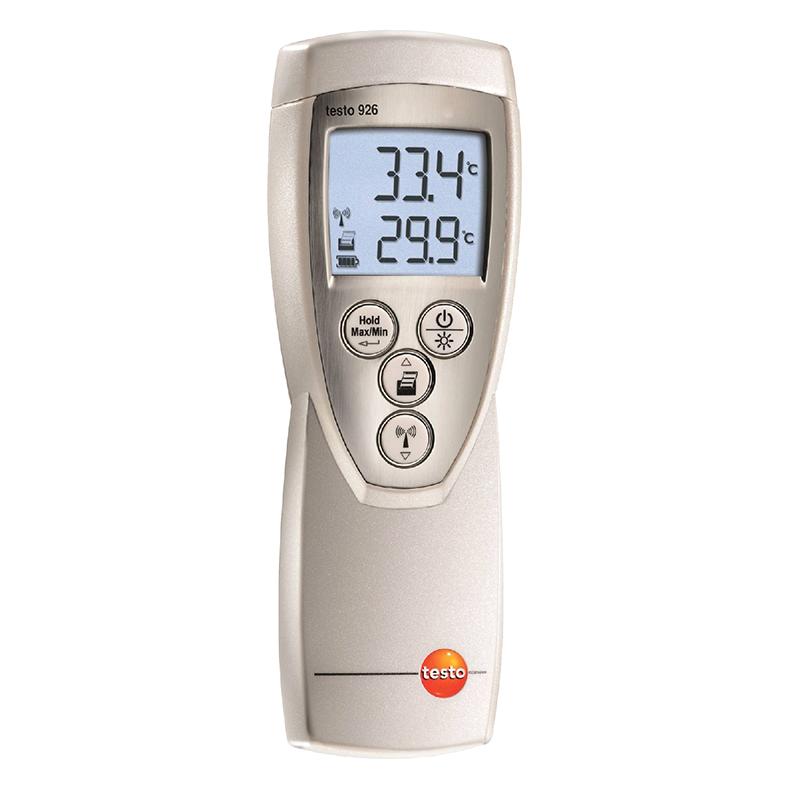
Professional temperature detection in restaurants, canteens, food supply chains, as well as in industrial and commercial applications: The testo 926 handheld digital thermometer is innovative, compact and easy to operate, simplifying workflows and increasing productivity.
The testo 926 electronic thermometer complies with HACCP and EN 13485 and is ideally suited for use in the food industry. The food safety thermometer can be set with customizable limits and an audible alarm when the limit is exceeded, making it easy to carry out daily work. The maximum/minimum values are automatically saved.
testo 926 thermometer – a wide range of probes to choose from
The testo 926 food safety thermometer is available with a wide range of different probe types to suit a wide range of measurement needs: standard food probes, frozen food probes, ultra-fine probes for trace-free detection, and adiabatic probes designed for in-oven measurements.
The instrument should be connected to at least one probe for normal use. Select the appropriate temperature probe from the list of probes for your application, or order the entry-level kit, which comes standard with a standard food probe.
Standard design for on-site use, with more accessories for added convenience and efficiency
Although the testo 926 already has all the standard practical features, we have further improved its functionality with even more practical accessories.
These useful accessories include the Testo infrared printer for fast data report printing in the field; The protective soft cover is dustproof, waterproof, impact-proof, and can be washed under running water.
Please note:A probe needs to be connected to the electronic thermometer for it to function properly.
