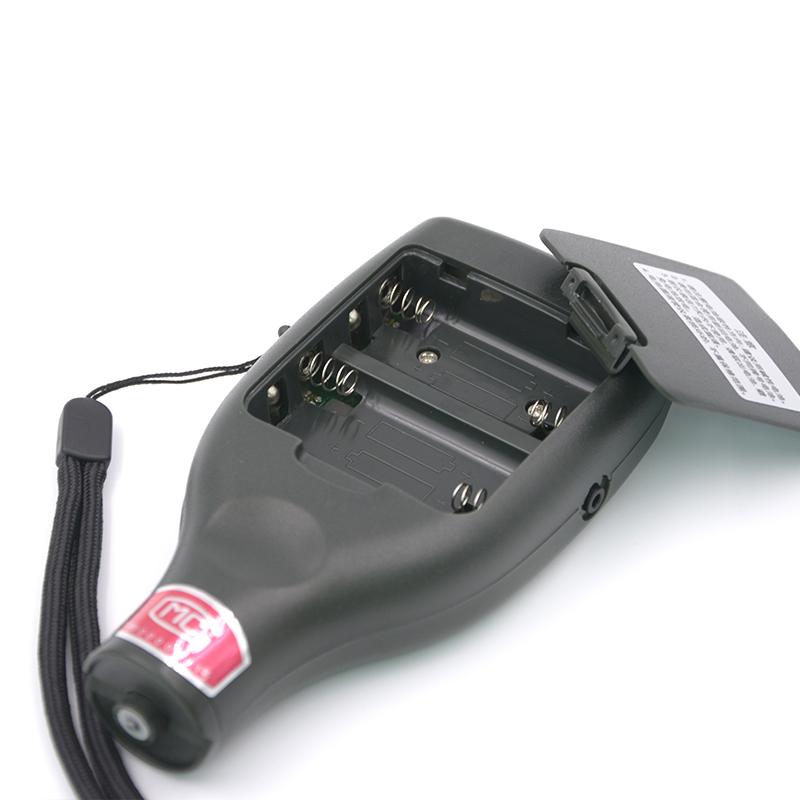

LANDTEK CM8825Fn platings Thickness Measurement Instrument Dual function coating Thickness Measurement Instrument
SE CM8825fn

-
 IPRE CT400 magnetic Induction eddy Current Coating Thickness Gauge Measurement range 0~1500μm$ 256.00SE
 -
 AMITTARI AC-110A built-in thickness probe with resolution of 0.1 μm$ 344.00SE
 -
 Statistical Coating Thickness Gauge AMITTARI AC-110B Integrated Sensors can store 99 sets of thickness measurement data$ 510.00SE
 -
 LANDTEK CM8828 Film Thickness Gauge for automotive coatings$ 389.00SE
 -
 LANDTEK CM8855 coating Film Thickness Gauge Integrated F magnetic Induction /NF eddy current statistical function$ 493.00SE





LANDTEK CM8825fn Coating Thickness GaugeSPEC
LANDTEK CM8825fn Coating Thickness GaugeDetails
LANDTEK CM8825fn Coating Thickness GaugePacking list

- SKU
- NB000273
- Measurement principle
- Magnetic induction + eddy current
- Measuring range
- 0 ~ 1250µm
- margin of error
- ±3%
- resolution
- 0.1mm | 1mm
- Minimum radius of curvature
- F: convex 1.5mm/concave 25mm; N: convex 3mm/concave 50mm
- thinnest matrix
- 0.3mm
- probe
- F and NF integrated probes
- icon function
- without
- Power
- 4 * AAA battery
- Calibrated Certificate
- without
- Language
- Chinese
- Display screen
- LCD
- supporting software
- without
- Total Weight
- 81G (without battery)
- Complete-built unit size
- 126*65*27mm
- Unit display
- μm/mils
- Voltage prompt
- Low Voltage prompt
- Operating Temperature
- 0~40℃
- Relative Humidity
- 10~90%RH

Introduction
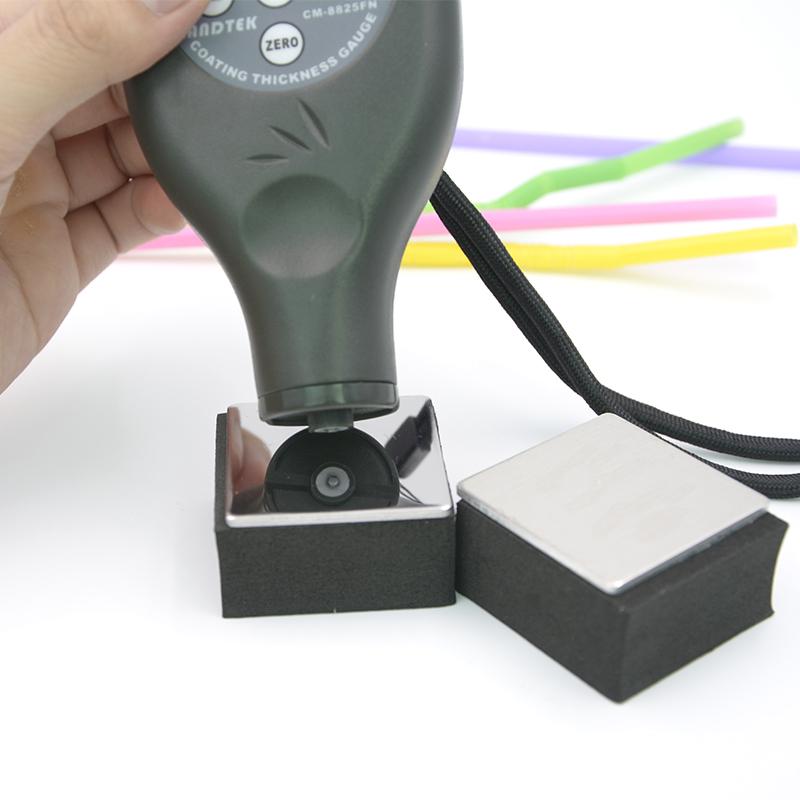
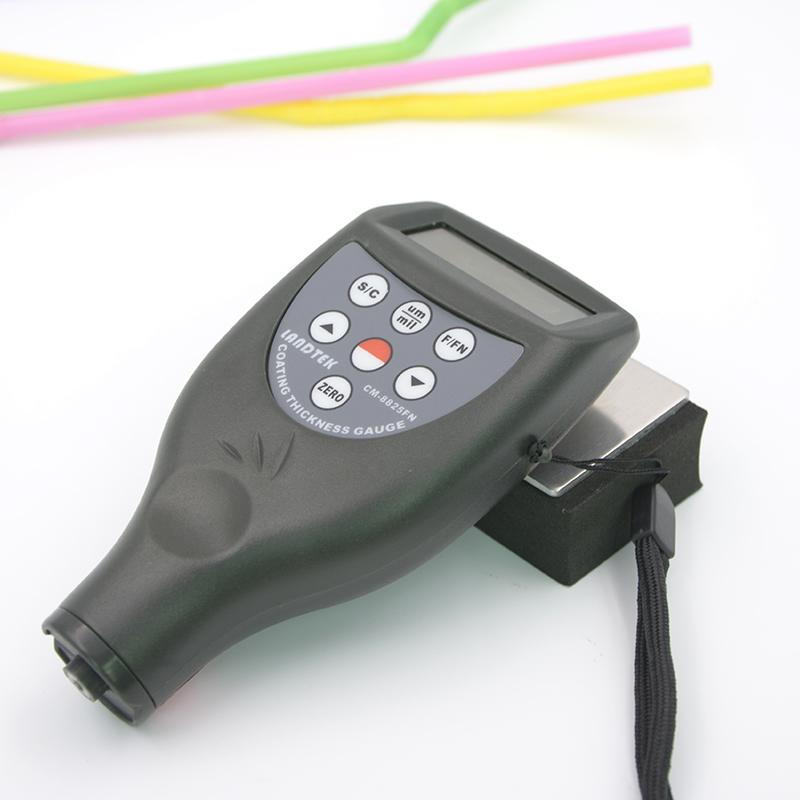
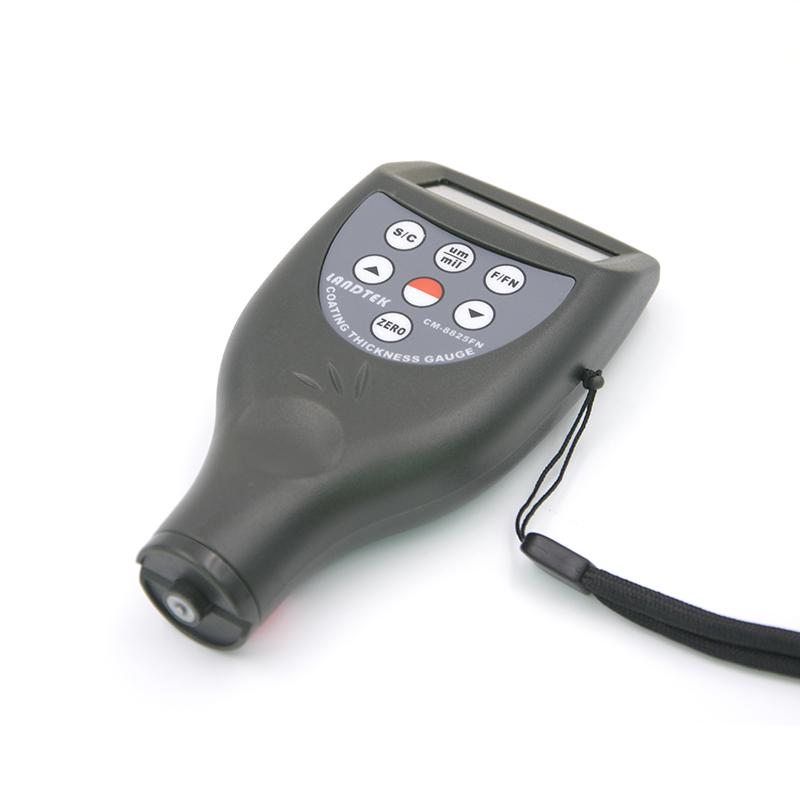
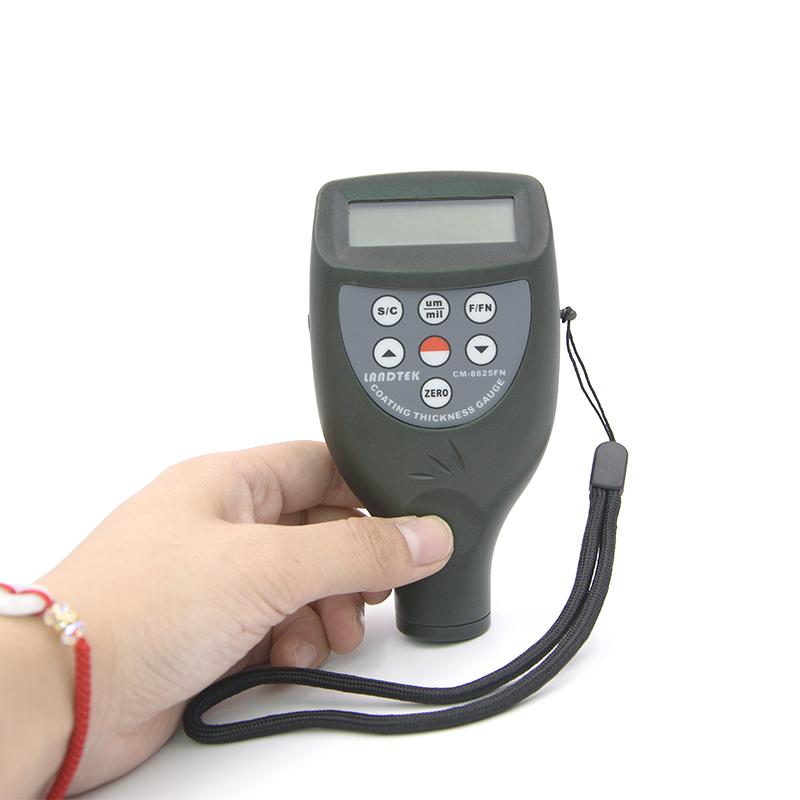
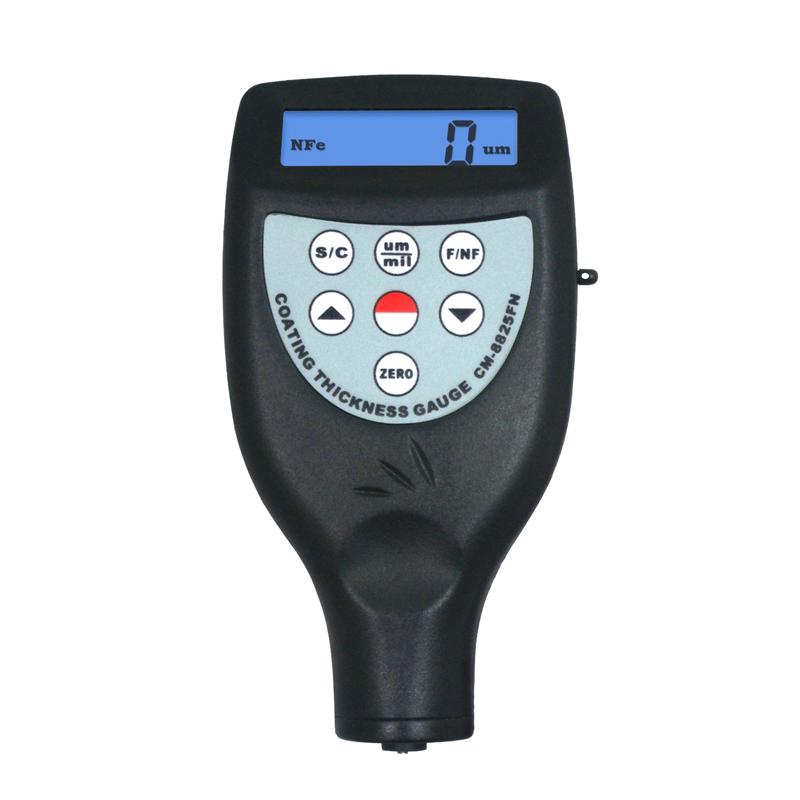
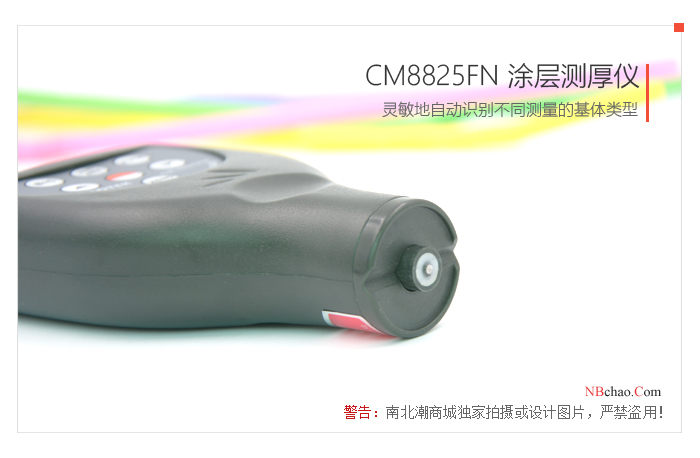
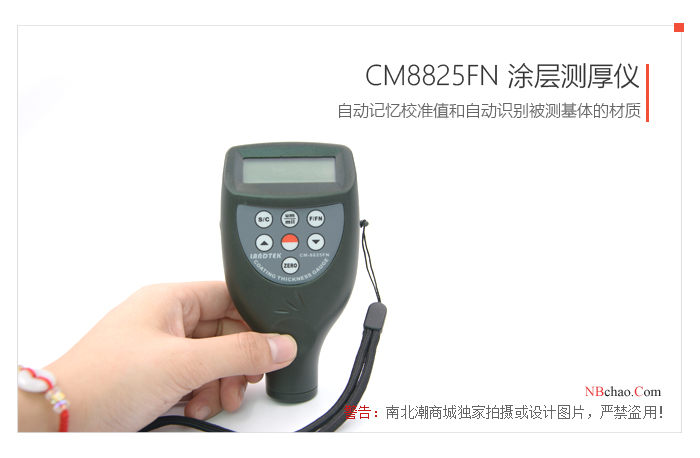
Lantek CM8825fn coating Thickness Gauge is a dual-function coating Thickness Gauge with built-in sensors that can sensitively and automatically identify different measured substrate types, and display the measured substrate type F/N on the LCD. The CM8825fn coating thickness measuring instrument has a USB interface, which can be connected to a PC to transmit data, and has two measurement modes: single and continuous, and supports automatic shutdown, thereby prolonging the service life of the battery.
Applications
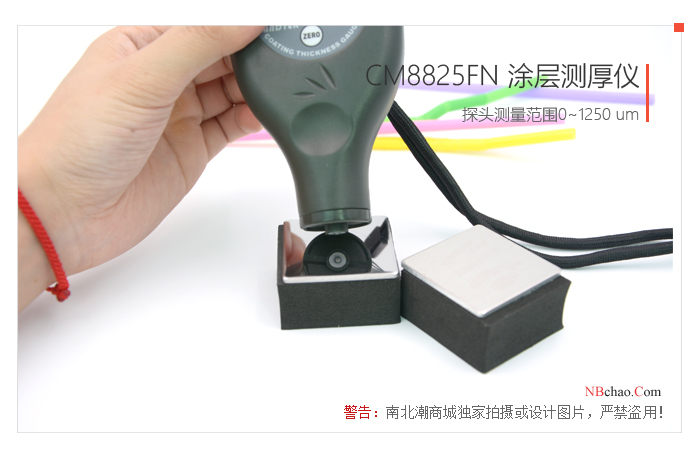
Coating thickness measuring instrument CM-8825fn uses a magnetic sensor to measure non-ferromagnetic coatings and coatings on ferromagnetic metal substrates such as steel and iron, such as: paint, powder, plastic, rubber, synthetic materials, phosphating, chromium, zinc , lead, aluminum, tin, cadmium, porcelain, enamel, oxide layer, etc. Use eddy current sensors to measure enamel, rubber, paint, plastic layers, etc. on copper, aluminum, zinc, tin, etc. substrates. Widely used in manufacturing, metal processing, chemical industry, commodity inspection and other testing fields.
Features
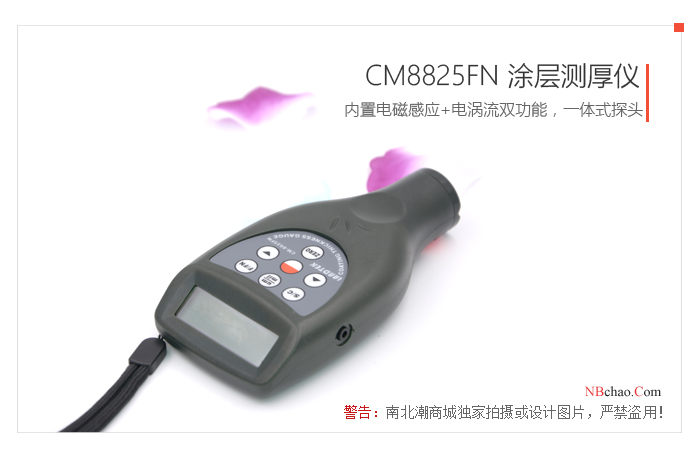
Coating thickness measuring instrument CM8825fn can measure the thickness of the non-magnetic coating on the magnetic conductive object and the non-conductive coating on the non-magnetic metal substrate
Pictures
Features and advantages
* CM8825fn coating thickness measuring instrument has two optional measurement methods: single and continuous.
* Metric/Imperial unit conversion.
* CM8825fn coating thickness measuring instrument has the functions of manual shutdown, automatic shutdown and underVoltage prompt.
* Automatically memorize the calibration value and automatically identify the material of the measured substrate.
* There is a buzzer sound during operation, but the buzzer does not sound during continuous measurement.
* CM8825fn coating thickness measuring instrument adopts USB data line output, RS-232C data connection line and software to communicate with PC.
* Optional Bluetooth™ data output option is also available.
* CM8825fn coating thickness measuring instrument, the integral type is suitable for one-handed operation, it has a "big probe", the large contact surface has better stability, and the results are accurate and repeatable.
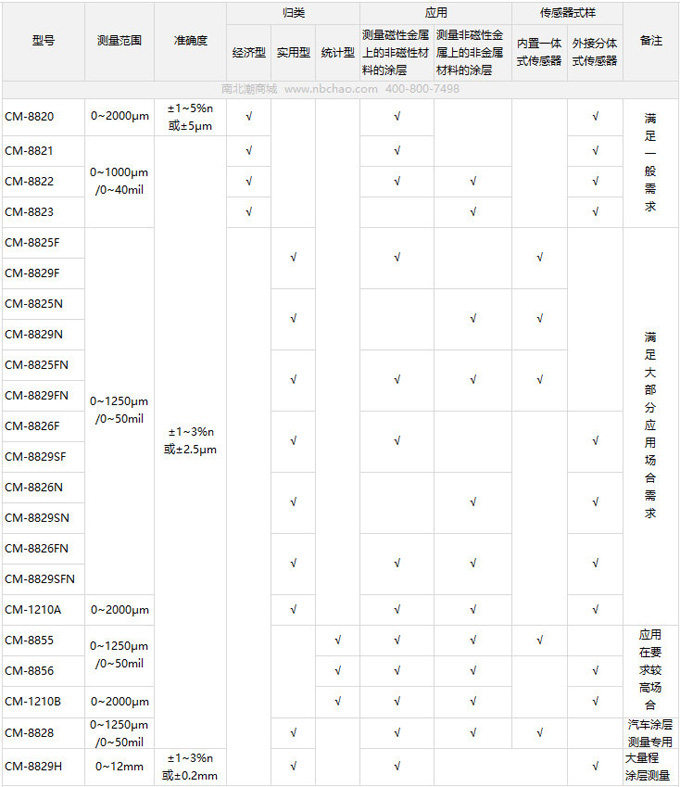
Selection reference chart
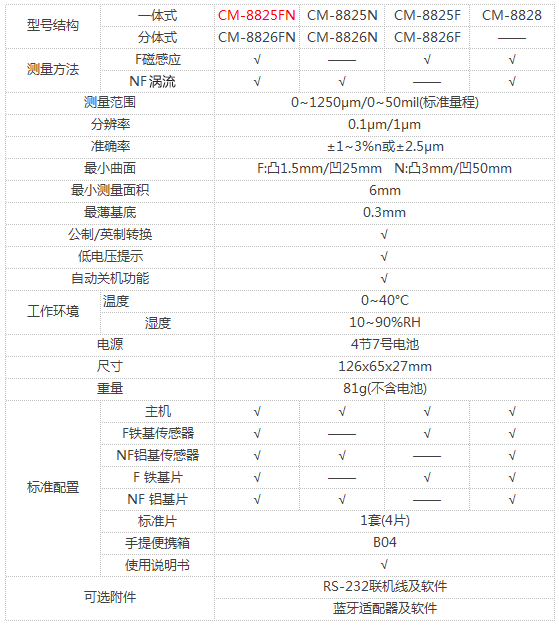
LANDTEK Coating Thickness Measuring Instrument Selection List
- 1QJ 990.3A-2011《Inspection methods of coating.Part 3:Measurement of coating thickness》
- 2NF EN ISO 2808-2007《Paints and varnishes - Determination of film thickness.》
- 3JJG 818-2018《Magnetic and Eddy Current M easuring I nstrument for Coating Thickness》
- 4GB/T 1727-2021《General methods for preparation of coating films》
- 5HG/T 20720-2020《Construction and acceptance specification of waterborne anti-corrosion coatings for steel structures in industrial buildings》
- 6HG/T 5367.1-2018《Coatings for rail transit vehicles - Part 1: Waterborne coatings》
- 7ASTM B244-2021《Standard Test Method for Measurement of Thickness of Anodic Coatings on Aluminum and of Other Nonconductive Coatings on Nonmagnetic Basis Metals with Eddy-Current Instruments》
- 8ASTM B499-2021《Standard Test Method for Measurement of Coating Thicknesses by the Magnetic Method: Nonmagnetic Coatings on Magnetic Basis Metals》
- 9 B530-2014《》
- 10ISO 2360-2017《Non-conductive coatings on non-magnetic electrically conductive base metals — Measurement of coating thickness — Amplitude-sensitive eddy-current method》