
Rongjida SZ-145 pointer mortar consistency meter
 SZ-145

RongJiDa SZ-145 Mortar consistency MeterSPEC
RongJiDa SZ-145 Mortar consistency MeterDetails
RongJiDa SZ-145 Mortar consistency MeterPacking list

- SKU
- NB028799
- sinking depth
- 0~14.5 cm
- sinking Volume
- 0~229.3 cubic centimeters
- Minimum scale (sinking depth)
- 1 mm
- cone cone angle
- 30°
- cone height
- 145 mm
- cone bottom diameter
- 75 mm
- The cone and the scale are combined
- 300 ± 2 g
- Dimensions
- 350×300×800mm
- Weight
- About 20kg
Introduction
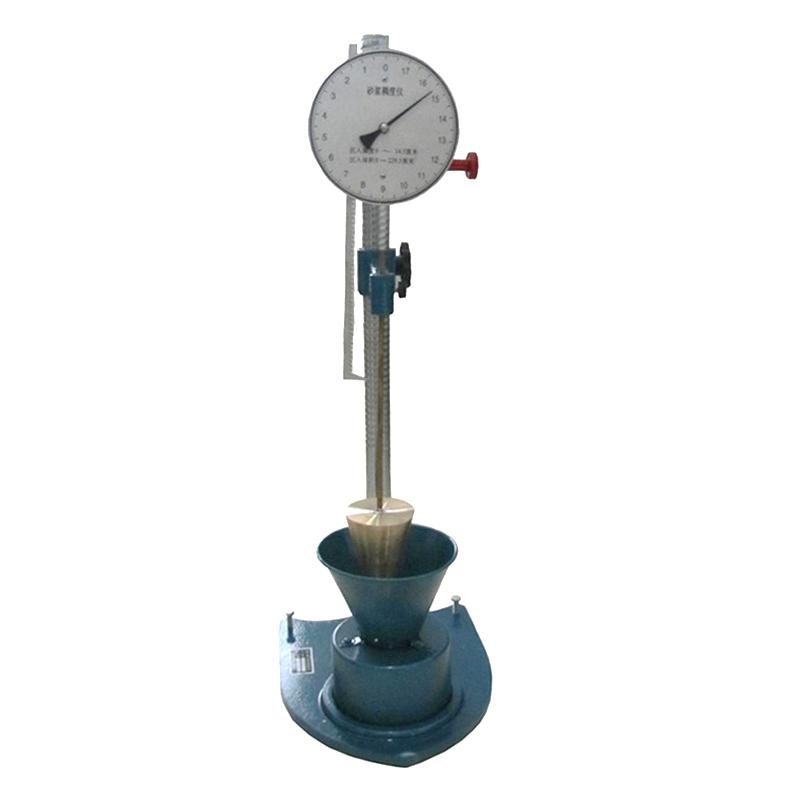
It is designed and manufactured according to the national standard of the basic performance test method of building mortar, and uses a special scale disc indicator. It is used to determine the mix ratio or control the consistency of the mortar during construction to achieve the purpose of controlling water consumption. Used to determine the fluidity and consistency of mortar. The consistency of the mortar is represented by the centimeters of the sinking depth of a standard cone of a certain geometric shape and weight that freely sinks into the mortar mixture under its own weight.
skills requirement
The rack that drives the dial should be clean and free from deformation.
The position of the dial is fixed, and the scale line should be clear and free of deformation.
The surface of the slide rod and the test cone should be straight and smooth, and they can fall freely by their own weight without any tightness or movement.
The total mass of the test cone and slide rod is 300±2g.
Test cone size: height 145±1mm, cone bottom diameter 75±1mm, cone angle 30±1°.
When the test cone is in contact with the plane of the base, the maximum deviation of the test cone shall not exceed 1.5mm.
Conical metal cylinder size: height 180mm±2mm, cone bottom diameter 150±2mm.
Mortar consistency meter structure
The instrument is mainly composed of a chassis, a bracket, a digital display scale, a standard test cone (with a scale) and a material container.
The chassis and uprights are joined together using keys, spring washers and nuts. The cross arm is controlled by two set screws to slide up and down on the column and the scale slides on it respectively. Loosen the left set screw on the upright, the cross arm can move up and down, and then fixed in the desired position.
The digital display scale is on the right side of the cross arm as shown in the figure. The digital display scale can be adjusted to zero at any position, and the vertical sinking depth of the standard test cone can be read directly on the scale.
- 1Principle, function and application of putty consistency meter
- 2 Introduction to the inspection method of Coating product mass
- 3Determination Principle and Detection Method of Coating Viscosity