
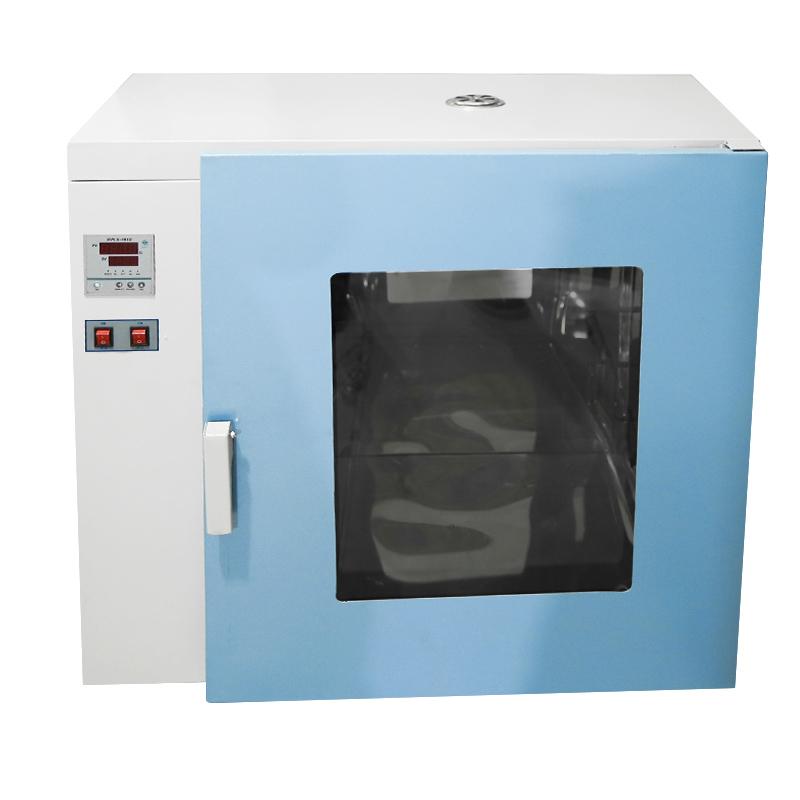
DADI DHG-9426A thermostatic Drying Oven
 DHG-9426A

DaDi DHG-9426A Thermostatic Drying OvenSPEC
DaDi DHG-9426A Thermostatic Drying OvenDetails
DaDi DHG-9426A Thermostatic Drying OvenPacking list
- SKU
- NB028813
- Temperature range
- RT+50~250℃
- Interior size
- 800*800*1000mm
- Chamber material
- Rounded stainless steel
- Timer
- 0~9999min
- Viewing Window
- Double-decked Large Glass Observation Door
- Display mode
- digital display
- Thermostat
- Microcomputer intelligent temperature Controller
- Heating power
- 4800W
- Safety Devices
- Over-temperature alarm
- Remarks
- SCR output
Uses and performance
The Drying Oven has a maximum operating temperature of 250°C and is suitable for baking, drying, heat treatment and other heating. The product structure is precise, the temperature control is sensitive and accurate, and the operation is simple, and it can be used by industry, laboratory or scientific research units.
The working temperature of the Drying Oven can be raised from room temperature to the maximum temperature, and the working temperature can be set arbitrarily within this range, and the temperature control system can automatically maintain the temperature after setting, and the blower is installed in the working room, which can promote the mechanical circulation of air.
Structural
The shell of the Drying Oven is made of thin steel plate, there is a studio made of stainless steel or galvanized iron plate for placing the sample in the box, there is a sample shelf in the studio, the sample can be placed on it for drying, if the sample is larger, the shelf can be removed, there is a considerable thickness of rock wool between the studio and enclosure, and the box door is a double-layer tempered glass door, and the situation in the studio can be observed without opening the door.
The temperature of this product is automatically adjusted by an intelligent thermostat. The temperature sensor reaches into the studio and senses sensitively. All electrical equipment, such as controllers and electric heaters, are operated on the panel, and the control room has side doors that can be removed for inspection or repair of wiring.
Notes:
(1) This box is non-explosion-proof, so do not put flammable volatile items into the Drying Oven to avoid explosion.
(2) THE AVERAGE LOAD OF THE SAMPLE SHELF IS 45KG/M2, DO NOT OVERLOAD AND OVERLOAD WHEN PLACING THE SAMPLE, AND DO NOT PLACE THE SAMPLE AND OTHER THINGS ON THE HEAT SINK SO AS NOT TO AFFECT THE HOT AIR CONVECTION.
(3) When using this box, the power supply Voltage must be consistent with the rated working Voltage of this box, otherwise it will cause damage to the electronic instruments in the box.
(4) Do not disassemble or unload the parts arbitrarily to avoid damaging the electrical circuits in the box.
(5) If the box fails, it should be repaired by an electrician who is familiar with electronic instruments.