
XINGHUO ZTT-301V digital display reverse reflection line Measurement Instrument, touch screen, voice broadcast
SE ZTT-301V

TianDiXingHuo ZTT-301V Reverse reflection marking Measurement InstrumentSPEC
TianDiXingHuo ZTT-301V Reverse reflection marking Measurement InstrumentDetails
TianDiXingHuo ZTT-301V Reverse reflection marking Measurement InstrumentPacking list

- SKU
- NB029504
- Observation angle α
- 1.05°
- Incident angle β
- 88.76°
- Light source Color temperature
- 2856K +/- 50K (CIEA Light source)
- Measurement range
- 0~3000mcd·lx-1·m-2
- complementary angle
- 1.24°
- Detector
- Silicon diode + V (λ) aligner, filter correction meets the requirements of CIE standard photometric observer Light spectrum optical efficiency V (λ)
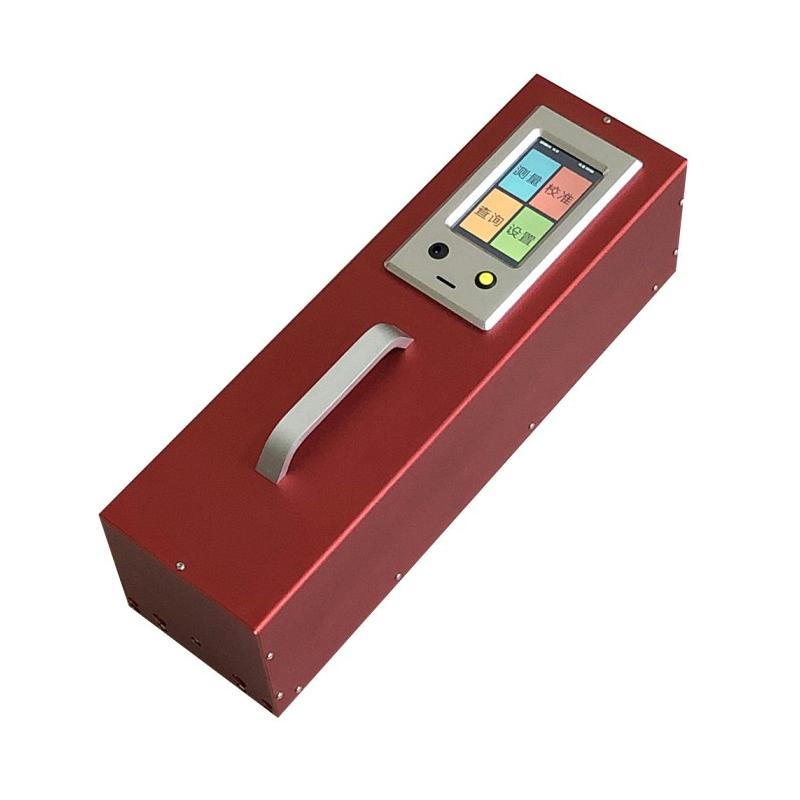
ZTT-301V retroreflective marking measuring instrument is a professional measuring instrument for measuring the reflective performance of road markings. The measured parameter is the retroreflection coefficient R' or the specific brightness of the marking line, and the unit is mcd·lx-1·m-2. The instrument is easy to operate and reliable in value. It is suitable for both laboratory environment and on-site measurement. It is the preferred instrument for production, quality supervision, engineering construction, supervision units, etc. to measure the retroreflective performance of road markings.
According to the standard
The instrument is designed and developed with reference to relevant international technical documents, as well as my country's current national standards and specifications. Comply with No. 72 published by the International Commission on Illumination (CIE), American ASTM D4061-94, German DIN67520, 67521 and my country's GB/T 26377-2010 "Retroreflective Measuring Instrument", GB/T 16311-2009 "Road Traffic Marking Quality Requirements and Monitoring Methods", JJG (Transportation) 059-2004 "Verification Regulations for Retroreflective Measuring Instruments" and other relevant standards.
Features
Large capacity, long standby time
LCD color touch screen display
With voice broadcast function
One-key calibration, fast detection
Temperature and humidity environment at a glance
Data storage function (self-contained data storage card can be connected to a computer to export stored data)
Support detection under dry, wet and continuous rainfall conditions
Aluminum alloy main structure, beautiful and rust-proof
The main unit is small and exquisite in size, easy to carry
The host is light in weight, only 4.30KG
Principle
The geometric conditions of the ZTT-301V touch-screen version of the marking line retroreflective Detector are to simulate the marking line made of retro-reflective material on the road surface illuminated by the headlights of the car when the car is driving on the road at night. Scenarios observed by the driver. The schematic diagram of its optical path is shown in the figure below.
The angle between the optical axis of the headlight and the normal line (reference axis) of the road surface becomes the incident angle (β), which is specified as 88.76°, and the angle between the optical axis of the headlight and the retroreflective line is called the observation angle (α), specified as 1.05°. The light source and optical system are projected to the reticle according to the incident angle β. The size of the reticle to be measured is 200 X 95mm. The light reflected from the reticle is emitted to the interior of the V(λ) filter according to the observation angle α of 1.05°. The detection is collected and processed and displayed on the measured value display, which is the measured value of the retroreflection coefficient R'.