
TIANDIXINGHUO ZTT-970 communication pipe static coefficient of friction Measurement Instrument, communication pipe inner wall static friction coefficient Tester
SE ZTT-970

TianDiXingHuo ZTT-970 Static coefficient of friction Measurement InstrumentSPEC
TianDiXingHuo ZTT-970 Static coefficient of friction Measurement InstrumentDetails
TianDiXingHuo ZTT-970 Static coefficient of friction Measurement InstrumentPacking list
- SKU
- NB029518
- Angle range
- 0~45°
- Measurement Graduation
- 2.0′
- Test Weight
- 270g±5g
- Stick finish
- 0.20-0.50μm
- Shore hardness of test rod material
- HD59±2
- meet the standard
- GB/T24456-2009、JT/T 683-2009、JTT496-2004、YD/T 841-2008
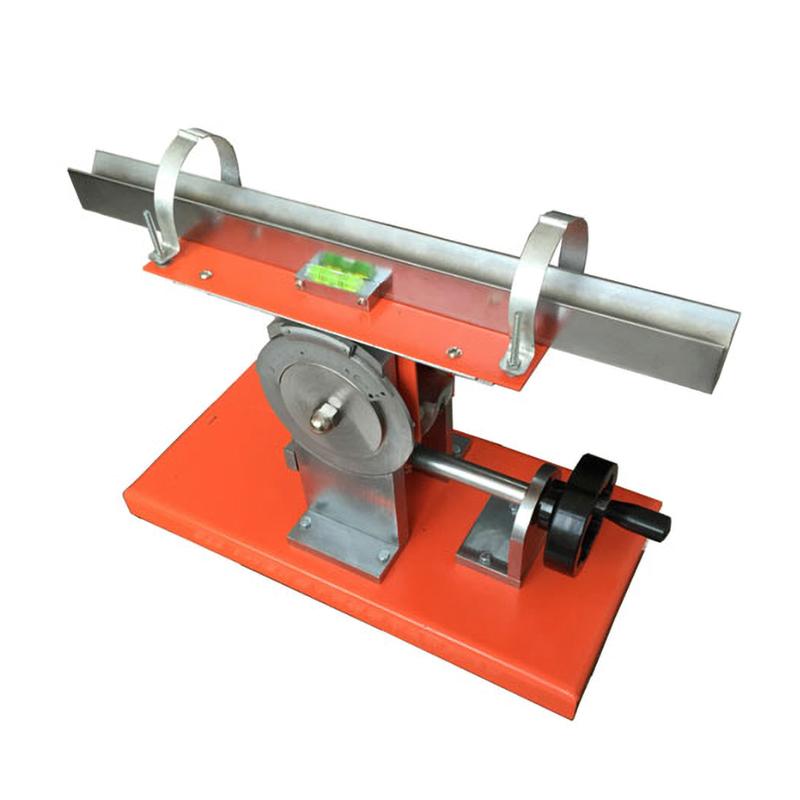
ZTT-970 Communication Tube Inner Wall Static Friction Coefficient Tester is specially designed and produced for production, quality supervision, engineering construction and supervision units to measure the communication tube inner wall static friction coefficient. It has the characteristics of reasonable structure, simple operation, wide usability, high measurement accuracy, safe and reliable measurement, etc. The instrument is mainly composed of adjustable base, angle adjustment mechanism (thread transmission mechanism, bearing support, screw, corrugated wheel and connecting rod), communication tube It is composed of installation base, installation card, fastening joint screw, slope gauge and pendant body, dish nut, communication tube for calibration and standard rod, etc.
ZTT-970 static friction coefficient Tester for the inner wall of communication pipes complies with GB/T24456-2009 of the People's Republic of CHINA for high-density polyethylene silicon core pipes, JT/T 683-2009 static friction coefficient Tester for communication pipes, and JTT496-2004 highway underground communication pipes High-density polyethylene silicon core plastic pipes and YD/T 841-2008 "Plastic pipes for underground communication pipelines" and other related technical standards.
ZTT-970 communication tube inner wall static friction coefficient Tester mainly consists of the following parts:
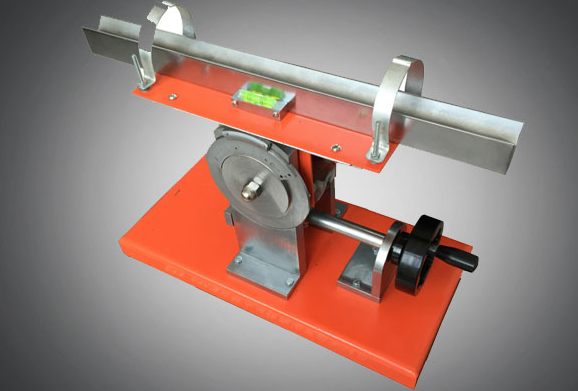
3.1 Base
3.2 Hand wheel and transmission rod
3.3 Worm gears
3.4 Upper base plate
3.5 Angle ruler and vice ruler
3.6 V-type card iron and horizontal device fixing clip
3.7 Test rod and chain rope
4 Operation steps
●Preparation: Adjust the bolts of the base to make the bottom surface level, and adjust the level of the installation base of the communication tube to be tested and its bottom plate. According to experience, it is also possible for the angle to be less than 5°.
● Angle calibration: Install the communication tube to be calibrated in its installation base and lock it with a fixed card. Put the standard rod into the upper end of the communication tube and leave 20mm inside and outside. Slowly turn the wave wheel clockwise to slowly raise the movable end of the installation base plate, and the reading of the angle gauge will increase until the standard rod moves. Convert the reading to the value of the positive function, and compare it with the value of the random calibration certificate. If the value is within the allowable range, otherwise, adjust the slope gauge to keep it consistent.
●Test: The installation and adjustment steps and requirements are the same as the calibration procedure. The difference is that a measured tube should be 45 ° or 90 ° as a measurement direction, and repeated measurement 9 times, record the measurement data and take the arithmetic mean value as the measurement result.
- 1GB/T 44572-2024《Biaxially oriented polyethylene (BOPE) film》
- 2GB/T 44757-2024《Anodizing coating on titanium and titanium alloys》
- 3GB/T 16311-2024《Specification and test method for road traffic markings》
- 4SY/T 6863-2012《Calibration method of mudcake coefficient device》
- 5JT/T 763-2017《Pendulum friction tester》
- 6GB/T 41899-2022《General quality requirements for coated tinplate and ECCS used in food container》
- 7GB/T 10006-1988《Plastics--Film and sheeting--Determination of the coefficients of friction》
- 8GB/T 10006-2021《Plastics—Film and sheeting—Determination of the coefficients of friction》
- 9ISO 15359-1999《Paper And Board -- Determination Of The Static And Kinetic Coefficients Of Friction -- Horizontal Plane Method》
- 10ISO 8295-1995《Plastics - Film And Sheeting - Determination Of Coefficients Of Friction》