
XINGHUO XH-3T Bolt TensIon Meter, bolt drawing instrument
SE XH-3T
XH-3T

TianDiXingHuo XH-3T Bolt Tension GaugeSPEC
TianDiXingHuo XH-3T Bolt Tension GaugeDetails
TianDiXingHuo XH-3T Bolt Tension GaugePacking list
- SKU
- NB029542
- High Voltage manual pump Working pressure
- 40Mpa
- High Voltage manual pump plunger diameter
- 12mm
- High Voltage manual pump Mass
- 4.5kg
- Maximum pulling force of hydraulic cylinder
- 30kN
- Hydraulic cylinder center aperture
- 18mm
- Hydraulic cylinder piston stroke
- 40mm
- Hydraulic cylinder Mass
- 1.8kg
- Pressure gauge Measurement Range
- 0~30KN
- Pressure gauge Power
- 1 9V battery
- Pressure gauge Mass
- 0.4kg
- Resolution
- 0.01KN
- Pressure gauge indication error
- ≤±2%F.S
Instrument Introduction
XH-1T/2T/3T Bolt TensIon Meter (pullout instrument) is suitable for testing the anchoring force of anchor bolts, anchor cables, steel bars, anchor bolts, etc. It is one of the instruments required for the quality inspection of anchor construction and support projects. one.
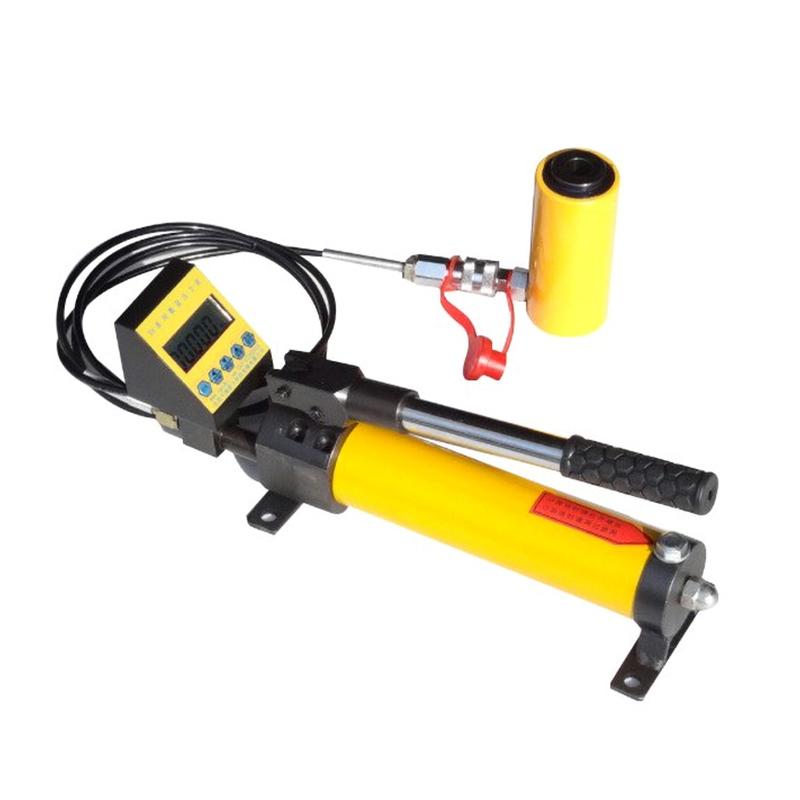
The tension gauge is composed of manual pump, hydraulic cylinder, digital pressure gauge and high-pressure rubber hose. The pump body is made of precision cast steel with long service life. The hydraulic cylinder is a hollow self-resetting type, and the XH series hollow cylinder has a handle and can be connected with a high-pressure hose through a quick connector. The reading of the digital pressure gauge is intuitive, which can directly read the value of the tension (kn) of the anchor rod. This series of tension gauges is compact in structure, easy to carry, small in size and light in weight.
Rally gauge manual pump can also be used as a power source for general small flow high pressure oil.
Principle
The Principle of the Anchor TensIon Meter (pullout instrument) is: when the center hole of the jack is covered with the measured rod, select a suitable clamp to clamp the part of the measured rod exposed from the center hole; under the action of the hydraulic pressure of the pressure pump After the oil pressure is transmitted to the cylinder body of the jack through the oil pipe, the piston rod moves outward against the special chuck; the pressure directly acts on the anchor shell, and then transmits to the clip, which clamps the rod under test after being stressed , and eventually the rod is subjected to an outward pulling force; at this time, the pressure gauge on the pressure pump displays the corresponding force (kN) value, which reflects the magnitude of the pulling force on the measured rod.
If the above-mentioned bar is a steel bar, the magnitude of the anchoring force on the steel bar can be measured. After the pulling instrument has finished testing, it is necessary to manually remove the anchor with a small force of shaking and vibration, so that the pulling jack can be easily removed.