
DAKOTA CMX Ultrasonic Thickness Gauge Simultaneous Measurement of Material and Coating thickness
 CMX
CMX

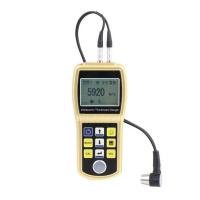
DAKOTA CMX Ultrasonic Thickness GaugeSPEC
DAKOTA CMX Ultrasonic Thickness GaugeDetails
DAKOTA CMX Ultrasonic Thickness GaugePacking list

- SKU
- NB029552
- Measurement range
- 1.0~152mm
- Probe style
- Split probe
- Probe Frequency
- 5MHZ dual crystal probe
- Speed of sound
- 1250~13995m/s
- Display resolution
- 0.01mm
- Probe contact temperature
- -10~60℃
- Measurement mode
- Pulse echo mode PE, pulse echo coating mode PECT, pulse echo temperature compensation mode PETP, echo mode EE, echo mode E-EV, coating mode CT only
- Data storage
- 4 Gb Internal SD Card
- statistical function
- MAX Maximum, MIN Minimum
- Operating Time
- NI-MH and alkaline batteries: gray scale 35 hours, color 12 hours. Nicad: gray scale 10 hours, color 5 hours.
- Operating language
- English
- Display
- 1/8 in, VGA gray scale display (240 x 160 pixels). Visible area 62x45.7mm, EL backlight (on/off/automatic)
- Host size
- 63.5*165*31.5mm
- Weight
- 13.5 ounces (with battery)
- Power Supply
- 3 * 5 alkaline battery, 3 * 5 nickel-cadmium battery
- Measurement range
- Multi-layer measurement (PECT) mode: 0.63~ 508mm (substrate), 0.01-2.54mm (surface coating); penetration coating measurement (E~ E) mode: 2.54~ 102mm (will change due to different coatings); only measurement coating (CT) mode: 0.0127~ 2.54mm (will change due to different coatings)
- probe interface
- Lock the "00" LEMO Connector that disconnects quickly
- Interface
- USB-C port, Windows ® PC interface software
- shutdown mode
- 5 minutes
- Body material
- Alloy shell
- keyboard
- A membrane switch with 12 tactile keys
- Probe line length
- 4 foot cable
- Pulse echo mode (PE)
- (Pit and defect detection) Measurement range 0.025 48.0 inches (0.63 to 1219.2 mm)
- Pulse echo coating mode (PECT)
- (Material, coating, pit and defect detection) Material: 0.63 to 1219.2 mm. coating: 0.01 to 2.54 mm
- Pulse echo temperature compensation mode (PETP)
- (Pit and defect detection) Automatic temperature compensation - Measurement range 0.63 to 1219.2 mm
- Echo Mode (EE)
- Dimensions through coatings and coatings are 2.54 to 152.4 mm. The range will vary depending on the coating +/-
- Echo Mode (E-EV)
- Dimensions of 1.27 to 25.4 mm through coatings and coatings
- Only coating mode (CT)
- (Coating thickness) 0.0127 to 2.54 mm
- Measurement speed
- 309.88~18542m/s
- Calibration method
- Single-point and two-point calibrating options for materials and coatings, or select the basic material type.
- unit system
- Imperial and metric systems
- Certificate type
- Factory calibrated to NIST and MIL-STD-45662A
- Environmental temperature
- -14 ° to 140 ° F (-10 ° to 60 ℃)
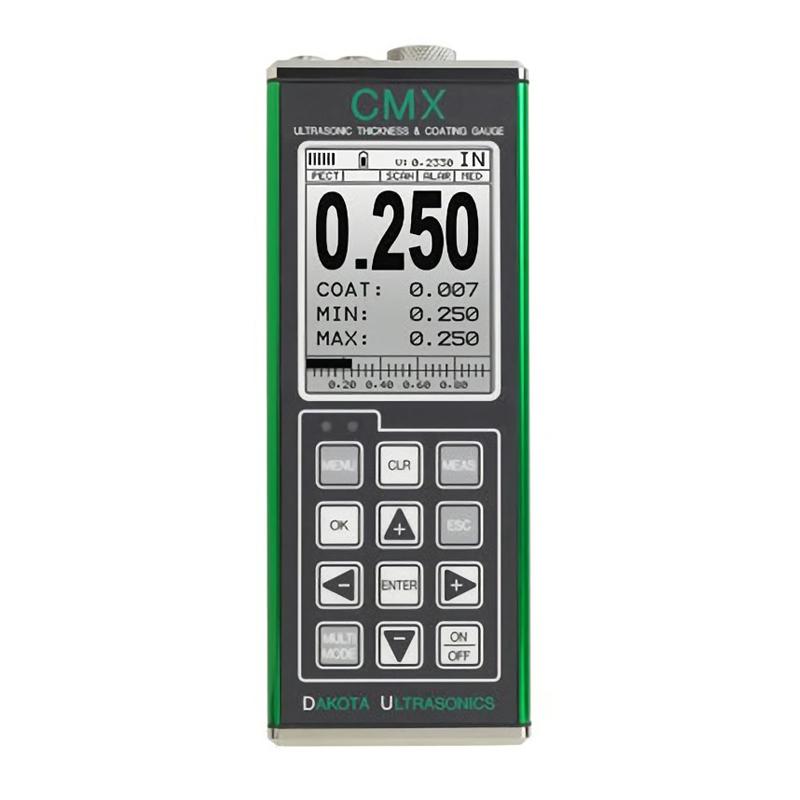
The CMX v2.0 has all the features of a ZX instrument plus a host of advanced features. Measure material and coating thickness simultaneously while still detecting pits and defects in a single mode (PECT). Also included is automatic probe zeroing, automatic probe identification, automatic temperature compensation. Optional large digital display and B-scan display options are also available, with up to 64 user-defined custom settings, selectable sensor tables for precise linearity, and material and coating calibration options.
Our standard through-through painting modes are still included, switching between modes depending on the identified or manually selected sensor. The 5-bit, 12dB gain switch allows the user to adapt to certain material types and succeed in common but difficult application scenarios. The built-in TDG (Gain Over Time) feature has been integrated into our list of sensors for attenuating materials. The gauge does have a large number of features and additional benefits. Everything is nicely packed in a small portable aluminum profile for added durability. USB-C connection, 4GB internal SD memory with file system. The screenshot is .tif. Our DakView Java-based PC or MAC OSX software is also part of the suite.
Structural diagram of the product display
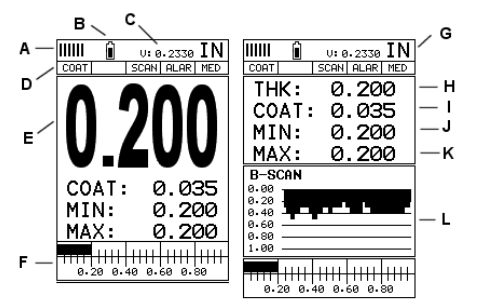
A. Repeatability/Stability Indicator – This indicator should generally be used in conjunction with the numeric thickness values displayed. When all vertical bars are fully lit and the last digit of the digital thickness value is stable, the CMX reliably measures the same value approximately 250 times per second (250 Hz), depending on the measurement mode and function enabled.
B. Battery Icon – Indicates the remaining battery life of the CMX.
C. Speed – The velocity value of the material that is currently being used or calibrated by the CMX
About. Displayed in imperial or metric units, depending on the unit of the gauge.
D. Feature Status Bar – Indicates the features that are currently enabled and in use in the following order:Measurement Mode,Difference mode,High-speed scanning mode,Alarm mode,Gain setting
E. Numeric Material Thickness Values – Extra-large font size for easy viewing.
F. Scan Bar – Another view of the material thickness in the horizontal bar of the deflection style. This is a vision tool that enables users to see thickness changes from defects and pits during high-speed scanning.
G. Units – The units of measurement (imperial, metric) currently in use.
H. Numeric Material Thickness Values – Smaller font size when B-scan display view is enabled.
I. Coating Thickness Value – Shows the actual thickness of any coating adhering to the surface of a metallic material (PECT mode) or the actual thickness of the coating adhering to a non-metallic surface (CT mode).
J. Minimum material thickness – part of the scanning function. Displays the minimum thickness value found during the scan.
K. Maximum material thickness – part of the scanning function. Displays the maximum thickness value found during the scan.
L. B-scan display – a cross-sectional view of the material. Provide the user with a graphical view of the relative/blind surface (i.e., the inner surface of the pipe wall) to give the user an idea of the condition or integrity of the material being measured.
Specific parameters
specification
Measurement Mode: Coating Off: Pulse-Echo (PE)
Coating: Pulse-Echo Coating (PECT)
Temperature Compensation: Pulse-Echo (PETP)
Straight-through drawing: Echo-Echo (EE)
Penetration Verification: Echo-Echo Verification (E-EV)
Coating Only: Coating (CT)
Pulse Generator: A two-way wave pulse generator.
Receiver: Dual receiver – manual or AGC gain control with a range of 110dB (limited).
Timing: Accurate TCXO timing with a single-pulse 100MHz 8-bit ultra-low-power digitizer.
measurement
Range: Pulse-echo mode (PE) :(pit and defect detection) has a measurement range of 0.025 48.0 inches (0.63 to 1219.2 mm).
Pulse-Echo Coating Mode (PECT) :(Material, Coating, Pit, and Defect Detection): Material: 0.025 to 48.0 in (0.63 to 1219.2 mm). Coating: 0.001 to 0.100 in (0.01 to 2.54 mm)
Pulse-Echo Temperature Compensation Mode (PETP) :(Pit & Defect Detection) Automatic Temperature Compensation – Measuring range from 0.025 to 48.0" (0.63 to 1219.2 mm).
Echo Mode (EE): Passes paint and coating) in sizes from 0.100 to 6.0 inches (2.54 to 152.4 mm). The range will vary +/- depending on the coating.
Echo Mode (E-EV): Passes Paint and Coating) are available in sizes from 0.050 to 1.0 inches (1.27 to 25.4 mm). It will vary depending on the coating.
Coating mode (CT) only :(coating thickness) is 0.0005 to 0.100 inches (0.0127 to 2.54 mm). The range will vary +/- depending on the coating.
Resolution: +/- .001" (0.01 mm)
Speed range: .0122 to .7300 in./ms (309.88 to 18542 m/s)
Calibration: Single- and two-point calibration options for materials and coatings, or select a basic material type.
Units: Imperial and Metric
display
Display View: Large numeric standard thickness view. Bit height: 0.700" (17.78 mm)
B-Scan – Time-based cross-sectional view. Each screen has a display speed of 15 seconds.
The scan strip takes 6 readings per second. Visible in B-scans and large digital views.
Repeatability bar charts The bar chart indicates the stability of the readings.
Feature Status Bar – Indicates the feature that is currently active.
link
Output: Direct USB-C 1.1 PC connection.
Sensor connection: Two LEMO 00 connectors
Data output: USB-C port. Windows®PC interface software.
Display: 1/8 in. VGA grayscale display
power supply
Line power: USB to PC or power outlet.
Three 1.5V alkaline or 1.2V NiCad AA batteries.
Alkaline: 35 hours of grayscale, 12 hours of color.
Nicad: 10 hours in grayscale, 5 hours in color.
NI-MH: 35 hours of grayscale, 12 hours of color.
Power-saving DIM (color), automatically power off after 5 minutes of idleness.
Battery status icon.
storage(CMXDL only)
Log Format: Grid (Alphanumeric)
Sequential (Automatic Identifiers)
Capacity: 4 Gb internal SD card.
Screen Capture: Bitmap graphic capture for quick documentation (.tif).
Obstacles that indicate unreachable locations.
- 1Measurement principle and influencing factors of high temperature ultrasonic Thickness Gauge
- 2Types and Usage Methods of Coupling Agent for Thickness Gauges
- 3The Principle, Application and Precautions of Copper Plate Ultrasonic Thickness Gauge
- 4Principle, Application and Selection of Ceramic Ultrasonic Thickness Gauge
- 5Principle, Application and Type Selection of Ultrasonic Thickness Gauge
- 6Principle, Application and Type Selection of Ultrasonic Thickness Gauge
- 7Four Methods of Ultrasonic Thickness Gauge measurement
- 8What are the paper physical properties testing instruments? How to maintain
- 9Distortion analysis of ultrasonic thickness indication
- 10Consequences of coating outside the recommended Film thickness range
Chrissy Stewart - 《KTA-Tator公司》