
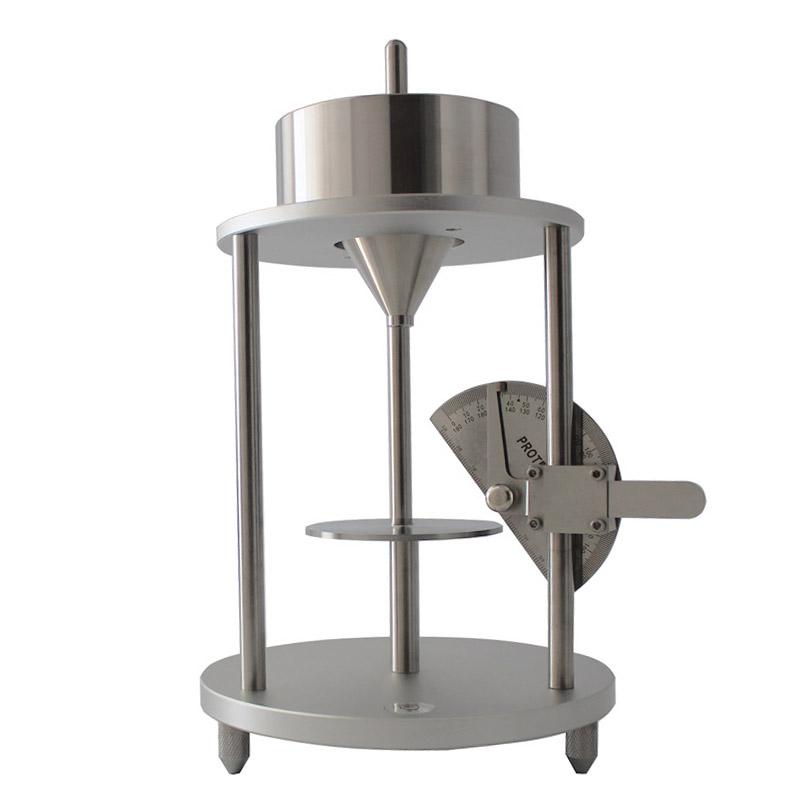

XIONGFA XF-4324 Powder Angle of repose meter Injection limited bottom surface method Angle of repose Tester
SE XF-4324


XIONGFA XF-4324 Angle of repose meterSPEC
XIONGFA XF-4324 Angle of repose meterDetails
XIONGFA XF-4324 Angle of repose meterPacking list

- SKU
- NB029785
- Funnel outflow diameter
- 5mm
- Funnel taper
- 60º±0.5º
- The distance between the bottom of the outflow port and the disk surface
- 80mm±2mm
- Disk diameter
- Φ80mm
- Measuringflask Volume
- 100ml
- Instrument material
- The bucket and bracket are stainless steel, and the base is aluminum.
- According to the standard
- GB/T16913-2008

XF-4324 Dust Angle of Repose Meter, injection limited bottom surface method angle of repose Tester (or called angle of repose) refers to the acute angle between the inclined plane of dust accumulation and the horizontal plane of the bottom. Injection method: The particulate material flows out of the funnel and falls on the plane to form a cone, and the bottom angle of the cone is the angle of repose (angle of repose).
The angle of repose Tester is designed and produced according to the national standard GB/T16913-2008-Test method for dust physical properties-determination of angle of repose. The applicable measurement object of this device is dust, and the angle of repose of dust is measured by injection into a limited bottom surface. The main technical difference from ISO 4324:1997 is that the dust height accumulated on the limited bottom surface is not measured, but the angle of repose of dust is directly measured by a protractor.
After this angle is formed, if you add this kind of bulk material to the top, it will slide down naturally. Keeping this angle will only increase the height and increase the bottom area at the same time. This phenomenon can often be seen in piles of soil, coal, and grain, and different types of bulk materials have different repose angles.

Instrument structure
(1) Funnel (outlet diameter 5mm), where the taper of the funnel is 60º±0.5º;
(2) Protractor: Protractor 10cm;
(3) Chassis: The distance between the bottom of the outflow port and the surface of the disk is 80mm±2mm, and the diameter of the material disk is Φ80mm.
(4) A measuring cylinder with a diameter of 80mm and a volume of 100ml;
(5) Straight dust-like scraper and stick needle; it is a cylinder made of stainless steel with a polished surface, 40mm high, and a groove at the bottom to connect with the center of the positioning pin on the bottom plate.

Particle repose angle is also called dust repose angle or accumulation angle. The angle between the generatrix of the cone and the horizontal plane formed when dust particles continuously fall on the horizontal plate through small holes. The average value of the angle of repose of many dusts is about 35°-40°, which is related to factors such as dust type, particle size, shape and moisture content. For the same kind of dust, the smaller the particle size, the larger the angle of repose; the smoother the surface or the closer to spherical particles, the smaller the angle of repose; the larger the moisture content of the dust, the smaller the angle of repose. The dust repose angle is one of the dynamic characteristics of dust, and it is the main basis for designing dust removal equipment (such as the cone of the dust storage hopper) and pipe (inclination angle).
principle
The dust enough to overflow the tray is injected into the horizontal tray from the mouth of the funnel; measure the acute angle between the inclined surface of the dust accumulation and the horizontal surface of the bottom, that is, the angle of repose of the dust.
Application: Abrasive materials: silicon carbide, diamond, quartz, boron carbide, boron nitride, white corundum, microcrystalline corundum, single crystal corundum, black corundum, etc. Battery materials: lithium cobalt oxide, lithium manganese oxide, cobalt oxide, lithium iron phosphate, manganese powder, electrolytic manganese dioxide, graphite powder, zinc powder, etc. Production, application and research fields of various non-metallic powders: talcum powder, graphite, powdered quartz, calcium carbonate, kaolin, wollastonite, tourmaline, mica, gypsum, diamond, quartz, feldspar, tremolite, clay, Brucite, Garnet, etc. Production, application and research fields of various metal powders: magnesium powder, zinc powder, iron powder, aluminum powder, copper powder, titanium dioxide, cobalt powder and other rare metal powders and various alloy powders.
test steps
1. Plug the outlet of the funnel with a stopper, and put a certain amount of powder into the funnel.
2. Pull out the stopper rod to make the powder flow out from the hole of the funnel; for the dust with poor fluidity, you can stir it with a rod needle to make the dust flow continuously onto the material tray. After all the powder flows out, rotate the protractor to measure the dust on the material tray The acute angle between the generatrix of the cone and the horizontal plane is the angle of repose A
- 1Angle of repose meter is what? How to select? Powder flowability detection core equipment full analysis
- 2Summary of test methods for powder resting angle
- 3Determination of Angle of Repose for Powder Coatings by Angle of Repose Tester
- 1GB/T 16913.5-1997《Methods of dust character test - Part 5:Determination of reposeful angle - Poured angle of restrictive pile》
- 2GB/T 16913-2008《Methods of dust character test》
- 3JG/T 158-2013《Products for external thermal insulation systems based on mineral binder and expanded polystyrene granule plaster》