
YANTE YT-SL1000 paper tearing Tester
SE YT-SL1000

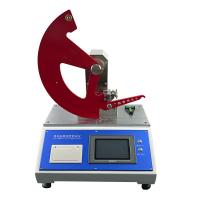
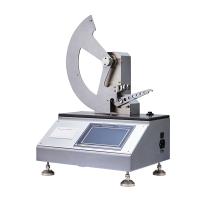
YanTe YT-SL1000 Paper tearing MeterSPEC
YanTe YT-SL1000 Paper tearing MeterDetails
YanTe YT-SL1000 Paper tearing MeterPacking list

- SKU
- NB029851
- Measurement range
- (10~1000)mN
- Standard pendulum
- (10~1000) mN, Graduation 10 mN
- error of indication
- 20% to 80% of the upper limit of measurement +/- 1% outside +/- 0.5% FS
- Indication Repeatability Error
- < 1% in the range of 20% to 80% of the upper limit of measurement, < 0.5% FS outside the range
- Tear arm
- 104±1㎜
- tearing initial angle
- 27.5±0.5°
- tear distance
- 43±0.5㎜
- Distance between clamps
- 2.8±0.3㎜
- environmental conditions
- Temperature 20~40 ℃, Relative Humidity ≤ 85%
- Dimension
- 510×400×365 mm
- Weight
- 23
Introduction
This instrument is used to measure the internal tearing resistance or tearing degree of the paper. The Principle of the instrument is based on the work consumed by tearing the test sample to a certain length. Normally, 16 sheets of paper are stacked on top of each other. together with the tear test. Therefore, the total work expended in tearing these sheets is divided by the number of sheets torn and the tear distance, and the quotient is the force, expressed in grams, required to tear . The scale and scale of the instrument are engraved according to the conditions of tearing 16 samples with a tearing distance of 86 mm (the tearing length of the sample is 43 mm, and the tearing distance is twice that).
In order to make the test results and readings as accurate as possible, it is hoped that after tearing, the pointer points to 200-600mN on the scale, so for thicker paper and cardboard, less than 16 samples can be used for the test. Generally, 8, 4, 2, 1 sheets are used, and according to the obtained test results, the actual tear value is obtained by applying the following formula:
a= sp/ n
Among them: a—tear degree mN
s—the average scale reading in the test direction
p—conversion factor, that is, the number of design layers of the scale 16
n—the number of layers to tear the sample at the same time
This instrument can be used to test packaging paper, writing paper, photographic paper, industrial technical paper and cardboard of various appropriate thickness.
product structure
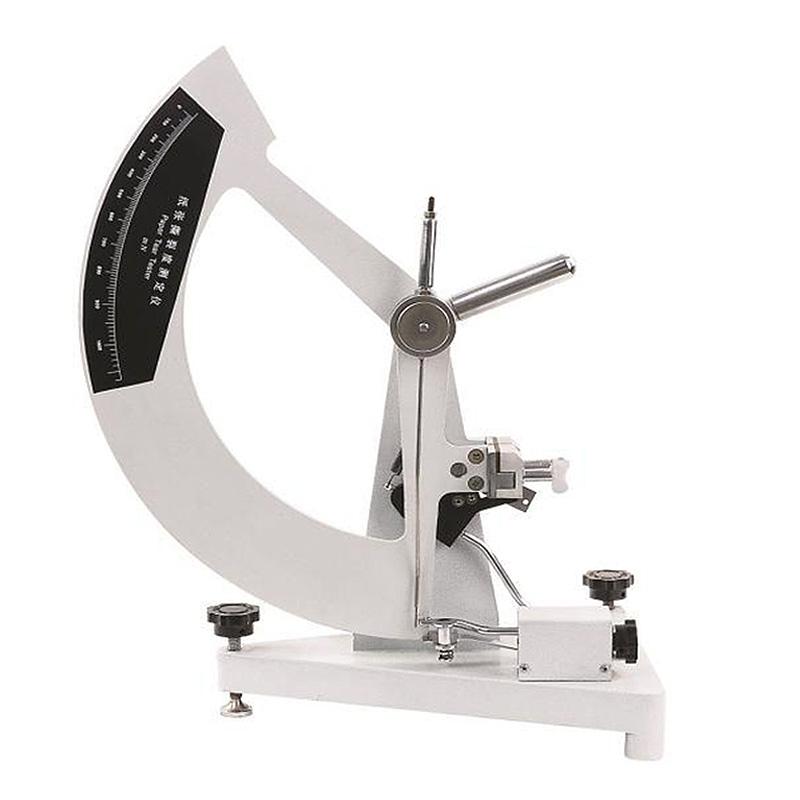
The instrument includes base (1), bracket (2), fan-shaped body (7), pointer (5) and sample holder (9) (12) and other main parts.
The bracket (2) is fixed on the base (1) with bolts, the pendulum support shaft (10) is installed on the support (2), and the fan-shaped body (7) is supported on the ball bearing of the pendulum support shaft (10). The pointer (5), sample holder (12), reading scale (13), etc. can freely rotate around the pendulum shaft (10). The pointer is fixed on the rotating shaft sleeve of the sector (7) by friction, and the pointer relies on the friction generated by the spring in the handle (11) to ensure that it can stop reliably at any position, but the friction cannot exceed the specified value.
The fan-shaped body (7) and its appendages are raised to the position to be tested. Since the swing limiter bears against one end of the fan-shaped body, it is fixed, and the pointer limiter (4) is to limit the position of the pointer.
The sample clamps (9) and (12) are used to clamp the paper sample to be tested, and the moving knife rod (8) can make the paper cutter cut the sample into a 20 mm incision, and press the button (6) to make The sector (7) is released from the swing limiter (3), swings to the right, and tears.
The horizontal adjustment screw (14) is used to adjust the horizontal position of the instrument installation, so that the total center of gravity of the swing part falls on the specified position.
The attached weight is used to calibrate the accuracy of the scale scale.

- 1Tear tester core knowledge guide: types, principles, applications and selection points
- 2Types, characteristics and applications of cellophane
- 3 Several common paper Testers
- 4Paper tearing determination - Alimendorf method and instrument operation guide
- 5Test method and principle of LW tearing Tester
- 6What are the components of paper and what are their properties?
- 7Common test performance items of paper
- 8What are the paper mechanical performance testing instruments? How to maintain
- 9Elmandorf single tearing meter test method
- 10Specific manufacturing method of synthetic paper
- 1GB/T 28210-2024《Thermal-sensitive paper》
- 2QB/T 1050-2012《Paper and board-tearing tester》
- 3GB/T 34722-2017《Surface decorated plywood and blockboard with paper impregnated thermosetting resins》
- 4GB/T 13519-2016《Polyethylene heat-shrinkable film for packaging applications》
- 5JJG (轻工)63-2000《Verification Regulation of Tear Tester for Paper and Board》
- 6JJG (轻工)63-2000《Tear Tester for Paper and Board》
- 7GB/T 455-2002《Paper and board--Determination of tearing resistance》