
HENGPIN HP-BD48B whiteness Tester
 HP-BD48B

HengPin HP-BD48B Whiteness TesterSPEC
HengPin HP-BD48B Whiteness TesterDetails
HengPin HP-BD48B Whiteness TesterPacking list

- SKU
- NB032723
- Zero drift
- ≤0.1
- Indication drift
- ≤0.1
- Error of indication
- ≤0.5
- Repeatability
- ≤0.1
- Mirror reflection error
- ≤0.1
- Specimen size
- Test plane ≥ 0019 30mm, thickness ≤ 40mm
- Dimensions
- 365*260*425mm
- Net Weight
- Approx. 11kg
- Power Supply
- AC220V 50Hz 0.2A
- Operating Environment
- Temperature 0 ℃~ 40 ℃, Relative Humidity does not exceed 85%
Introduction
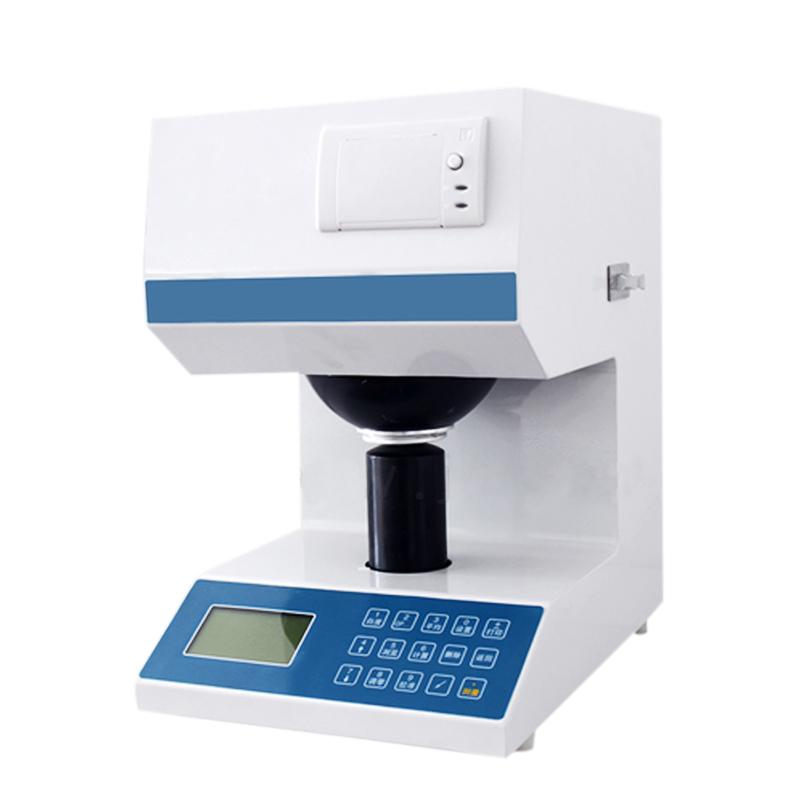
HP-BD48B whiteness Tester (also known as Whiteness Meter, Whiteness Meter) mainly measures the whiteness of paper and cardboard, pulp and chemical fiber pulp, cotton and chemical fiber, textiles, plastics, ceramics, porcelain, starch, salt, white cement, china clay, talcum powder and other objects. Optical properties such as the opacity of thin-sheet materials can also be measured. This instrument conforms to GB3978-83 standard illuminator and illumination observation conditions. Simulates D65 illuminator illumination. The geometric conditions of D/O illumination are used to observe, the diameter of the diffuse ball is 150mm, the diameter of the test hole is 30mm, and the light absorber is equipped to eliminate the influence of specular reflection light of the sample. The peak wavelength of the spectral power distribution of the R457 whiteness optical system is 457 nm, the half-height width is 44 nm, and the Y10 optical system conforms to GB3979-83 and the object color measurement method. Measure and digitally display whiteness, fluorescence (whitening) whiteness, opacity (%), etc.
Product test items
1. Determine the blue light diffuse reflectance factor (R457) of the sample, which is called "blue light whiteness" or "ISO brightness".
2. Analyze whether the sample material contains fluorescent brightener, and measure the fluorescent whiteness produced by fluorescence emission, that is, whiteness.
3. Measure the luminance stimulus value Y10 of the sample, that is, the diffuse reflection factor of green light Ry.
4. Measure the opacity, transparency, light scattering coefficient and light absorption coefficient of the sample.
5. Measure the ink absorption value of paper and cardboard.
Features
1. The instrument adopts optical, mechanical and electrical integrated design, microcomputer measurement and control technology, compact structure, beautiful appearance and convenient maintenance.
2. It has the function of statistical analysis and processing of test data.
3. Wide range of tests, which can test the whiteness (brightness), opacity, transparency, light scattering coefficient and light absorption coefficient of various objects.
4. Chinese graphical menu displays the operation interface, which is simple and convenient to operate.
Meets standards
GB/T 7933-87 Determination of diffuse reflection factor of pulp, paper and cardboard (d/o method)
GB/T 7974-87 Determination of whiteness of paper and cardboard (d/o method)
GB/T 8940.2 Pulp whiteness determination method
GB/T 1840 Methods for the determination of industrial potato starch
GB/T 2913 Test method for whiteness of plastics
GB/T 13025.2 General test method for salt industry, determination of whiteness
GB/T 1543-88 Determination of opacity on paper
GB/T 10339-89 Methods for determining the light scattering coefficient and light absorption coefficient of paper and pulp
GB/T 5950 Methods for measuring the whiteness of building materials and non-metallic mineral products
ISO 2470 Method for Determining the Diffuse Reflectance Factor of Blue Light on Paper and Cardboard
ISO 2471 Paper and Cardboard Opacity Determination
Textile industry standards: methods for determining the whiteness of pulp for chemical fibers, etc.