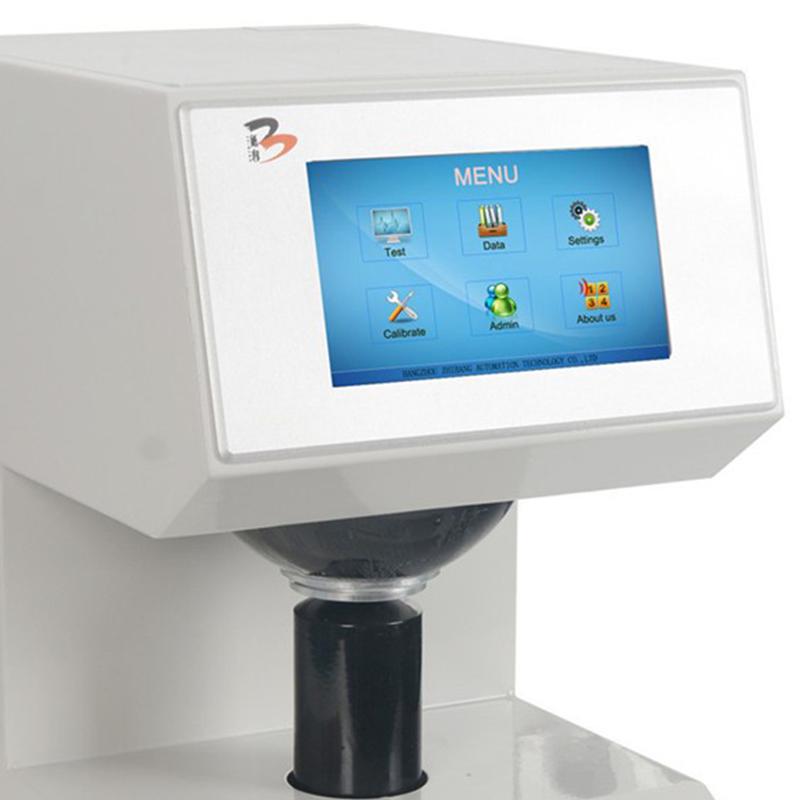
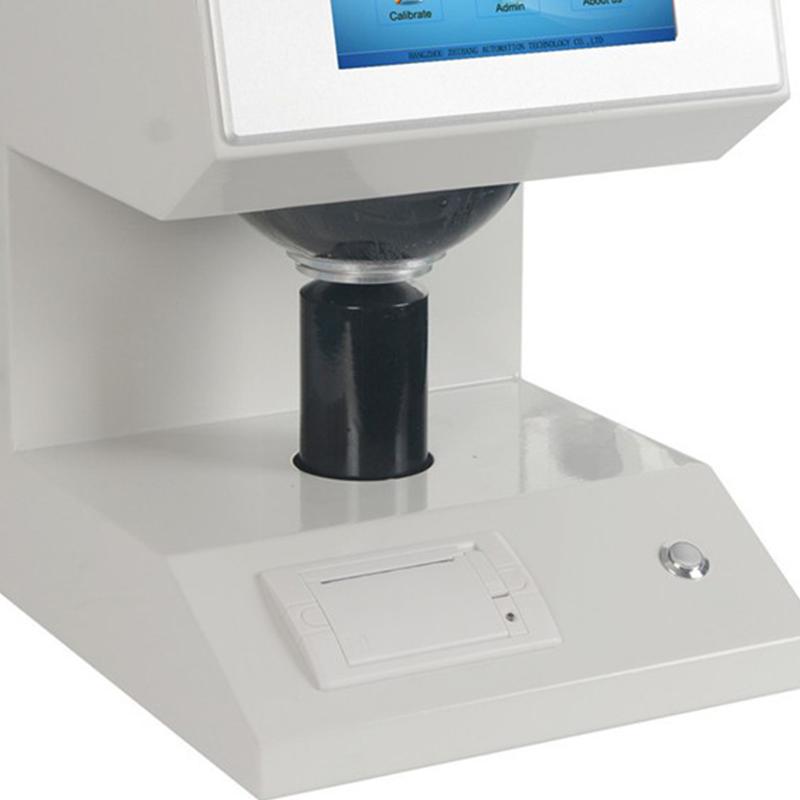
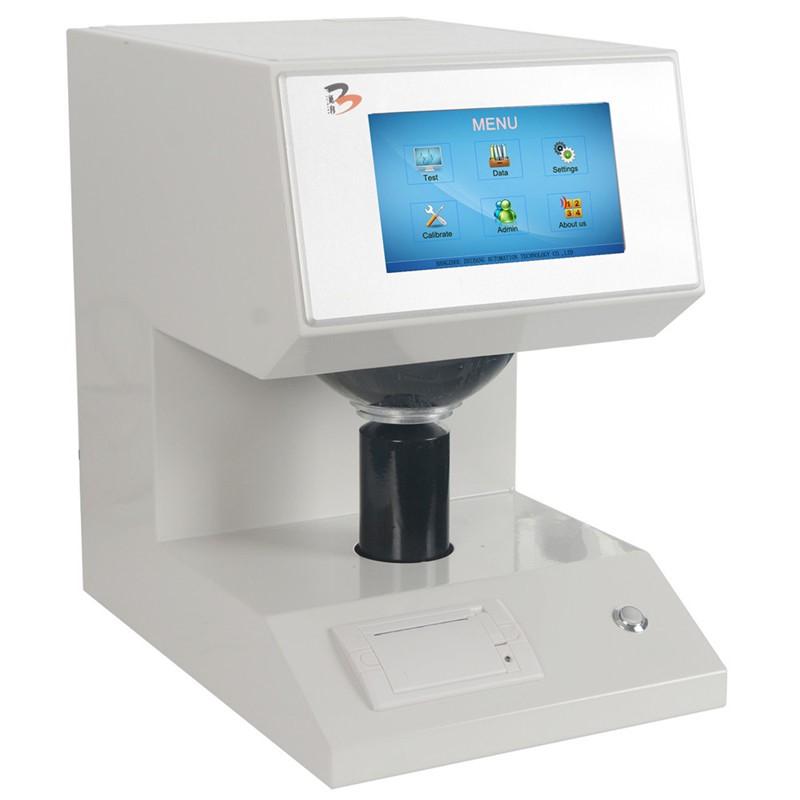

ZHIBANG ZB-A Automatic Colorimeter whiteness/yellowness/color difference/opacity/transparency/inks Absorption value
 ZB-A
ZB-A

ZhiBang ZB-A Automatic ColoriMeterSPEC
ZhiBang ZB-A Automatic ColoriMeterDetails
ZhiBang ZB-A Automatic ColoriMeterPacking list
- SKU
- NB032774
- Power supply Voltage
- AC220V±10% 50HZ
- Indication Accuracy
- Chromaticity coordinates 0.0001, remaining 0.01
- Measured value Stability
- Within 30 minutes, ≤ 0.1
- Repeatability
- Rx, Ry, and Rz's ≤ 0.10 chromaticity coordinate's ≤ 0.0010 R457 value's ≤ 0.10
- Specimen size
- The test plane is not less than φ 30mm, and the thickness is not more than 40mm.
- Dimensions
- 360ⅹ264ⅹ400mm
- Net Weight
- 23kg
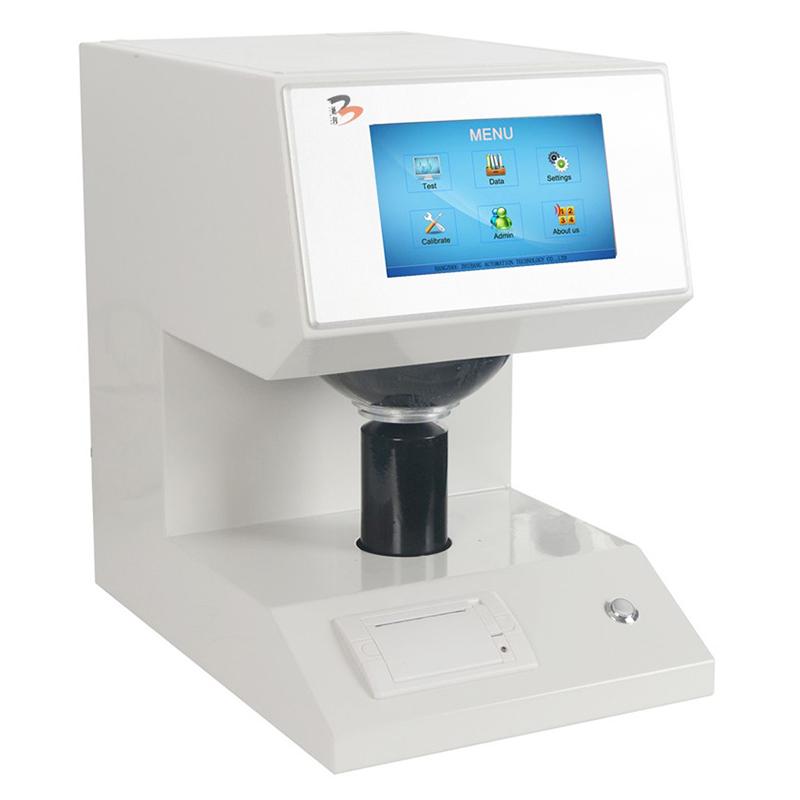
Introduction
ZB-A Colorimeter is to measure the whiteness, yellowness, color and color difference of objects, and can also determine the opacity, transparency, light scattering coefficient, light absorption coefficient and ink absorption value of paper. It is widely used in papermaking, printing, ceramics, chemical industry, textile printing and dyeing, building materials, grain, salt and other industries.
Instrument features
1. Measure the color and chromatic aberration reflected by the object, which can be displayed or printed: diffuse reflection factor Rx, Ry, Rz, stimulus value Y10, X10, Z10, color coordinates x10, y10, z10, luminosity L*, chromaticity a*, b*, chroma C*ab, hue angle h*ab, main wavelength λd, excitatory purity Pe, chromatic aberration ΔE*ab, luminosity difference ΔL*, chromaticity difference ΔC*ab, hue difference ΔH*ab, Hunter system L, a, b.
2. Measure ISO brightness (blue light whiteness R457) and Z whiteness (Rz), which can measure the fluorescence whiteness produced by the emission of fluorescent substances in the fluorescent whitening sample.
3. Measure CIE whiteness (Gantz whiteness W10 and color cast value TW10).
4. Measure the whiteness of the ceramic.
5. Measure the whiteness of building materials and non-metallic mineral products.
6. Measure Hunter Whiteness WH.
7. Measure the yellowness YI.
8. Measure the opacity OP of the specimen
9. Measure the transparency T of the specimen
10. Measure the light scattering coefficient S of the specimen
11. Measure the light absorption coefficient A of the sample.
12. Measure the ink absorption value.
Main performance parameters
1. The instrument adopts 7.0-inch, 65K color, high-definition color LCD touch screen, simple and friendly human-computer interaction interface, simple and convenient operation.
2. The appearance of the instrument is novel and compact, abandoning the old manual rotating handwheel, automatic switching of optical path, automatic positioning, and truly realizing automatic detection, which not only improves the testing efficiency, but also greatly reduces human error.
3. Using 32-bit MCU microcomputer processor, as well as high-speed op amp chip and high-precision ADC converter, professional circuit design effectively ensures the accuracy and stability of measurement data.
4. The instrument simulates D65 illuminator lighting. The CIE1964 supplemental chromaticity system and the CIE1976 (L*a*b*) color space chromatic aberration formula were used.
5. The instrument adopts D/O illumination to observe geometric conditions. The diameter of the diffuser ball is 150mm, the diameter of the test hole is 30mm, and the light absorber is equipped to eliminate the influence of specular reflection of the sample.
6. The instrument is embedded with a serial port thermal printer, which does not need to use ink and ribbon, no noise during work, and fast printing speed.
7. The instrument is equipped with corresponding communication interfaces, which can communicate with microcomputer software.
7. The instrument has power-off protection, and the calibration data will not be lost after power-off.
8. 9 reference samples can be stored.
Enforce the standard
ISO2469 Determination of Diffuse Reflectance Factor --- Paper, Cardboard and Pulp
ISO2470 Paper & Cardboard - Whiteness Measurement (Diffusion/Vertical Method)
ISO2471 "Determination of --- Opacity (Paper Backing) of Paper and Cardboard (Paper Backing--- Diffuse Reflectance Method"
ISO9416 "Determination of Light Scattering and Light Absorption Coefficients on Paper (Kubelka-Munk)"
ISO11475 "Determination of CIE whiteness of paper and cardboard, D65/10º (outdoor daylight)"
GB/T7973 "Determination of Diffuse Reflectance Factor of Paper, Cardboard and Pulp (Diffusion/Perpendicular Method)"
GB/T7974 "Determination of brightness (whiteness) of paper, cardboard and pulp (diffusion/vertical method)"
GB/T7975 "Determination of the color of paper and cardboard (diffuse reflectance method)"
GB/T24288 "Determination of the main wavelength and excitatory purity of paper and cardboard D65/10º diffuse reflectance method"
GB/T10339 "Determination of light scattering and light absorption coefficient of paper, cardboard and pulp"
GB/T8424.2 "Instrumental evaluation method for relative whiteness of textile color fastness test"
GB/T13173.14 "Determination of whiteness of powdered detergents by test methods for surfactant detergents"
GB/T8424.1 "General Principles for the Determination of Surface Color of Textile Fastness Test"
GB/T22880 "Determination of CIE whiteness of paper and cardboard, D65/10º (outdoor daylight)"
GB/T1543 "Determination of Opacity of Paper and Cardboard (Paper Backing) (Diffuse Reflection Method)"
GB/T6688 "Instrumental Method for Determination of Relative Strength and Color Aberration of Dyes"
GB/T13025.2 "General test method for salt industry, determination of whiteness"
GB/T2913 "Test Methods for Whiteness of Plastics"
GB/T5950 "Measurement method for whiteness of building materials and non-metallic mineral products"
GB/T3979 "Measurement Methods for Object Color"
GB/T8424.3
GB/T2679
GB/T9338 "Instrument Method for Determination of Relative Whiteness of Fluorescent Brighteners"
GB/T11186
GB/T9984.5 "Determination of whiteness of industrial sodium tripolyphosphate test method"
GB/T22427.6
GB/T13835.7 "Test method for whiteness of rabbit hair fibers"
GB/T12911 "Determination of the Absorption of Paper and Cardboard Inks"
GB/T4739 "Methods for Determining the Chromaticity of Daily Ceramic Pigments"
GB/T11942 "Chromaticity Measurement Methods for Colored Building Materials"
QB/T2789 "Determination of Color Tristimulus Value and Color Aberration △E* by General Test Methods for Cosmetics"
QB/T1503 "Method for Determining the Whiteness of Daily Ceramics"
HG/T3862
FZ-T50013 "Cellulose Chemical Fiber Whiteness Test Method Blue Light Diffuse Reflection Factor Method"