
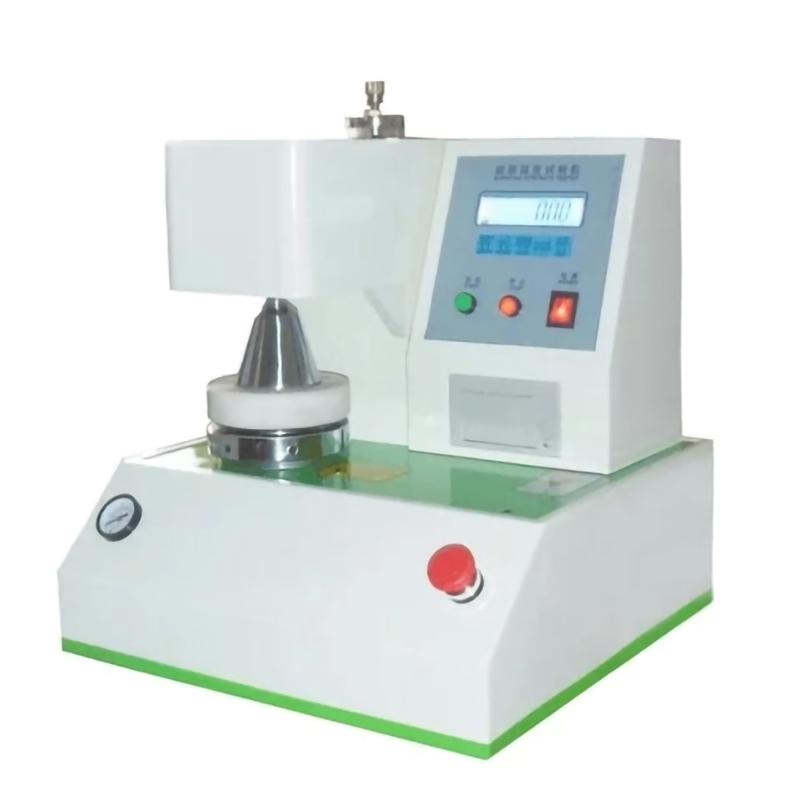
JINGJI NPD-D Automatic Burst Tester
 NPD-D
NPD-D


jingji NPD-D Automatic Burst TesterSPEC
jingji NPD-D Automatic Burst TesterDetails
jingji NPD-D Automatic Burst TesterPacking list

- SKU
- NB033358
- Operation mode
- fully automatic
- unit conversion
- kpa、psi(Lbs/in2)、kgf/cm2
- Measurement range
- 250~5000Kpa
- Clamp ring material
- stainless steel
- Resolution
- 0.01Kpa
- Clamp ring diameter
- Upper ring: high Voltage type Should be 31.50mm Lower ring: high Voltage type Should be 31.50mm
- Hydraulic oil
- silicone oil
- Oil delivery speed
- 170±10mL/min
- Accuracy
- ±1 %
- Weight
- About 40Kg
- Power supply Voltage
- AC220 V
Introduction
It is used to determine all kinds of cardboard and single-layer and multi-layer corrugated cardboard, and can also be used for the bursting strength test of non-paper materials such as silk and cotton.
Operating Principle:
As long as the material is put in, it will automatically detect, automatically test, automatically return to the oil pressure and automatically calculate, store the test data, and print, and the instrument will display the test results and data processing with digital display.
Design standards
GB/T 1539-2007 Determination of burst resistance of cardboard
GB/T 6545-1998 Determination of burst strength of corrugated cardboard
Features
1. High precision: using high-precision pressure sensor, the accuracy is controlled at ±1%FS when leaving the factory, which is better than the ±3%FS specified in the standard.
2. Advanced technology: In addition to the traditional sense of burst resistance, the instrument can also measure the effective burst resistance value after removing the resistance of the adhesive film, which is of great significance to the production and research departments.
3. Good sealing and durability: good copper cylinder and precision design and processing make the test system have good sealing and durability, precision screw drive, aluminum alloy panel, good stainless steel measuring head and reasonable design to ensure that the instrument is durable.
4. Easy to use, easy to operate: LCD Chinese display, friendly man-machine interface operation. Automatic completion of the test, with test data statistical processing function, micro printer output, can also be connected to the computer operation. When connected to a PC, in addition to automatically memorizing and storing the results, it is also possible to display and save the blasting process curve during the test.
5. The test process is completed quickly and the results are accurate
6. Easy to measure and calibrate: The internal calibration program is specially set up, and the external calibration hole is specially equipped to facilitate the measurement and calibration department (third party) to calibrate the instrument.
7. Diversity of unit selection
- 1Application of Digital Blasting Strength Testing Machine in Textile Testing
- 2Test method for bursting resistance of paper and paperboard
- 3Method for determination of bursting resistance and folding resistance of paper
- 49 Corrugated Box Test Methods to Ensure Packaging Quality
- 5The difference between paper burnout meter and cardboard burnout meter
- 6How does the rupture strength Tester check the quality of paper?
- 7Method for controlling the water volume of printing layout
- 8 Buy a rupture strength Tester? Please read this article first
- 9What are the factors that affect the bursting strength of carton cardboard?
- 10Test principle of bursting resistance Tester