
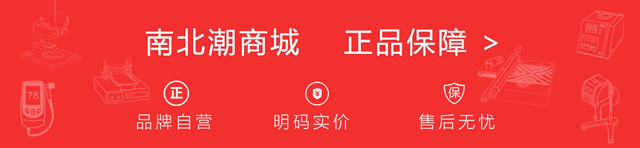
DRICK DRK103 Whiteness Instrument
 DRK103


Drick DRK103 Whiteness TesterSPEC
Drick DRK103 Whiteness TesterDetails
Drick DRK103 Whiteness TesterPacking list
- SKU
- NB034128
- Zero drift
- ≤0.1%;
- Indication drift
- ≤0.1%
- Error of indication
- ≤0.5%
- Repeatability
- ≤0.1%
- Mirror reflection error
- ≤0.1%
- Specimen size
- The test plane should not be less than Should 30mm (or Should 19mm), and the thickness of the sample should not exceed 40mm.
- Power Supply
- AC220V ± 5%, 50Hz,0.4A。
- Operating Environment
- Temperature 0~40 ℃, Relative Humidity < 85%;
- Dimensions
- 310*380*400mm
- Weight
- 16kg。
Introduction
DRK103 Whiteness Meter is also called Whiteness Meter, whiteness Tester, etc. This instrument is used to determine the whiteness of objects, which is widely used in papermaking, textile, printing and dyeing, plastics, ceramics, ceramics, fish balls, grain, building materials, paints, chemicals, sales cotton, calcium carbonate, calcium bicarbonate, salt and other production and commodity inspection departments that need to determine the whiteness of the special body. The DRK103 Whiteness Meter can also determine the transparency, opacity, light scattering coefficient and absorption coefficient of paper.
Features
1. Measure ISO brightness (i.e., R457 whiteness), and the fluorescence whiteness produced by the emission of fluorescent substances can also be measured for the fluorescent whitening sample.
2. Measure the brightness stimulation value Y10. Determine Opacity. Determination of transparency. The light scattering coefficient and absorption coefficient are determined. 3. Simulate D65 illuminator lighting. The CIE 1964 supplemental chromaticity system and the CIE 1976 (L*a*b*) color space chromatic aberration formula were used. The geometric conditions were observed by D/O illumination. The diameter of the diffuser ball is φ150mm, and the diameter of the test hole is φ30mm and φ19mm, and there are two kinds of light absorbers, which eliminate the influence of specular reflection light of the sample.
4. The appearance of this instrument is novel, the structure is compact, and the professional circuit design effectively ensures the accuracy and stability of the measurement data.
5. Using high-pixel LCD module, Chinese display and prompt operation steps, display measurement and statistical results, friendly man-machine interface makes the instrument operation simple and convenient.
6. The instrument is equipped with standard RS232 interface, which can communicate with microcomputer software.
7. The instrument has power-off protection, and the calibration data will not be lost after power-off.
Applications
This instrument is used to determine the whiteness of objects, which is widely used in papermaking, textile, printing and dyeing, plastics, ceramics, ceramics, fish balls, grain, building materials, paints, chemicals, sales cotton, calcium carbonate, calcium bicarbonate, salt and other production and commodity inspection departments that need to determine the whiteness of the special body. The DRK103 Whiteness Meter can also determine the transparency, opacity, light scattering coefficient and absorption coefficient of paper.
Technical standards
1. Comply with GB3978-83: standard illuminator and illumination observation conditions.
2. Simulate D65 illuminator lighting. The D/O illumination observation geometric condition (ISO2469) is adopted, the diameter of the diffuse ball is φ150mm, the diameter of the test hole is φ30mm and φ19mm, and the light absorber is provided to eliminate the influence of specular reflected light of the sample.
3. The peak wavelength of the spectral power distribution of the R457 whiteness optical system is 457nm, and the half-height and width are 44nm, and the RY optical system conforms to GB3979-83: object color measurement method.
4. GB7973-87: Pulp, paper and cardboard diffuse reflection factor determination method (d/o method).
5. GB7974-87: Whiteness determination method of paper and cardboard (d/o method).
6. ISO2470: Paper and cardboard blue light diffuse reflection factor determination method (ISO whiteness
7. GB8904.2: Pulp whiteness determination method.
8. GB1840: Methods for the determination of industrial potato starch.
9. GB2913: Test method for whiteness of plastics.
10. GB13025.2: General test method for salt industry, determination of whiteness
11. GB1543-88: Opacity determination method of paper.
12. ISO2471: Paper and cardboard opacity assay.
13. GB10336-89: Determination of light scattering coefficient and light absorption coefficient of paper and pulp
14. GBT/5950 Measurement method for whiteness of building materials and non-metallic mineral products.
15. The whiteness of citric acid and its detection method GB10339: the determination of light scattering coefficient and light absorption coefficient of paper and pulp.
16. GB12911: Determination of the absorptivity of paper and cardboard inks.
17. GB2409: Test method for plastic yellow index.