


Yongxin ZDJ-100 Pulp Beating Degree Tester
SE ZDJ-100

-
 LD-DJD-B Schopper, Pneumatic Freeness Tester Pulp Tester$ 1173.00SE
 -
 Pulp suspension beating degree ZY-DJ beating degree Tester$ 1066.00SE
 -
 YINUO YN-DJD01 Freeness Tester 0~100 Freeness Tester$ 1291.00SE
 -
 PUYUN PY-Y811 Pulp Beating Degree Tester$ 1128.00SE
 -
 YANTE YT-DJ-100 beating degree Tester measurement dilute pulp suspension filtration rate$ 1092.00SE





ChangChunYongXin ZDJ-100 Pulp beating degree TesterSPEC
ChangChunYongXin ZDJ-100 Pulp beating degree TesterDetails
ChangChunYongXin ZDJ-100 Pulp beating degree TesterPacking list
- SKU
- NB034354
- Measurement Range
- 0~100°SR
- Measuringflask Graduation
- 1°SR
- Test distillation water temperature
- 20±0.5℃
- Volume of test distillation water
- 1000ml
- Drain time
- 149±1s
- Dimensions
- 460*250*1240mm
- Mass
- 32kg
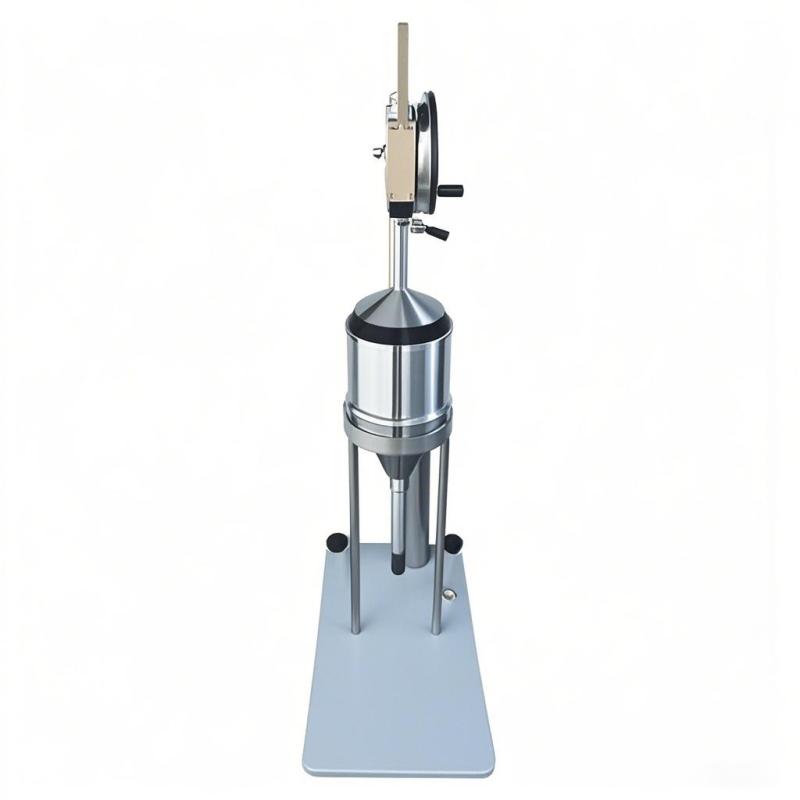
The instrument is suitable for measuring all kinds of pulp suspensions not greater than 100°SR. It can economically utilize raw materials, end the beating process in a timely manner during the production process, and serve as a measure of fiber status in scientific research.
Structure and Principle
The design principle of the instrument is to filter a given volume of pulp water suspension through the fiber filter layer formed on the filter screen during the measurement, and the filtrate flows into the funnel equipped with bottom holes and inclined tubes. Collect the filtrate flowing from the inclined tube in a graduated cylinder with a Schober value scale. According to this scale, drainage of 1000ml is equivalent to an SR value of zero, and drainage of zero ml is equivalent to an SR value of 100.
In general, the higher the beating degree of pulp or the more crushed the pulp, the lower the drainage speed of pulp. The instrument is designed according to this phenomenon.
Pour 1000ml of pulp suspension with a concentration of 0.2% into the pouring chamber. Due to the action of the copper mesh in the instrument, the fibers remain on the mesh, the water is removed, and flows into the measuring cylinder through the inclined pipe and the straight pipe below. Because the beating degree of the beating material is different, the drainage speed is different, and the amount distributed in the lower inclined pipe and the straight pipe measuring cylinder is also different. If the beating degree of the beating material is high, the drainage speed is low, and the water flowing into the straight pipe is More, on the contrary, less water flows into the straight pipe. It is stipulated that the beating degree is expressed by the amount of water flowing out of the straight pipe, and every 10ml flowing out is 1°SR.
Usually, for the convenience of use, the value of the beating degree is read based on the water volume in the measuring cylinder under the inclined tube. Because the water volume flowing out of the straight tube is equal to 1000ml minus the water volume flowing out of the inclined tube, it is only necessary to use the following formula Find the beating degree.
Beating degree=1000-ɡ/10
where g is the volume of water in the measuring cylinder under the inclined tube, in milliliters.
The instrument is equipped with a special measuring cylinder with beating scale, which can be read directly under the inclined tube without conversion.
operating procedures
1. Sampling and preparation
Take a 2g dry pulp sample suitable for the test and pour 200 ml of distilled water at 20±0.5°C into the raw material drum to soften the dry pulp and stir evenly, then pour distilled water at 20±0.5°C into the mark of the raw material drum , so that it is exactly 1000ml.
2. Test procedure
(1) Check whether the instrument is installed correctly.
(2) Check the copper mesh. If there is rust, damage or unevenness, it should be replaced immediately. After the inspection is passed, put the copper mesh in the pouring chamber into water to soak the copper mesh.
(3) Place the infusion chamber on the separation chamber.
(4) Rotate the sheave (22) with the handle (21) so that the sealing cone enters the filling chamber until the wedge (18) is buckled.
(5) Sampling: Obtain samples according to the method described in Section 1.
(6) Measure the temperature of the prepared sample in the stock drum and record it.
(7) Stir the sample effectively so that the fibers are evenly distributed in the water, and quickly and steadily pour the sample into the pouring chamber.
(8) Press the retaining handle (16), the sealing cone is automatically lifted, and water flows into the two measuring cylinders.
(9) When there is no flow of water at the outlet of the inclined tube, read the beating degree value from the special measuring cylinder.
(10) Remove the pour chamber and remove the slurry from the copper grid (see 4).
(11) Empty the special graduated cylinder, flush the sealing cone and separate.
3. Reading
The special measuring cylinder needs to be placed on the calibrated horizontal surface. When reading, read the beating degree value according to the scale pointed by the horizontal line tangent to the liquid surface, accurate to one degree. In order to observe clearly, the white plate can be stood behind the special graduated cylinder.
4. The method of removing the slurry
Turn the bottom of the filling chamber up, and gently rinse the copper grid with water to remove the slurry on the grid. Or immerse the pouring chamber into a bucket full of water and shake it gently. In addition, the pouring chamber can be removed to remove the slurry on the net.
- 1How to self-test the beating meter?
- 2What is paper synthetic pulp
- 3Pulping process and equipment in paper preparation
- 4Papermaking Process: The Difference Between Wet and Dry Process
- 5What is the difference between the free meter and the pulp beating meter?