
ZHS-4 Paper and Cardboard thickness Tester
SE ZHS-4
ZHS-4


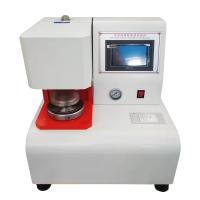
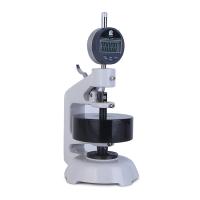
ChangChunYongXin ZHS-4 Paper and Cardboard thickness TesterSPEC
ChangChunYongXin ZHS-4 Paper and Cardboard thickness TesterDetails
ChangChunYongXin ZHS-4 Paper and Cardboard thickness TesterPacking list

- SKU
- NB034358
- Measuring range
- 0~4mm
- Contact Pressure
- 100 ± 10kPa
- Contact area
- 2±0.05cm²
- Dimensions
- 240*160*120mm
- Weight
- 4.5kg
- Display
- pointer

Application
The instrument is suitable for measuring the thickness of various paper, cardboard and other sheet materials below 4mm.
Operating Principle
This instrument is a special instrument for the thickness determination of paper and cardboard designed by the principle of contact measurement method.
Thickness refers to the vertical distance between paper and cardboard under a certain pressure between two measuring boards, and the result is expressed in mm or um. According to the thickness and thinness of the paper, multi-layer measurement or single-layer measurement can be takenThe result of the layer measurement represents the thickness of the paper. The instrument is divided into the following four parts:
1. Paper-pressing mechanism: It is composed of heavy thallium (2), measuring head (3) and measuring anvil (4), which is used to form a specified pressure on the sample.
2. Indicating mechanism: It is a standard dial gauge (8), which is in contact with the upper face of the measuring rod and the measuring head, so that the measured thickness is converted into the angle of the pointer through the displacement of the measuring rod and the reading is obtained. The dial gauge is installed with a small dial gauge pointer pointing to 1.000 mm as the zero point of the Thickness Gauge to make full use of the accuracy of the gauge (the error is the smallest in the range of 1.000~1.100mm of the dial gauge).
3. Lifting mechanism: It is composed of a lever (5) and a small shaft (6), which is used to lift the measuring head so that the sample can be put into the sample for measurement.
4. Connecting mechanism: It is composed of a seat body (1) and a fastening screw (7), which is the structure of the base of the instrument and the upper three parts of the connection.
The lower end of the measuring head is a contact area of 2 cm², and the sum of the weight thallium, the gravity of the measuring head and the spring force of the dial gauge produces a contact pressure of 100 kPa. When a certain material is pressed between the measuring head and the anvil, the measuring head moves a distance equal to the thickness of the material, and this displacement is transmitted to the watch rod, which is amplified by the gear mechanism in the table and transformed into a fingerThe needle follows the angle of the dial and gives a reading of the thickness.
Installation and commissioning
(Digital dial gauge, dial indicator view manual)
Place the instrument on a level table with the height of the table so that the center of the instrument dial is at the same level as the operator's eyes.
1. Zero point adjustment
(1) Press down on the lever with your left thumb and lift the measuring head.
(2) Relax the lever evenly and slowly, drop the measuring head to the measuring surface to contact each other, and leave the hand from the instrument.
(3) Observe whether the big pointer points to the zero point and the small pointer points to 1.
(4) If the big pointer is not at the zero point, you can slightly turn the dial of the watch to make it to zero.
(5) Repeat the above steps several times, and the large pointer should be stable at the zero point. If the large pointer is not at zero and is too far off, adjust it as follows:
(a) Turn the dial zero of the watch to the highest position.
(b) Loosen the screws with a screwdriver (7).
(c) Move the dial indicator up and down to the big pointer pointing to zero and the small pointer pointing to 1.
(d) Use a screwdriver to tighten the screws properly (not too loose or too tight, too loose will not be accurate, too tight will affect the flexibility of the watch rod movement.
(e) Slightly turn the dial to zero.
2. Verification of indication accuracy:
(1) Loosen the screw (7), pull the watch out of the sleeve 1mm so that the small pointer indicates zero, the large needle is vertically upward, and tighten the screw.
(2) Match the table to zero exactly.
(3) Replace the specimen with 1.000, 1.010, 1.012, 1.020, 1.022, 1.100, 1.200, 2.000, 3.000, 4.000, 5.000mm block gauge for operation.
(4) Find out the difference between the reading and the block gauge.
(5) Subtract 1mm from the difference measured at each point, and the difference obtained is the error of each point when 1 is used as the zero point, and this error should be within the following table:
| Measuring range | Dial gauge readings | Allowable error |
| (mm) | (mm) | (mm) |
| 0-0.100 | 1.000-1.100 | ±0.005 |
| 0.100-1.000 | 1.100-2.000 | ±0.008 |
| 1.000-4.000 | 2.000-5.000 | ±0.012 |
If the error is too large, it should be changed to the dial gauge and then calibrated, and then every six months.
2. Verification of parallelism
The steel ball held by a clamp is measured at four points and the center point near the edge before the measurement, after the measurement, left and right, and it should be noted that the five measurements are all at the same point of the steel ball, and the maximum difference between the five readings obtained should be less than 0.005mm.
Operating Procedures
1. Measurement
(1) Press the lever (5) with the thumb of the left hand and lift the measuring head (3);
(2) The right hand places the test sample between the probe (3) and the measuring anvil (4), and the sample needs to cover the measuring surface;
(3) Relax the lever (5) evenly and slowly, drop the measuring head as for the specimen contact, the thumb is completely relaxed, and the hand leaves the instrument;
(4) Record the readings on the dial, the small hand indicates the millimeter integer, and the large hand indicates the millimeter decimal number;
(5) Press the lever (5), lift the measuring head (3), take out the sample, repeat the above steps, and take a measurement at at least three different points on the same sample.
2. Result processing
The readings obtained on each specimen are averaged and their arithmetic mean is taken.
Maintenance and troubleshooting
1. When not in use, the instrument should be placed in a glass cover or plastic bag to prevent dust from falling on the measuring surface.
2. The end face of the measuring head and the top of the measuring anvil should be wiped with gauze before and after each measurement to prevent collision and rust.
3. After the measuring head is lifted during measurement, it should be allowed to fall gently under the action of gravity to prevent the impact force from being too large and damaging the instrument.
4. The lifting height of the measuring head should not be too high.
5. Wipe and lubricate the instrument regularly.
6. If there is rust on the measuring head and anvil surface, the instrument should be stopped. Then the screw fixing the anvil (4) should be loosened, the anvil and the measuring head (3) and the heavy thallium (2) should be removed, and the measuring surface should be grinded. After reassembly, the inspection method is carried out according to the three steps of adjustment, and the inspection is qualified
The instrument can only be used after passing the inspection.
- 1 The function and role of packaging
- 2Basic Principle and Application of Cardboard Strength Testing Machine
- 3Paper and Cardboard Thickness Gauge