
Yongxin ZXK-200 paper Water Absorption Tester, Krem method
SE ZXK-200

-
 CHENCHI XSL-1 paper Water Absorption Tester 5~ 200mm$ 555.00SE
 -
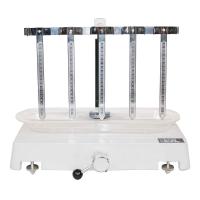 CHINA ZY-XF200 paper water absorptIon Meter, Krem water-absorptIon Meter$ 588.00SE
 -
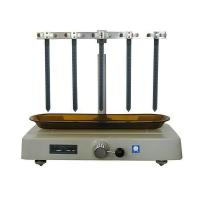 Jinan HORIZON XSL-200 Krem paper Water Absorption Tester$ 552.00SE
 -
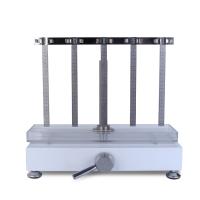 YANTE YT-XSL200 paper Water Absorption Tester, water absorption height 0~200mm$ 668.00SE




ChangChunYongXin ZXK-200 Paper Water Absorption TesterSPEC
ChangChunYongXin ZXK-200 Paper Water Absorption TesterDetails
ChangChunYongXin ZXK-200 Paper Water Absorption TesterPacking list
- SKU
- NB034365
- Measuring range
- 5-200mm
- Specimen size
- 250x15mm
- Ruler Graduation
- 1mm
- Simultaneous measurement of the number of samples
- Article 10
- Number of engraving rulers
- 5
Application
This instrument is suitable for the determination of capillary liquid absorption height of unglued paper and cardboard. (Not suitable for paper and cardboard with capillary height less than 5mm within 10 minutes).
Instrument structure
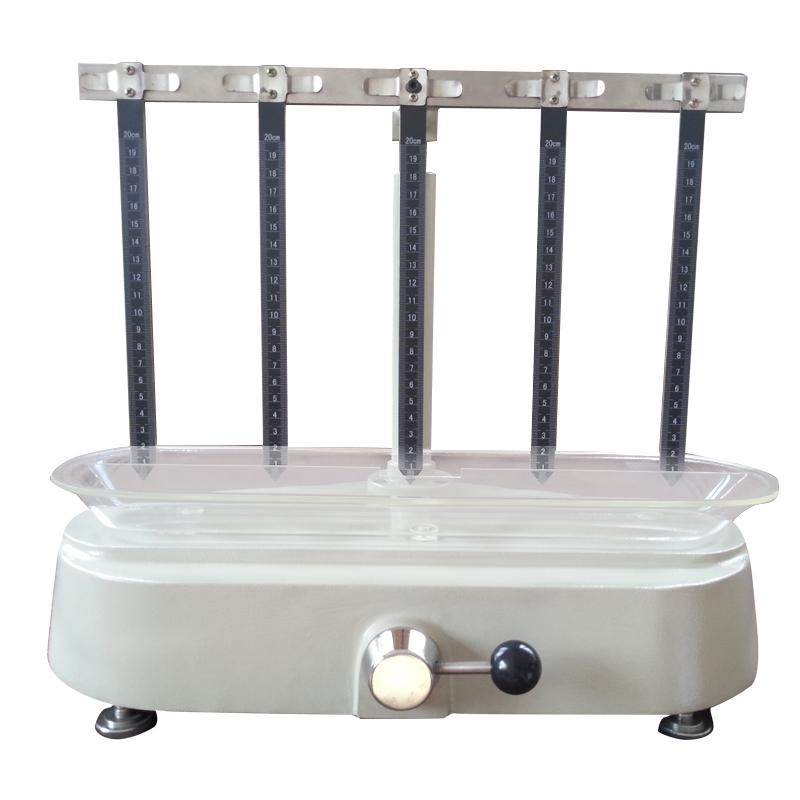
The instrument consists of a base, a pillar, a beam, a horizontal plate, a scale, a handle and a sink (see Figure 1). Turning the handle starts the eccentric mechanism so that the beam drives the horizontal plate and the scale to rise or fall steadily.
Steps
1. Turn the eccentric handle to lower the scale to the lowest position.
2. Pour an appropriate amount of water into the sink so that the zero points of all scales touch the water surface, and this is achieved by adjusting the feet.
3. Turn the handle to raise the scale to the highest position.
4. Lay the sample flat, draw a straight line perpendicular to the length direction at a distance of 205mm from one end of the sample, and then clamp 10 samples on both sides of the scale on the horizontal plate. The horizontal line drawn should be 200mm from the scale. line alignment.
5. Turn the eccentric handle to lower the scale to the lowest position. At this time, the zero point of each scale just touches the water surface, and the sample is 5mm deep into the water. At this time, press the stopwatch to time, so as to measure the required height of the capillary liquid absorption of the sample. Time or the height value of sample capillary absorption within a certain period of time. Generally, the suction height within 10min±3s is used, expressed in s/mm or mm/s.
6. Accurate to 1mm when reading numbers. If the wetting line is sloped or curved, the result should be read as the average height.
7. The length of the sample that penetrates into the liquid can be appropriately extended according to product standards or other requirements, but it must be indicated in the test report.
Instrument inspection
1. The ruler and the horizontal plate should be in a vertical position.
2. The zero points of the five scales should be on the same horizontal line.
3. The lifting and lowering mechanism of the eccentric wheel should be flexible and easy to operate.
4. The sample clamp should keep firmly clamping the sample
maintainance
1. Keep the instrument clean and wipe off the cover after the test.
2. Regularly inject lubricating oil between the shaft and sleeve, between the positioning key and the groove.