
Fungilab ViscoBall falling ball viscometer Viscosimeter
SE ViscoBall

Fungilab ViscoBall falling ball viscoMeterSPEC
Fungilab ViscoBall falling ball viscoMeterDetails
Fungilab ViscoBall falling ball viscoMeterPacking list

- SKU
- NB035210
- Viscosity range
- 0.5~100,000mPa·s
- Temperature range
- -20 ℃ to 120 ℃
- Repeatability
- Better than 0.5%
- comparability
- Better than 1%
- material
- 1, 2, G ball, Borosilicate Glass
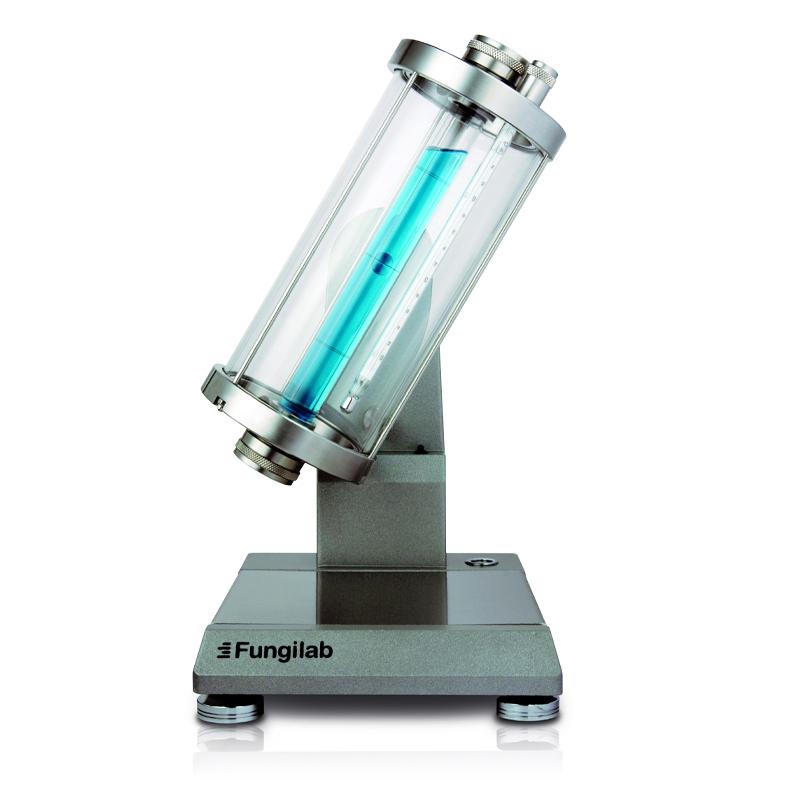
Introduction to the device
Accurate measurement of viscosity of transparent Newtonian fluids and gases
● Application: It can accurately measure the absolute viscosity of transparent Newtonian fluids and gases, and can be used as a reference instrument. Under the accurate temperature control system of the circulator, its measurement accuracy is well-known among all viscometers
● Principle: The rolling of the ball in the sample liquid is timed in an inclined cylindrical measuring tube. The viscosity of the specimen is related to the time it takes for the ball to travel a defined distance. The measuring tube can be flipped over to take another measurement
● Test results: given in mPas units of dynamic viscosity specified in the national standard
Applications
● Chemical industry (polymer solutions, solvents, inks)
● Industry (raw materials, glycerin)
● Food industry (gels, sugar solutions)
● Mineral oil industry (oils, liquid carbohydrates)
Features
· High precision
· Easy to operate
· Precise ball return to run, thus minimizing test time
· The sample is sealed in a test tube during the measurement, and there is no external influence
· The ball diameter is different, and the measurement range is different
Technical Indicators
· Viscosity range: 0.5-100,000mPa.s(cP)
· Temperature range: -20°C to 120°C
· Repeatability: Better than 0.5%
· Comparability: Better than 1%
· Material: 1, 2, G spherical borosilicate glass
Materials: No. 1, 2, G spherical borosilicate glass, No. 3 and No. 4 spherical iron-nickel alloy, No. 5 and No. 6 spherical stainless steel
Measuring range
| Ball number | Measuring range (mPa.s) |
| 1 | 0.6-10 |
| 2 | 7-130 |
| 3 | 30-700 |
| 4 | 5,800-10,000 |
| 5 | 800-10,000 |
| 6 | 6,000-7,500 |
Scope of application
It is mainly used to accurately measure the viscosity range of liquid and gas viscosity samples in Newtonian mechanics, and has a good application in research fields, production monitoring, and quality control.
The main applications are:
*Mineral oil industry (oils, liquid hydrocarbons)
* Food industry (syrup, honey, beer, milk, colloids, fruit juices)
*Chemical industry (polymer solvents, solutions, resins, rubbers, additives)
*Cosmetics / Industrial (raw materials, glycerin, latex, suspended solids, solvents, extracts)
*Petroleum industry (natural oil, engine oil, crude oil)
*Fuel (gasoline, diesel, paraffin)
*Paper industry (emulsions, pigment dispersions, pulp additives)
* Paints and varnishes (inks, varnishes, water paints, inks)
*Detergents (lotions, detergents, surfactants)
- 1Application of different types of solvents and analysis of their construction requirements
- 2Plastic viscosity measurement using falling ball viscometer