
MUXUAN MXR-D55 Bottom Mulser 55kw
 MXR-D55

MuXuan MXR-D55 Bottom MulserSPEC
MuXuan MXR-D55 Bottom MulserDetails
MuXuan MXR-D55 Bottom MulserPacking list
- SKU
- NB035254
- Power
- 55kw
- Speed range
- 1000rpm
- processing Volume
- 5000L
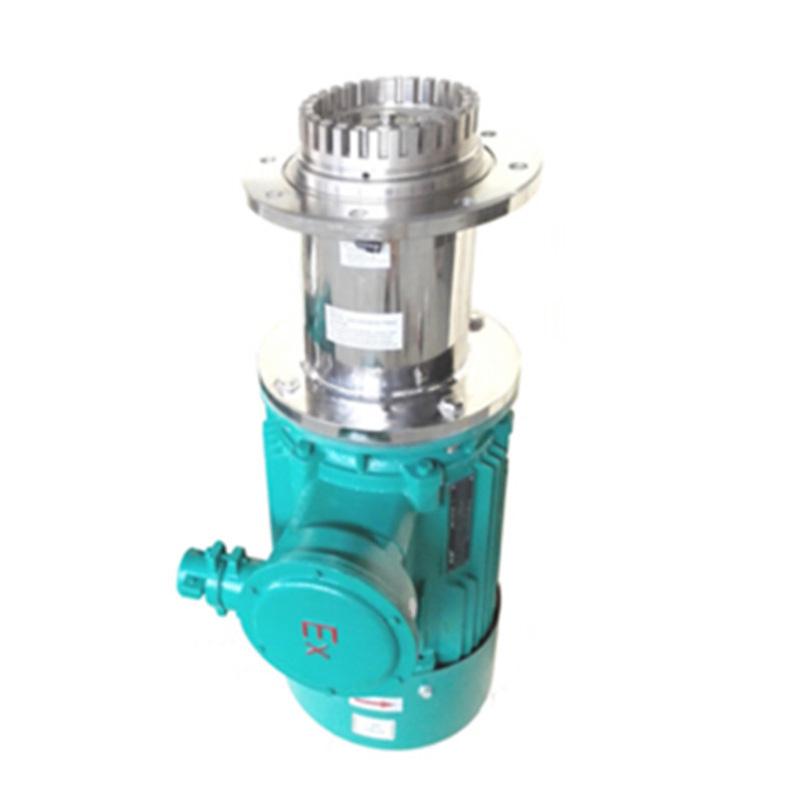
Equipment introduction
The kettle bottom emulsifier is a crushing, emulsifying and homogenizing equipment installed at the bottom of the reaction kettle. It can solve the sedimentation at the bottom of the kettle that cannot be solved by other equipment. It can crush, emulsify, mix, homogenize, and disperse the materials at the bottom of the kettle. , can be combined with different mixer forms such as dispersing and stirring to achieve multi-purpose functions in one machine. The equipment is suitable for a wide range of viscosity and temperature, and can be customized to meet the needs of vacuum (100mbar), explosion-proof (ATEX), and pressure conditions.
Application scope
[Application fields]: Suitable for dispersion, emulsification and homogenization of product materials in industries such as biology, food, coatings, inks, textile auxiliaries, cosmetics, lubricants, pesticides and other industries.
[Applicable materials]: Solids and liquids, liquids and liquids can be mixed to form solutions, colloids, suspensions or emulsions; such as juices, soups, dairy products, tissue homogenates, cosmetics, surfactants, Asphalt, emulsifiers, oil field chemicals and other materials.
Applicable process
It is used for installation and use at the bottom of open or closed containers for mixing, dispersing, emulsifying, crushing, homogenizing, reaction and other processes. Used for cleaning between each batch of material processing.
âSuitable for normal pressure, vacuum and pressure-resistant Operating Conditions
âSuitable for dispersion, emulsification, homogenization, dissolution and suspension
âPower supply: 380V, 50/60Hz
âContact material: 304/316L, special materials need to be customized
âSealing form: PTFE, skeleton seal, double-end mechanical seal
working principle
The strong centrifugal force of the cauldron bottom emulsifier shakes the material from the radial direction, and the material is initially dispersed and emulsified in the narrow gap between the rotors. At the same time, it is subjected to centrifugal extrusion, impact and other forces.
The cauldron bottom emulsifier generates a linear speed of at least 15m/s at the outer end of the high-speed rotating rotor, which can reach 50m/s, and forms strong mechanical and hydraulic shear, liquid layer friction, impact and tearing, so that the material is fully Dispersing, emulsifying, homogenizing, crushing, and ejecting through the stator slot at the same time. Materials are continuously ejected from the radial direction at high speed. The flow direction is changed under the resistance of the material itself and the container wall. At the same time, under the action of the upper and lower axial suction generated in the rotor area, two strong upper and lower churning turbulences are formed. The material goes through several cycles to complete the wet material processing processes of dispersion, emulsification, homogenization, crushing and mixing.