
MUXUAN ZKR-30 Vacuum Homogenizer 25L
 ZKR-30

MuXuan ZKR-30 Vacuum Homogeneous MulserSPEC
MuXuan ZKR-30 Vacuum Homogeneous MulserDetails
MuXuan ZKR-30 Vacuum Homogeneous MulserPacking list
- SKU
- NB035260
- Design Volume of emulsification pot
- 30L
- Working Volume of emulsification pot
- 25L
- Rotation speed of emulsification pot
- 0-86rpm
- Emulsification Pot Homogenizer Rotation speed
- 0-2800rpm
- Lifting method
- Electric lift
- Working Volume of aqueous pot
- 20L
- Rotation speed of aqueous pot
- 1400rpm
- Oil phase pot working Volume
- 14L
- Rotation speed of oil pot
- 1400rpm
- Total electric heating Power
- 12Kw
- Power of steam heating
- 5Kw
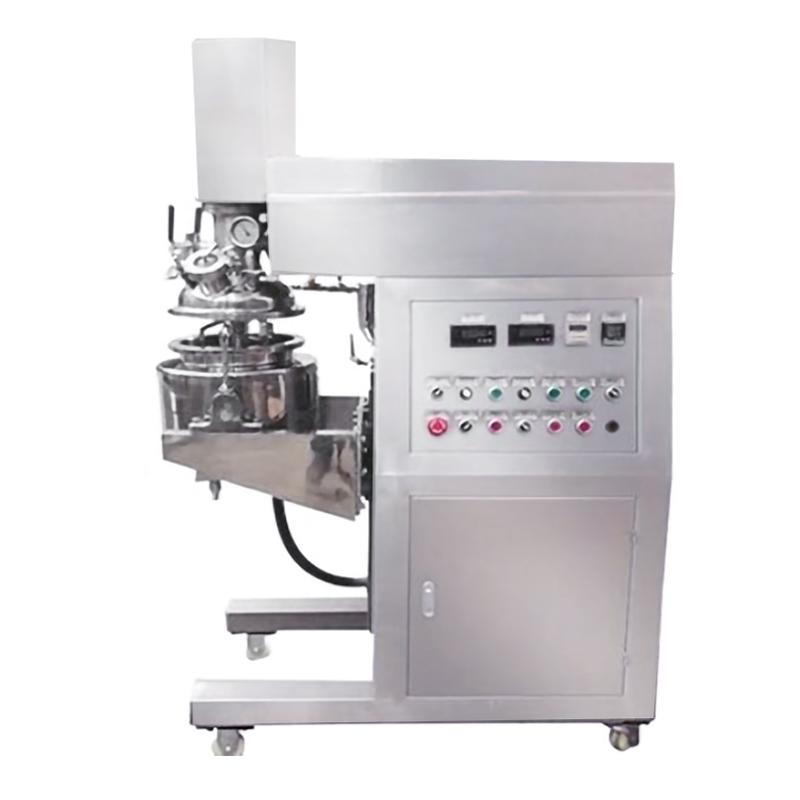
Equipment introduction
The laboratory vacuum emulsifier has the functions of fast homogenization, good homogeneous emulsification effect, heating, cooling and vacuum degassing. The production conditions are in line with national standards, high thermal efficiency, reliable electrical control, stable operation, convenient operation and maintenance, low labor intensity and other functions. Advantages: The vacuum emulsifier is an ideal production equipment for cosmetics such as ointments, creams, thick sauces, and honeys. It is also suitable for experiments and production in high-viscosity material industries such as pharmaceuticals, food, and fine chemicals.
Application scope
1. Daily chemicals and cosmetics industry: skin care cream, shaving cream, shampoo, toothpaste, cold cream, sunscreen, facial cleanser, nutritional honey, detergent, shampoo, etc.
2. Industry: latex, emulsion, ointment (ointment), oral syrup, etc.
3. Food industry: thick sauce, cheese, oral liquid, baby food, chocolate, boiled sugar, etc.
4. Chemical industry: latex, sauce, saponified products, paints, resins, adhesives, detergents, etc.
Applicable process
Suitable for dispersion, homogenization, emulsification, crushing, polymerization, suspension and dissolution of materials in experiments and small batches.
Features
1. The emulsification pot of the laboratory emulsifier is an automatic lifting type. The materials in the water pot and oil pot can be directly sucked into the emulsification pot under vacuum through the conveying pipe.
2. The discharging method is to heat the heat-conducting medium in the emulsification pot to heat the materials. The heating temperature can be set arbitrarily and controlled automatically.
3. The material can be cooled by inserting cold water into the mezzanine. The operation is simple and convenient. There is an insulation layer outside the mezzanine.
Homogeneous stirring and paddle stirring can be used separately or at the same time.
4. Material micronization, emulsification, mixing, mixing and dispersion can be completed in a short time.
5. The parts in contact with the material are made of stainless steel (medical use is made of 316L material), the inner surface is mirror-polished, the vacuum stirring device is clean, and the laboratory emulsifier is manufactured in compliance with GMP standards. It is a more satisfactory ointment and cream production equipment).
working principle
In the homogenizing pot of the laboratory emulsifier, the material passes through the polytetrafluoroethylene scraper on the stirring frame in the pot (the scraper always caters to the inner wall of the pot and sweeps away the sticky material hanging on the wall), constantly generating new interfaces, and then passes through the frame The stirrer and its opposite stirring blades cut, compress, and fold the materials, causing them to stir and mix and flow downward to the homogenizer below the pot body, and then pass through the shear generated between the high-speed rotating rotor and the stator. , impact, turbulent flow and other processes cause the material to be cut in the shear seam and quickly broken into particles of 200nm ~ 2μm. Material micronization, emulsification, mixing, mixing, dispersing, etc. can be completed in a short time. Since the homogenizer pot is in a vacuum state, the bubbles generated during the mixing process of the materials are removed in time. After the homogenization of the laboratory emulsifier is completed, the pot lid is raised and the dump button switch is pressed to discharge the materials in the pot to the container outside the pot. (or open the pot bottom valve and pressure valve to discharge directly).