
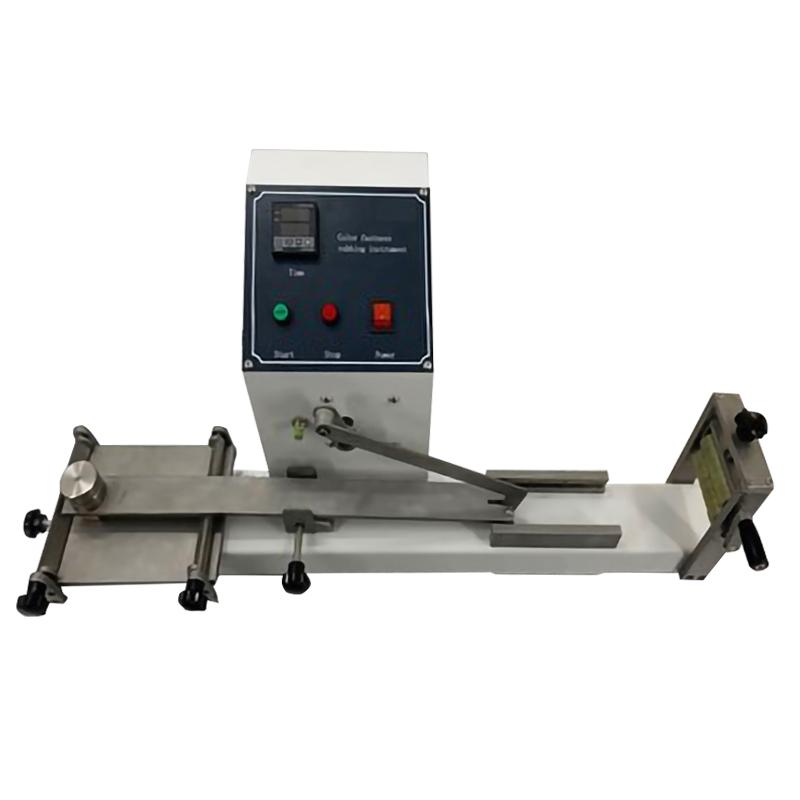
HUITAO CSI-454S Preset Friction Color fastness Tester Dry and wet friction Tester
SE CSI-454S

huitao CSI-454S Color fastness TesterSPEC
huitao CSI-454S Color fastness TesterDetails
huitao CSI-454S Color fastness TesterPacking list
- SKU
- NB035905
- Reciprocating times setting range
- Electronic preset Counter, arbitrarily set 1~ 9999
- Friction head pressure
- 9N
- Friction head type
- Rectangular rubbing heads for velvet fabrics, circular rubbing heads for Miscellaneous Spinning & weaving products
- AATCC and ISO standards
- Use different rubbing white cotton
- Friction head size
- Rectangular 19 × 25mm or round Φ16 mm
- Friction cloth size
- 50mm * 50mm for circular friction head, 25 * 100mm for rectangular friction head
- Specimen size
- 50*140mm
- Reciprocating friction speed
- 60 times/min
- Friction type
- electric friction
- Reciprocating stroke
- GB
- Motor power
- 40w
- Dimensions
- 780×290×260mm
- Instrument Weight
- About 20Kg
Application
It is used for rubbing cotton, chemical fiber, blended and other colored fabrics and leather with dry/wet white cotton cloth respectively, and then evaluates the discoloration of the sample and the staining of white cotton cloth with the staining gray scale, so as to obtain the dry/wet friction resistance of the fabric performance.
Standards
GB/T3920 GB/T 5712 ISO105X12 AATCC8 AATCC165 JIS L0849
Features
It adopts automotive-grade good metal baking paint, which is beautiful and not easy to scratch the surface.
The process design is reasonable, and the details are handled meticulously.
Stable performance, smooth operation, more accurate test results.
Care and Maintenance
1. Always apply lubricating oil to the connection of the transmission mechanism to ensure the smooth rotation of the transmission mechanism.
2. Apply a lubricant such as butter to the stainless steel groove on the side of the base.
3. The counter is located on the upper part of the instrument and is easy to be damaged. Avoid damage caused by heavy objects during use.
4. The stainless steel grooves and stainless steel plates on the base are pasted with glue, and the inspection results before leaving the factory are firm and reliable. When it is still possible to be knocked by heavy objects or pried by sharp objects and fall off, the operator should pay attention.
5. The friction head is made of plastic, which has been polished before leaving the factory, and there is no gap between it and the stainless steel plate. The friction head should not be directly rubbed with sandpaper, it is easy to wear the friction head and make it no longer smooth, and there is a large gap with the steel plate, which will cause uneven pressure on the sample and affect the test results
Steps
1. Sample preparation
1.1 The sample and standard friction small white cloth need to be conditioned in a constant temperature and humidity environment.
1.2 When the sample has multiple colors, all colors should be rubbed.
1.3 If the area of each color is large enough, it must be sampled separately.
1.4 Cut out the sample, do dry friction and wet friction respectively, and ensure that all colors are rubbed.
1.5 If the front and back of the sample are made of different materials and colors, the rubbing color fastness test should be done on both sides.
1.6 The dry and wet rubbing fastness should not be repeated on the same part of the sample.
2. dry rub
2.1 Place the sample flat on the friction instrument covered with sandpaper, make the length direction of the sample consistent with the stroke direction of the instrument and fix the sample on the pressure plate, the clamped sample should be flat.
2.2 Fix the standard friction small white cloth on the friction head, clamp it with a spring clip, and put the friction head lightly on the sample;
2.3 It should be ensured that the sample does not slip or wrinkle during friction;
2.4 The motor shakes the friction arm 10 times at a rate of once per second, making the friction arm rub back and forth 20 times;
2.5 Take off the standard friction small white cloth and rate it.
3. wet rubbing
3.1 Wet the standard friction white cloth completely in distilled water;
3.2 After taking it out, clamp it in filter paper and squeeze it to make it have a certain moisture content;
3.3 The remaining steps are the same as the above dry friction steps;
4. result processing
4.1 Before grading, use transparent glue to gently stick and rub the loose fluff on the white cloth.
4.2 Use three layers of unused white rubbing cloth under the white rubbing cloth to be evaluated, and evaluate the staining grade of the white rubbing cloth with reference to the standard staining gray scale.
5. testing report
5.1 Reporting standard methods
5.2 Report the results of dry friction and wet friction respectively.
5.3 If pretreatment or posttreatment is carried out on the sample, report the treatment method.
- 1GB/T 46471-2025《Leather—Tests for colour fastness—General principles of testing》
- 2GB/T 3324-2024《General technical requirements for wooden furniture》
- 3GB/T 44161-2024《Disperse dyestuffs—Determination of thermal migration》
- 4QB/T 4961-2016《Leather rubbing color fastness tester》
- 5GB/T 3921-2008《Textiles - Tests for colour fastness - Colour fastness to washing with soap or soap and soda》
- 6GB/T 3920-2008《Textiles - Tests for colour fastness - Colour fastness to rubbing》
- 7HG/T 5180-2017《Water-based Coatings for Automotive Plastic Parts》