
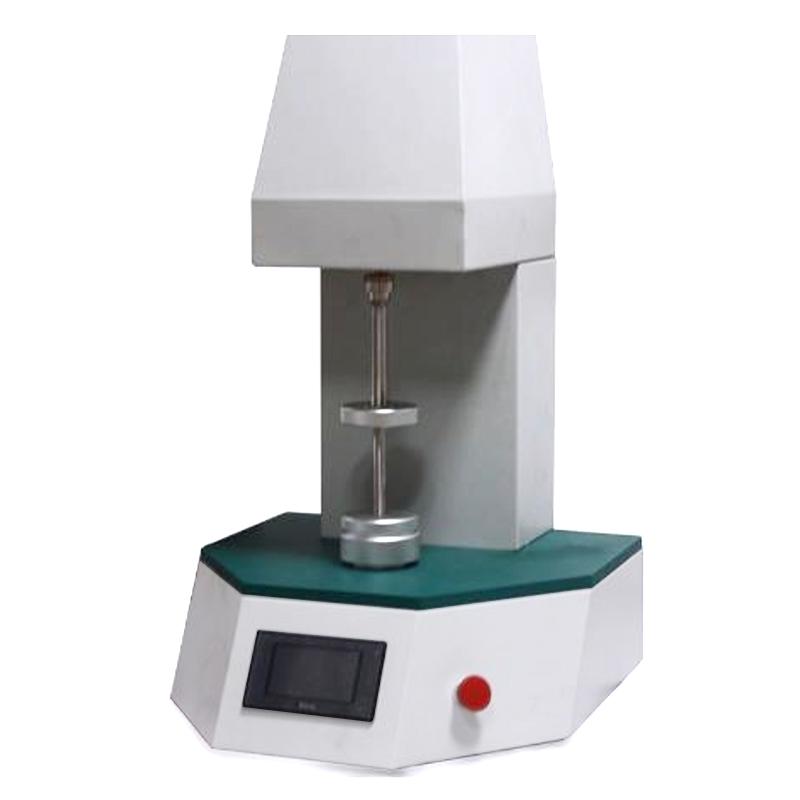
HUITAO CSI-SX48 automatic crease recovery Tester, fiber fabric folding recovery detection
SE CSI-SX48

huitao CSI-SX48 Automatic wrinkle recovery TesterSPEC
huitao CSI-SX48 Automatic wrinkle recovery TesterDetails
huitao CSI-SX48 Automatic wrinkle recovery TesterPacking list
- SKU
- NB035917
- Specimen size
- 15Cm × 28cm (6 × 11 inches)
- Weight
- 2000G, 1000g, 500kg, 200kg, cumulative
- Dimensions
- 150*150*330mm
- Weight
- 9.5kg (21lb)
The main purpose
The wrinkle recovery angle Tester is suitable for testing any fabric made of pure or blended fibers, to test the recovery ability of the sample after being folded under a certain load for a certain period of time.
Standards
AATCC 128, ISO 9867, ENKA 3061
GBT-29257
main feature
1. The base with a bracket, the fixed circular steel plate on the base matches the movable steel plate on the upper end, and the movable flange is equipped with locking pins;
2. 4 standard weights, respectively 2000g, 1000g, 500kg, 200kg;
3. Provide a full set of 5" x 3" plastic plates for easy grading (1-5 grades).
Experimental procedure
1. First use the sample pressing device to test three samples continuously with an interval of about 1 minute;
2. Fold the sample face to face, clamp the edge of the cloth with a clip, no more than 5mm from the edge of the cloth;
3. In some cases, the surface of the sample will stick together. A piece of paper or aluminum foil should be used with a size of 18x14mm. Be careful not to touch the sample with your hands;
4. Place the folded sample between the two pressing blocks, apply weight immediately, turn on the timing device, wait for 60+2 seconds, and prepare the next sample according to 2, 3, 4;
After 5.5 minutes, quickly and slightly remove the first weight. Transfer the folded sample to the sample holder of the gauge with clamps;
6. Remove the paper or aluminum foil, put one side of the sample into the sample holder, and hang the other side freely. After 60+2 seconds, put the second and third pieces into the sample holder;
7. Adjust the instrument so that the lower end of the sample is consistent with the vertical mark of the instrument, and should be adjusted continuously within 5 minutes (to make the lower end of the sample consistent with the vertical mark of the instrument) to avoid the influence of gravity;
After 8.5 minutes, record the recovery angle of the sample. If the drooping end is slightly curled or twisted, take the vertical plane passing through the center of the drooping end and the axis of the dial as the benchmark for the reading of the crease recovery angle;
9. Repeat the above steps, and then make three reverse-folded samples and weft-folded front and reverse folds (total 12 pieces).
main principle
Under standard atmospheric conditions, use a standard crimping device to apply a predetermined pressure to the sample and keep it for a specified time. The overall structure of the instrument and the precise helical column can ensure that the loaded sample produces uniform deformation. After the sample is removed, re-adjust the humidity of the sample under standard atmospheric conditions and allow it to recover for a certain period of time, then compare the sample with the reference sample to evaluate the appearance of the sample.