
Germany PCE PCE-3500 Metal Hardness Measurement Instrument
 PCE-3500

PCE PCE-3500 Hardness Measurement InstrumentSPEC
PCE PCE-3500 Hardness Measurement InstrumentDetails
PCE PCE-3500 Hardness Measurement InstrumentPacking list
- SKU
- NB036263
- Measurement range
- HV230~940;HRC20~70;HB90~650
- Accuracy
- ±3%;±1.5%;±3%
- traction resistance
- 370~1.74 quadrillion Pa
- Hardness system
- HRC、HRB、HB、HV、兆帕
- probe
- Ultrasonic probe (UCI) for steel (precalibr) only (probe in standard distribution)
- Impact Probe (Richter)
- Steel, holy steel, cast iron, alum, bronze (monitor optional)
- Vickers probe
- Determination of Piercing Sample at 136 Degree Through Load 50N (Self-Load)
- Probe
- Comprehensive 360-degree automatic recognition
- storage
- SD memory card
- Interface
- USB port
- screen
- Liquid crystal color display; backlight
- Power Supply
- 6 VDC or 3 × AA batteries
- Battery life
- About 10 hours
- Operating temperature
- 20~+40℃;30~80%R. H.
- size
- 160×75×30mm
- Weight
- 0.3 kg (without probe)
- Protection category
- IP54
overview
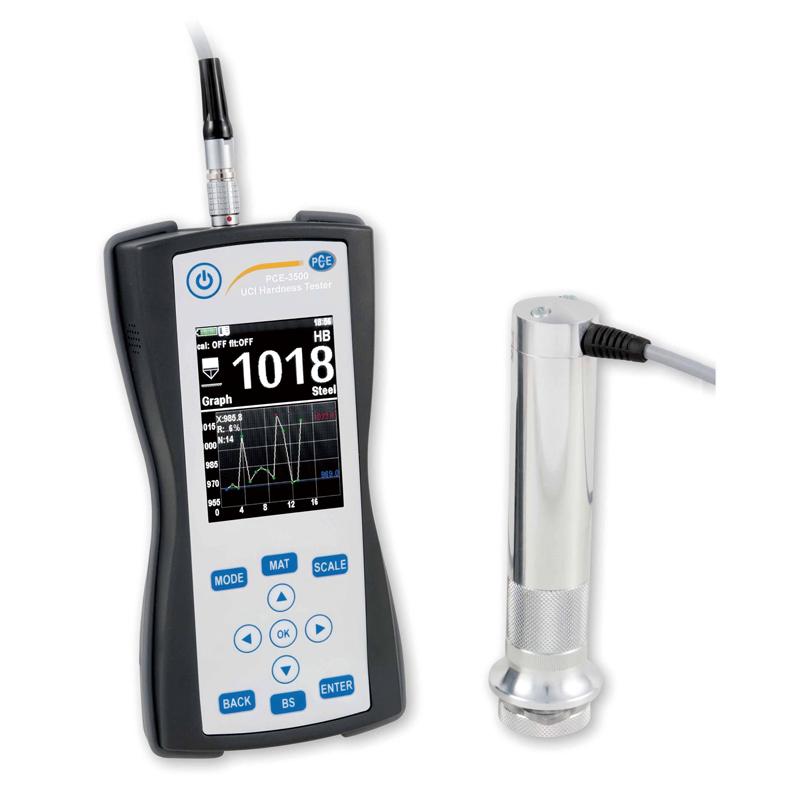
The UCI Hardness Tester PCE-3500 is designed for non-destructive hardness measurement of metal components. The UCI Hardness Tester works according to the ultrasonic contact impedance test procedure. Here's how this UCI procedure works: The Vickers diamond at the probe has a self-resonance function. By pushing the probe, the vibration frequency can be reduced, depending on the hardness of the surface and the hardness of the e-module of the material and the contact surface. Taking into account the characteristic curve of the material, the hardness of the surface can be determined based on the frequency shift.
UCI Hardness Tester works non-destructively. There is a slight pressure acting on the surface microscopically, but it is usually not visible. Due to the low penetration depth of Vickers diamonds, this UCI Hardness Tester is particularly suitable for edge-hardened parts, such as those present during nitriding or induction hardening. It is commonly used for stamping tools, presses, thin-walled components, cogs, turbine blades, camshafts, or welds. The UCI Hardness Tester is also suitable for many other hardness testing applications. It has interchangeable probes that have different pressures so they can cover a wide range of applications.
After measuring the hardness of the component, the UCI Hardness Tester PCE-3500 displays different statistical values such as MAX/MIN values and averages. In addition, the standard deviation and other coefficients can be determined. You can indicate a bar chart. Since the UCI Hardness Tester is equipped with internal memory, the measurement data can be evaluated by software.
Features
Measurement method: Ultrasonic Contact Impedance Measurement (UCI) method
Hardness measurement display scales are optional: HV, HRC, HRB, HB, MPa
Backlit color LCD screen
SD card is supported
Support USB connection and computer connection
Display with support for different sensors (universal type)
Waterproof housing