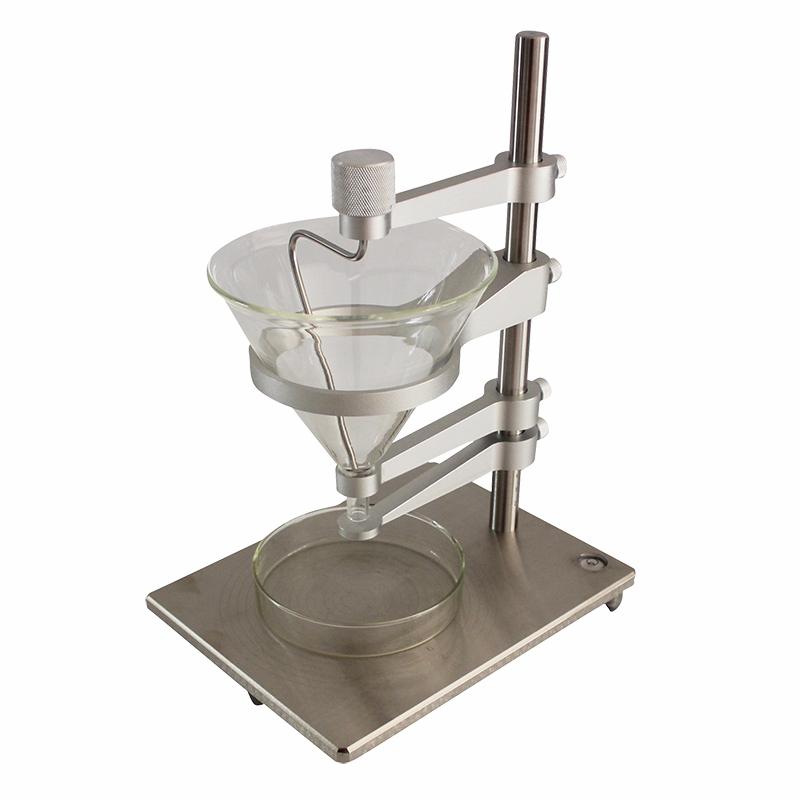

XIONGFA XF-11986 Powder Carr Angle of Repose Tester, Surfactant Powder Particle flowability Tester
SE XF-11986

XIONGFA XF-11986 Powder Carr Angle of Repose TesterSPEC
XIONGFA XF-11986 Powder Carr Angle of Repose TesterDetails
XIONGFA XF-11986 Powder Carr Angle of Repose TesterPacking list

- SKU
- NB038540
- Glass funnel
- Inner diameter 10mm, minimum height 25mm, Capacity 250mL
- Stirrer
- Including two rods placed opposite each other, which can be stirred in the early Glass funnel
- baseplate
- The minimum length is 220mm, the minimum width is 158mm, the surface is polished and engraved with concentric circles of 10mm-100mm, and the center of the circle should be perpendicular to the Glass funnel
- strut
- Engraved scale above 0-100mm, for measurement of vertebral height
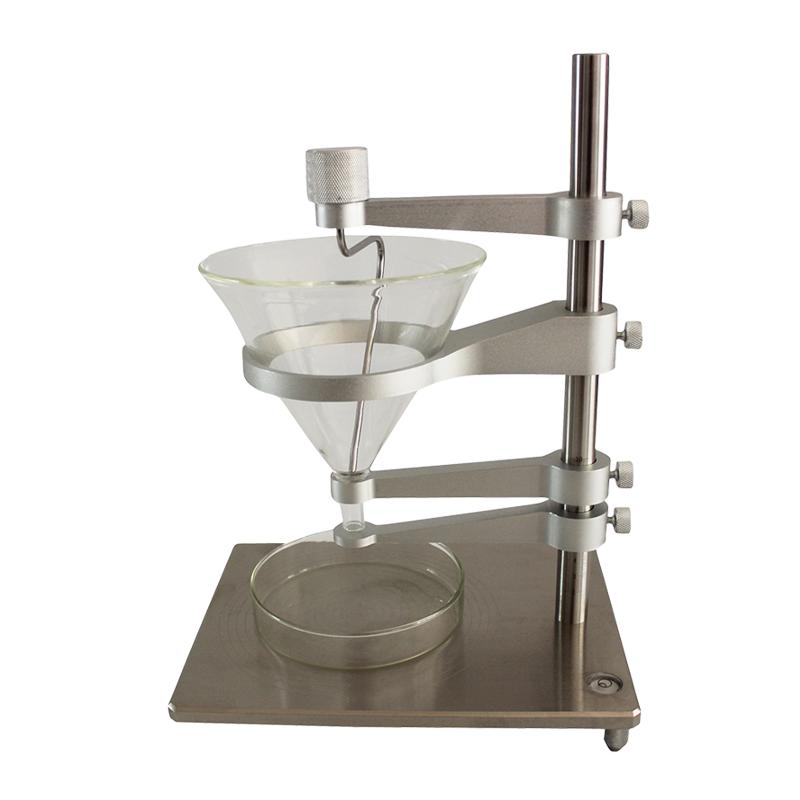
The angle of repose measuring instrument is designed and manufactured according to the provisions of GB11986-89, ISO 4324-1977 "Determination of the Angle of Repose of Surfactant Powder and Particles". The instrument is suitable for the routine determination of the angle of repose of non-agglomerate powder or granular surfactants and washing powder. The equipment fully meets the requirements of the United States Pharmacopoeia and the European Pharmacopoeia. At the same time, the instrument meets the requirements of ISO 4324 and ISO 8398. The angle of repose refers to the angle between the conical accumulation and the plane when the granular powder is poured into the plane (also known as the test platform).
The weight difference of solid preparations is greatly affected by the fluidity of the powder, and there are many methods for evaluating and measuring the fluidity of the powder. Among them, the measurement of the angle of repose is a simple method to test the fluidity of the powder. The size of the angle of repose reflects the degree of freedom of relative movement between powder particles, which is generally defined as the maximum angle between the accumulation slope formed by the free accumulation of powder and the horizontal plane. In this experiment, the fixed funnel method was used to determine the fluidity of drugs and powders. Fix the funnel at a certain height above the coordinate paper (the paper is placed on the water platform), add materials from the funnel until the bottom of the formed accumulation cone just touches the bottom of the funnel, measure the diameter of the cone, and use the ratio of the height of the bottom of the funnel to the radius of the cone as the tangent value to calculate the stop
Principle
It is to pour the sample into the funnel, stir it if necessary, the powder flows out to the measuring platform to accumulate and form a cone, measure the height of the cone with a height gauge, and calculate the angle of repose of the powder according to the formula.
The angle of stop refers to the maximum angle measured in a static state when the gravity and the friction between the particles are balanced when the particles slide on the free slope of the powder accumulation layer in the gravitational field. There are two methods for measuring the angle of repose: the injection method and the discharge method. Injection method: Slowly add the powder from the top of the funnel, and the material leaked from the bottom of the funnel forms a conical accumulation on the horizontal plane at an inclination angle. Discharging method: put the powder into the cylindrical container, keep the bottom surface of the cylinder horizontal, when the powder flows out from the center hole at the bottom of the cylinder, the inclination angle of the inverse conical residual powder accumulation formed in the cylinder. These two inclination angles are angles of repose, and sometimes the inclination method is also used; add 1/2-1/3 of the powder in the cylindrical container rotating slowly around the horizontal axis, when the surface of the powder produces When sliding, the inclination angle of the surface is measured. The angle of repose can be directly measured with a protractor, or can be calculated based on the height of the powder layer and the radius of the disk, that is, tanθ=height/radius
Device structure
The instrument consists of the following components: test platform, all stainless steel funnel, stirrer, bracket
1. Glass funnel: inner diameter 10mm, minimum height 25mm, capacity 250mL
2. Stirrer, including two opposite rods, can stir in the glass funnel
3. Bottom plate: The minimum length is 220mm, the minimum width is 158mm, the surface is polished and engraved with concentric circles of 10mm-100mm, and the center of the circle should be perpendicular to the glass funnel
4. Rod: engraved with a scale of 0-100mm or more, in order to measure the height of the vertebral body
test steps
1. After the device is adjusted, take 150ml of powder and prepare for measurement.
2. Block the small hole at the bottom of the funnel with your hands, and pour 150ml of the weighed sample into the funnel. Note that the powder needs to fill the entire small hole at the bottom of the funnel
3. Open the small hole of the funnel, let the powder flow freely through the small hole into the cup, until the cup is completely filled and the powder overflows.
4. Stand still for 2 minutes, measure the height of the vertebral body
Summary of test methods
A. Injection method: The particulate material flows out of the funnel and falls on the plane to form a cone, and the bottom angle of the cone is the angle of repose.
B. Discharge method: The granular material is discharged from the opening at the bottom of the container. After the material stops flowing, the angle between the inclined surface of the material and the curve of the bottom surface is the angle of repose.
C. Tilting method: tilt the rectangular container containing 1/3 of the granular material or fluctuate the cylindrical container, and the angle formed by the surface of the material after it is still is the angle of repose
The significance of measuring the angle of repose
Clarify the ambiguity of the concept of angle of repose, analyze the cause of systematic deviation of the angle of repose measured by the fixed funnel method, and propose a new method for measuring the angle of repose. Methods: The influence of the fixed funnel method on the determination of the angle of repose was summarized, and the reasons for the systematic deviation of the measured value of the angle of repose caused by the fixed funnel method due to the change of operating conditions were analyzed. The definition of angle of repose has been revised to some extent. Based on the establishment of the model, the regression analysis is carried out on the experimental data. On the basis of the analysis, a new method for measuring the angle of repose is proposed. Results: The results of variance analysis showed that the fixed funnel method had statistical deviation, and the correlation of regression analysis was extremely significant. Conclusion: The fixed funnel method does have systematic deviation caused by the change of measurement conditions, and the deviation can be corrected by mathematical treatment. The analysis of experimental data shows that the new assay method has certain advantages