
Essence LD-YLD Canadian Free Degree Meter
SE LD-YLD


JingHuaYiQi LD-YLD Canadian Isolation MeterSPEC
JingHuaYiQi LD-YLD Canadian Isolation MeterDetails
JingHuaYiQi LD-YLD Canadian Isolation MeterPacking list

- SKU
- NB039748
- Measuring range
- 0~1000CSF
- Capacity of round container
- 1000ml
- Cylinder inner diameter
- 110±0.2ml
- Overall height of cylinder block
- 190±0.2ml
- Screen mesh aperture
- Diameter 0.50mm
- Calibrated
- Self-calibrating
- Weight
- 65kg
Applications
Determination of pulp freeness by standard freeness Tester. It is mainly applicable to the test value of the production control of groundwood pulp, and is widely applicable to the change of drainage of various chemical pulps in the process of beating and refining. During the processing of pulp, a large number of fine fibers will be produced, and sometimes the freeness will be abnormally increased (false freeness ), and the value is lower than 100ml. The freeness value does not necessarily correlate with the drainage performance of the pulp on the paper machine wire.
Principle
Freeness is to measure the drainage of diluted pulp suspension (3G dry pulp in 1L water), that is, freeness or drainage rate, which reflects the surface condition and swelling of fibers . In addition, the results of the determination are also related to the test conditions carried out, such as the preparation of the slurry, the temperature and the quality of the water.
Canadian standard freeness refers to the water filtration performance of 1000ml slurry water suspension with a content of (03±0.0005)% and a temperature of 20°C measured by a Canadian freeness Tester under specified conditions . The volume (mL) of water represents the CSF value.
Features
The instrument provides a test value suitable for the production control of groundwood pulp; it is also widely applicable to the change of drainage of various chemical pulps in the process of beating and refining; it reflects the surface condition and swelling of the fiber.
Canadian standard freeness refers to the water filtration performance of 1000mL slurry water suspension with a content of (0.3±0.0005)% and a temperature of 20°C measured by a Canadian freeness Tester under specified conditions. The volume (mL) of water represents the CFS value.
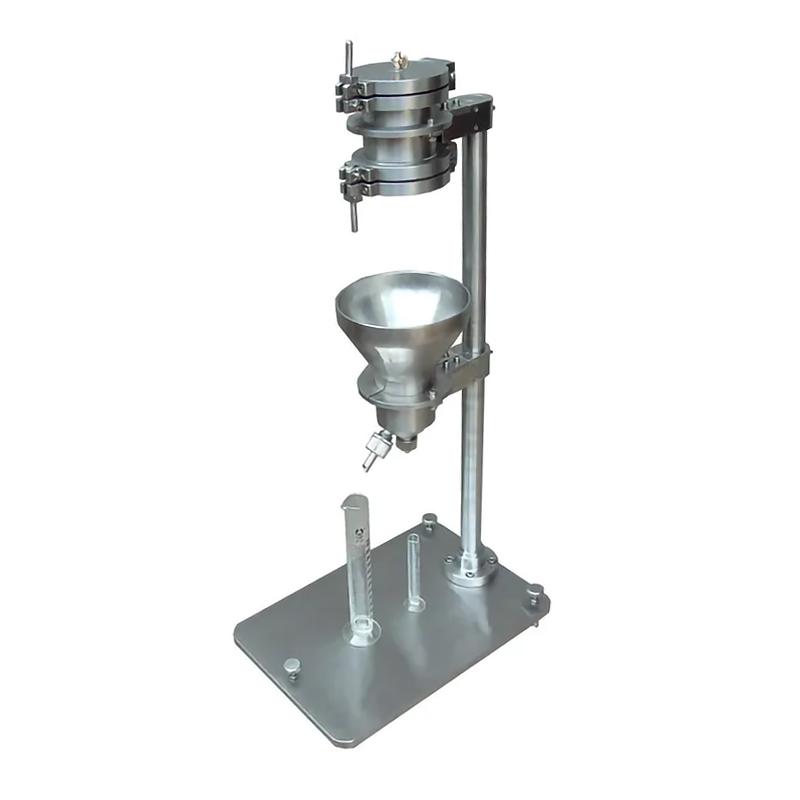
The freeness meter consists of a water filter chamber and a proportional split measuring funnel, mounted on a fixed support. The water filter chamber is made of stainless steel. The bottom of the cylinder is a porous stainless steel sieve plate and an airtight sealed bottom cover. It is connected to one side of the Yuantong with a loose leaf and fastened to the other side. The top cover is sealed. , open the bottom cover, the pulp flows out. The cylinder and filter cone are respectively supported by two machined bracket flanges with openings on the bracket.
Structural features
1. The freeness Tester includes a measuring funnel through which the water filter chamber is proportionally divided and installed on a fixed bracket (as shown in Figure 1. The water filter chamber is made of stainless steel
2. The bottom of the cylinder is a porous stainless steel sieve plate and an airtight sealing bottom cover, which is connected to one side of the Yuantong with a hinge and fastened to the other side.
3. The top cover is sealed. Install the slurry, open the bottom cover, open the vent valve, and the slurry flows out.
4. The cylinder and filter funnel are respectively supported by two bracket flanges with openings machined on the bracket. This installation can reduce vibration as much as possible.
5. Use a spirit level to find the level at the opening upper end of the rate measuring funnel of the lower bracket.
6. All 99% materials of the standard freeness Tester are made of 304 stainless steel, which has a long service life.
Standards
TAPPI T227 ISO 5267/2, AS/NZ 1301, 206s, BS 6035 part 2, CPPA C1, and SCAN C21; QB/T1669-1992