

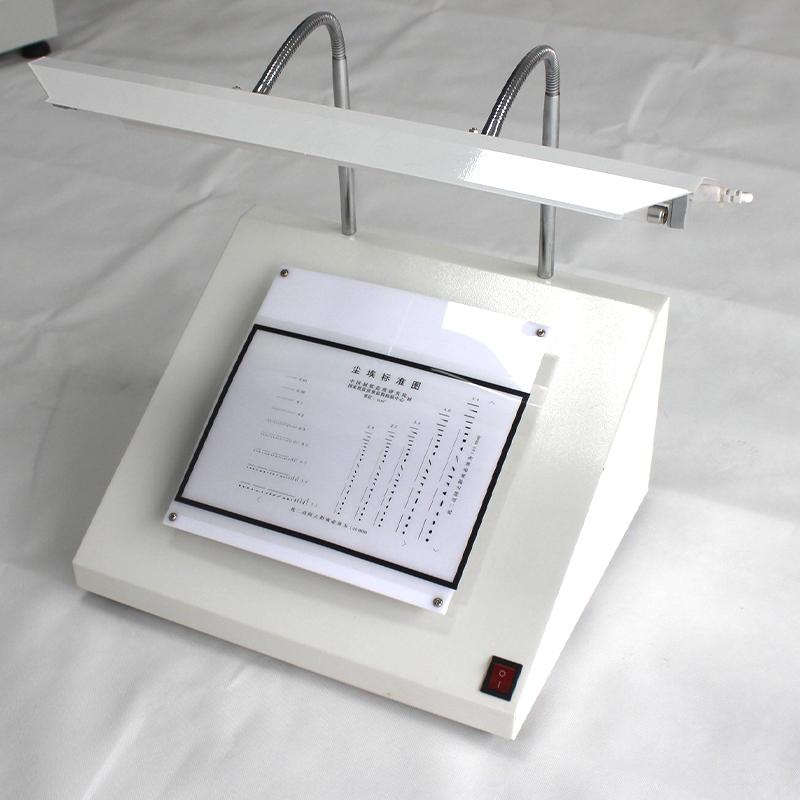


CHINA ASR-5641 Paper Dust Tester
 ASR-5641

-
 CCYONGXIN ZCA-625 Dirt Count Tester swirl/spin table 20W fluorescent lamp$ 378.00SE
 -
 CHINA NBC-5641 Dirt Count Tester$ 555.00SE
 -
 CHENCHI ZCA-1 Dirt Count Tester 20W fluorescent lamp$ 311.00SE
 -
 CHINA ZY-CA dust meter Dirt Count Tester, conforming to GB/T1541$ 350.00SE
 -
 Jinan HORIZON ZCA-625 NB033852 Paper and Cardboard Surface Cleanliness Tester$ 353.00SE





AISRY ASR-5641 Dirt Count TesterSPEC
AISRY ASR-5641 Dirt Count TesterDetails
AISRY ASR-5641 Dirt Count TesterPacking list
- SKU
- NB039770
- light source
- 20W fluorescent lamp
- irradiation angle
- 60°
- Table size
- 270 * 270mm, effective area of 0.0625 ㎡, swirling/spinning 360 °
- Accuracy
- 0.1 second
- Measuring range
- 0-9999 seconds
- test area
- 10±0.05cm^2
- pressure
- 100kPa ± 2kPa
- show
- Chinese dot matrix menu
- Communication output
- Standard RS232 interface
- Operating Environment
- Temperature 5~ 35 ℃, Relative Humidity ≤ 85%.
- Dimensions
- 318*362*518mm
- Weight
- 36kg
- Power
- AC220V±10% 50Hz
- Dimensions
- 428*350*250mm
- Weight
- 8kg

The dust Tester is suitable for the determination of the dustiness of paper or cardboard, and is designed and manufactured according to GB/T1541-1989 "Measurement of Dustness of Paper and Cardboard". With reasonable structure and convenient operation, it is widely used in the field of testing paper materials in colleges, scientific research units, quality inspection departments, and paper printing and packaging production departments. It is used for testing high-smooth paper and cardboard. It should not be used to test materials with a thickness of more than 0.5mm or paper or cardboard with high air permeability, because the amount of air passing through the sample may cause unreal results. It is a variety of high-smooth Instruments required for paper testing.
Executive standard
QB/T 1665, ISO 5627, GB456
operation method
1. Sampling: Cut more than 4 pieces of 250mm×250mm samples
2. Observation: Put one of the samples on the rotatable workbench. Turn on the fluorescent lamp, and check the visible dust on the sample surface under the fluorescent lamp. When observing, keep the visual distance of the eyes at 250~300mm, and use different marks to circle the dust in different areas; it is also possible to record the number of dust in the same area according to the size of different areas.
3. Comparison: Rotate the workbench by 90°. After each rotation, use the standard Dirt Count picture to identify the size of the Dirt Count area on the sample. You can also use different areas to mark the newly discovered Dirt Count until you return to the original position.
(The above individual parameters may be adjusted) (The picture is for reference, the actual product shall prevail)