
LABO 17071 Stiffness meter indentation Stiffness meter
 17071(0-10000mN)

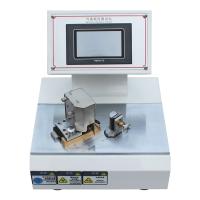
Labo 17071(0-10000mN) Stiffness MeterSPEC
Labo 17071(0-10000mN) Stiffness MeterDetails
Labo 17071(0-10000mN) Stiffness MeterPacking list
- SKU
- NB039924
- Measurement range
- 0~10000mN
- Specimen length
- 1~50mm
- Angular velocity control
- 0.5~ 50 °/sec (adjustable)
- bending angle
- Adjustable from 0 to 90 °, can simultaneously measure 3 angle forces and delay forces
- Unit selection
- mN、gf、ozf
- Power supply Voltage
- 100‒240VAC, 50/60Hz
- air pressure
- >0.2MPa
- Dimensions
- 430*240*350mm
- Net Weight
- 15Kg
- Display
- LCD touch screen
- Crease stiffness
- 45°/s
- sample
- Width 38mm, maximum thickness 3mm
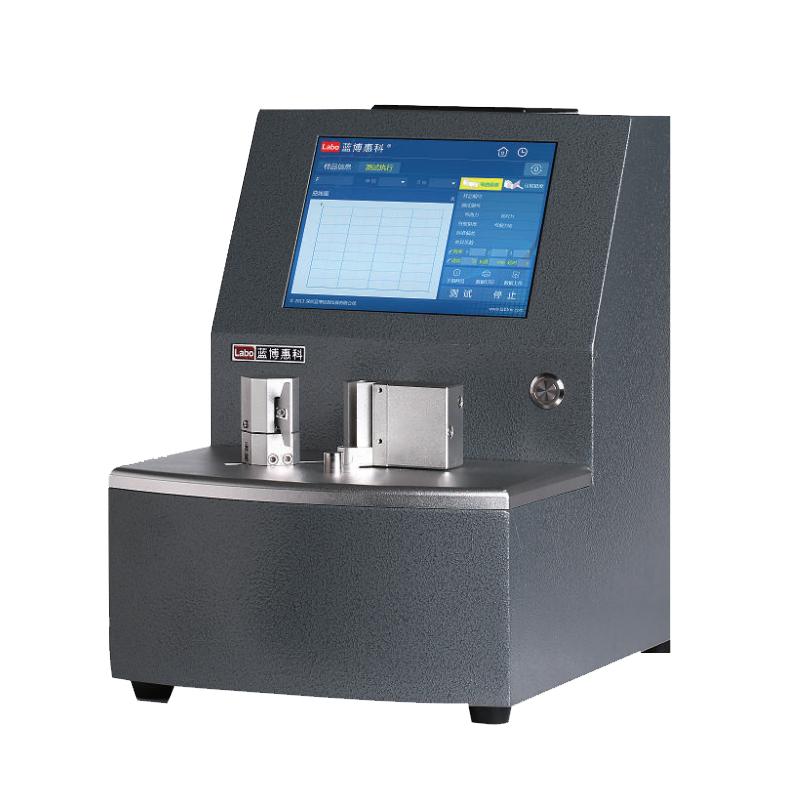
Introduction
17071 is used to test the bending resistance of materials, is a materialThe determination of an elastic performance index of the material is easy to useQuickly, the instrument clamps the specimen and automatically rotates the specimen clamp to make itAfter bending to a certain angle, the force value (in mN, g) is recorded,At the same time, the bending stiffness (in mN-m) is calculated and testedIt automatically returns to the initial measurement position and prepares for the next measurementTry.
This instrument can test crease force and bending stiffness.
Features
Imported high-precision load cell, the accuracy is controlled at <0.5%;
The bending length is adjustable from 1~50mm, and the angle of 090° can be set arbitrarily, making the test faster and more accurate;
8-inch touch screen Chinese display, friendly man-machine interface operation;
Automatic clamping of the specimen (photoelectric induction, pneumatic clamping), fully automatic completion of the test;
It has the function of statistical processing of test data, printout of test report, measurement average, maximum, minimum value and each test value, which is convenient for technology;
Experimenters quickly make statistics and compile test reports
The calibration program is specially set up inside the instrument, which is convenient for the measurement and calibration department (third party) to calibrate the instrument. For calibration, standard weights can be usedcode or force measuring device to calibrate the accuracy of the indication value.
Description of the experiment
Bending stiffness: Evenly cut the specimen from the sample with a sampling device, clamp one end of the specimen in the specimen clamp, and bend it at an angle of 15° to one side (orother angles) to record the force value, and measure 10 valid data on the front and back sides.
Crease force: use special sampling equipment to evenly cut the sample from the sample, clamp one end of the sample in the sample clamp, and bend it at an angle of 90° to one side.Hold for 15 seconds to record the force value.
Applicable Standards
Flexural stiffness: GBT23144-2008 ISO2493 ISO5628 TAPPIT556 DIN53121 SCAN P29
Stiffness: BS6965 BS3748
- 1QB/T 5023-2017《Stiffness tester for paper cup》
- 2QB/T 1051-2012《Board bending resistance tester》
- 3JJG (轻工)57-2000《Stiffness Tester for Board》
- 4GB/T 2679.3-1996《Paper and board-Determination of resistance bending》
- 5GB/T 23144-2008《Paper and board - Determination of bending stiffness by static methods - General principle》
- 6GB/T 22364-2018《Paper and board—Determination of bending resistance》