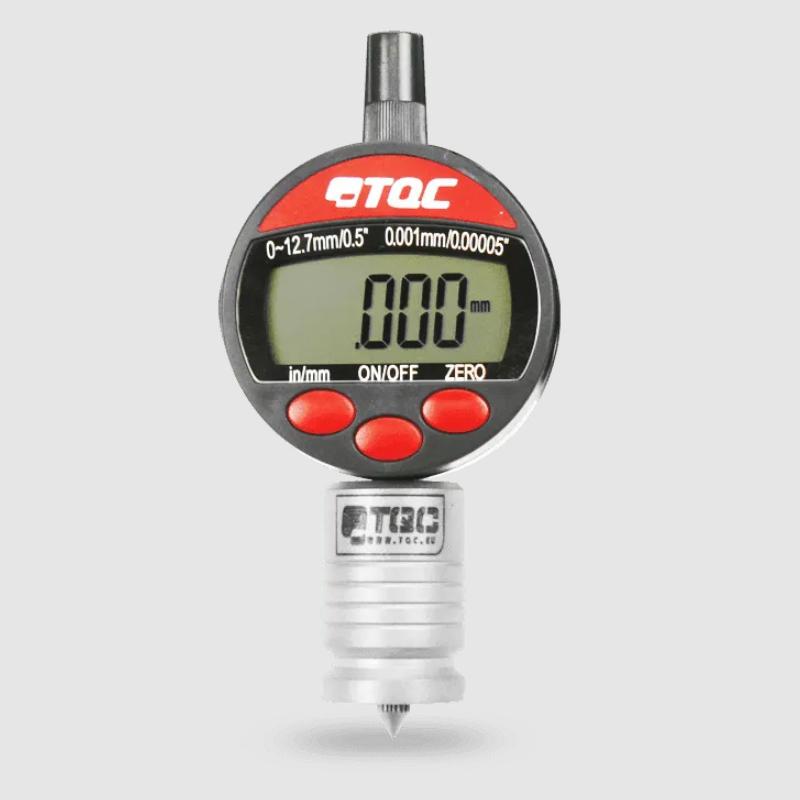

TQC SP1560 Digital display Surface Roughness Tester Coating thickness Measurement Instrument 2-in-1
SE SP1560

TQC sheen SP1560 Digital Surface Roughness TesterSPEC
TQC sheen SP1560 Digital Surface Roughness TesterDetails
TQC sheen SP1560 Digital Surface Roughness TesterPacking list
- SKU
- NB040132
- Measurement range
- 3.4mm
- Minimum scale
- 1μm
- Accuracy
- 5μm
- Probe diameter
- 8mm

The TQC Sheen SP1560 Digital Surface Roughness Tester is a combination instrument that can be equipped with two different probes, one for surface roughness testing and one for coating thickness testing.
Sharp tungsten carbide replaceable probes for surface roughness measurements, hardened round probes for coating thickness measurements, glass plates for zero calibration, and leather carry bags for everything are available.
Instrument advantages
Accurate and fast measurement of peaks and troughs on clean and rough surfaces
Comply with international standards
The thickness of the coating can be measured by placing the flat base on the lacquer surface, probing the probe and stopping at the base substrate
Corrosion craters and crack depth can be measured
Interchangeable probes are used to measure roughness
Instructions
Measure roughness
1. Press the on/off button to turn on the meter.
2. Check that the correct prompt is selected. (Sharp tip for roughness measurement)
3. Press the IN/MM button to select the parameters.
4. Place the needle of the gauge on the flat glass specimen (zero plate) and press down on the gauge along with the holder until the base of the stent stands firmly on the zero plate.
5. Press the ZERO button to make the instrument read zero.
6. Gently place the needle on the blasted surface and press the base of the gauge holder firmly against the steel. Do not drag the instrument.
7. Read peak-to-valley values.
8. Take 10 measurements at each desired location and determine the average value as the surface profile.
Measure the thickness
1. Press the on/off button to turn on the meter.
2. Check that the correct prompt is selected. (Round head is suitable for thickness measurement)
3. Press the IN/MM button to select the parameters.
4. Place the needle of the gauge on the flat glass specimen (zero plate) and press down on the gauge along with the holder until the base of the stent stands firmly on the zero plate.
5. Press the ZERO button to make the instrument read zero.
6. Gently remove a piece of paint with a diameter of 8mm from the surface. Try to remove the paint without damaging the underground material.
7. Place the needle where the paint has been removed. Make sure the aluminum base is in the painted area.
8. The coating thickness appears on the display.
Enforce the standard
ISO 2808-4B、ASTM D 4417-B、JIS K 5600-1-7、BS 3900-C5
- 1Surface roughness measurement
- 2What is surface finish?
- 3Which industries need to use surface roughness meters?
- 4Roughness and Surface Roughness
- 5Why handle the substrate? What does it do?
- 6Surface roughness of metal
- 7The relationship between abrasive and surface roughness
- 8Evaluation of steel surface roughness
- 9High-precision roughness instrument measures the surface roughness of plastic materials Case sharing [Video demonstration]
- 10Influence of surface roughness of parts
- 1GB/T 45767-2025《Silicon nitride ceramic subtrates》
- 2JJF 1105-2018《Calibration Specification for Contact(Stylus)Instruments of Surface Roughness Measurement by Profile Method》
- 3JJG 2018-1989《Measuring Instruments for Surface Roughness》
- 4GB/T 28210-2024《Thermal-sensitive paper》
- 5HB 6172-1988《General surface roughness》
- 6GB/T 42671-2023《Test method for surface roughness of carbon materials》
- 7JJG (轻工) 52-2000《Verification Regulation of Roughness Tester for Paper and Board》