
LEEB LBTQ703 Ultra-thin Piece Penetration Thickness Gauge
SE LBTQ703

Leeb LBTQ703 Ultra-thin piece penetration Thickness GaugeSPEC
Leeb LBTQ703 Ultra-thin piece penetration Thickness GaugeDetails
Leeb LBTQ703 Ultra-thin piece penetration Thickness GaugePacking list

- SKU
- NB042179
- Probe type
- single crystal
- Measurement Range
- Ordinary I-E mode: 0.15mm~ 30mm (steel) Penetration E-E mode: 0.5mm~ 10mm (steel), maximum penetration coating thickness 0.5mm
- Probe frequency
- 15M, 20M single crystal
- Display resolution
- 0.01mm、0.001mm
- Sound speed range
- 1000~9999m/s
- Display
- 128 * 64 LCD display, LED backlight
- index error
- +/- 0.005mm (below 5mm) +/- 0.01mm (5-30mm),
- Automatic shutdown
- Automatic shutdown after 5 minutes of no operation
- Ambient Operating Temperature
- -10 ℃~ + 50 ℃, up to -20 ℃ with special requirements
- Working Voltage
- Two 5 #1.5V AA batteries, when the power is insufficient, there is a low Voltage prompt
- operating time
- Alkaline batteries last up to 200 hours (without backlight)
- data storage
- 500 value storage functions
- default stored sound speed
- It can store the sound velocities of five different materials and adjust them continuously.
- Host size
- 153mm*67mm*26 mm
- Machine Weight
- 220g
- Standard configuration
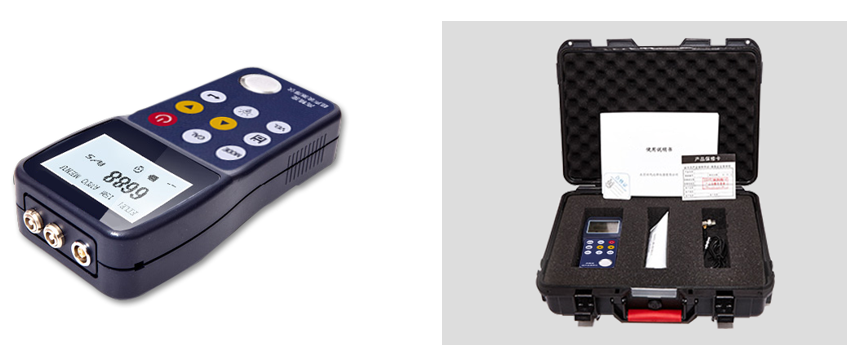
- 1 host, 1 15M single crystal probe, 1 delay block, 1 bottle of coupling agent, 2 AA batteries, and 1 set of documents.
- optional accessories
- data transmission line
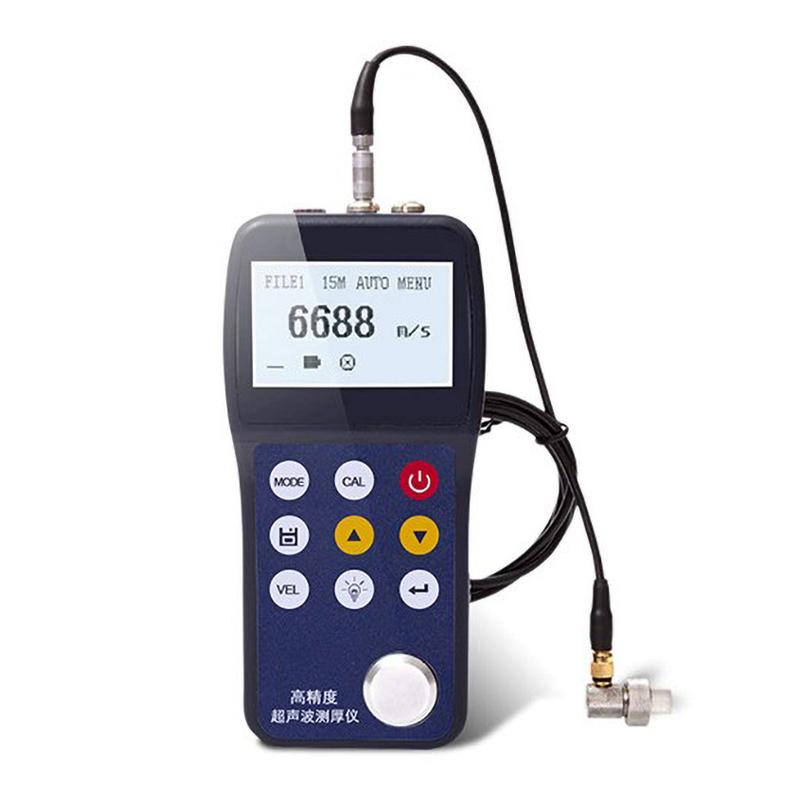
TML-730 ultra-thin piece penetration Thickness Gauge adopts the principle of ultrasonic measurement, which is suitable for measuring the thickness of materials that can make ultrasonic waves propagate in it at a constant speed and can be reflected from its back.
This instrument can accurately measure plates and processed parts. Another important aspect is that it can monitor pipelines and pressure vessels in production equipment, and monitor their thinning degree after being corroded during use. It can be used in petroleum, chemical industry, metallurgy, shipbuilding, aviation, aerospace and other fields.
The main function
● Using "echo-echo" technology, it can realize the measurement of ultra-thin parts, the minimum thickness (steel) can reach 0.15mm; on the other hand, it can realize high-precision thickness measurement, and the resolution can reach 0.001mm; it can also penetrate Surface coating thickness measures substrate thickness;
● Increase the function of measuring the thickness of the substrate through the coating;
● Two kinds of measurement: mode bottom wave-echo mode meets conventional thick workpiece measurement; echo-echo mode meets thin workpiece measurement with high accuracy);
● The probe is placed on the test block of the Thickness Gauge and the button is automatically zeroed;
● With LED backlight display, it is convenient to use in dimly lit environment;
● It has the function of sound velocity calibration (reverse measurement of sound velocity) or single-point calibration;
● Alarm setting and difference mode setting can be done;
● Metric and imperial conversion; millimeter and inch can switch units;
● The sound velocity of 5 different materials can be stored.
Applicable material
Suitable for measuring the thickness of metals (such as steel, cast iron, aluminum, copper, etc.), plastics, ceramics, glass, glass, fiberglass and other good conductors of ultrasonic waves.
Fundamental
The principle of ultrasonic measurement of thickness is similar to that of light wave measurement. The ultrasonic pulse emitted by the probe reaches the object under test and propagates in the object. When it reaches the material interface, it is reflected back to the probe. The thickness of the material under test can be determined by accurately measuring the time that the ultrasonic wave travels in the material.
- 1Application, Principle Introduction and Precautions for Selection of Pipeline Thickness Gauges
- 2The Principle, Application and Precautions of Copper Plate Ultrasonic Thickness Gauge
- 3Principle, Application and Selection of Ceramic Ultrasonic Thickness Gauge
- 4Principle, Application and Type Selection of Ultrasonic Thickness Gauge
- 5Principle, Application and Type Selection of Ultrasonic Thickness Gauge