
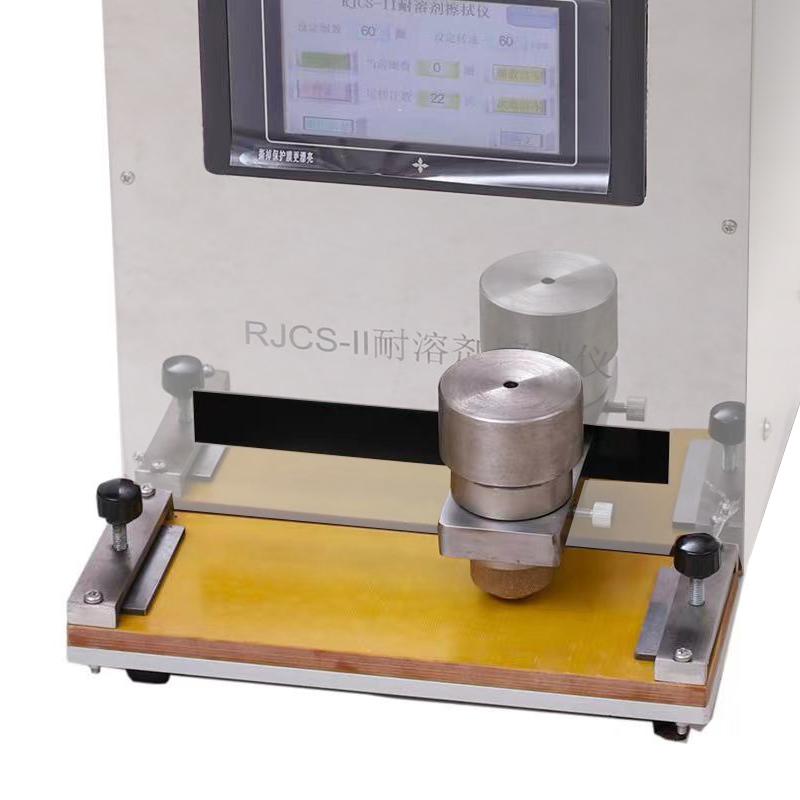

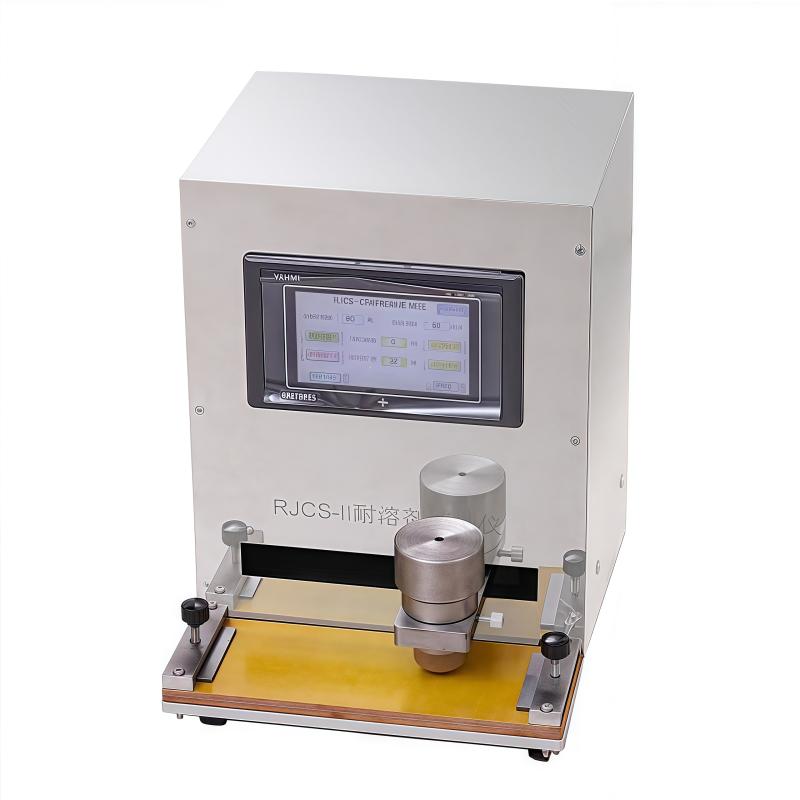
JINGKELIAN RJCS-II Solvent Rub Resistance Tester
SE RJCS-II

JingKeLian RJCS-II Resistance to solvent TesterSPEC
JingKeLian RJCS-II Resistance to solvent TesterDetails
JingKeLian RJCS-II Resistance to solvent TesterPacking list
- SKU
- NB042181
- erasure stroke
- 120±5mm
- erasure frequency
- 100cpm
- friction load
- 1000±10g
- Grinding head area
- 2cm²±0.5mm
- Wiping pressure on the test plate
- 0.06Mpa
- Specimen size
- 75*200mm
- Power Supply
- 220V 50Hz
- Dimensions
- 260*260*340mm
- Weight
- About 20kg
Introduction
Solvent Wipe Resistance Tester is a device used to measure the solvent wipe resistance of coatings. Use a wiping head with a certain speed and wiping pressure (absorbent cotton wetted with a solvent when in contact with bread) to wipe back and forth on the surface of the sample. The number of times of wiping can be directly read on the display screen. times and rotational speeds), the solvent wiping resistance of the coating can be evaluated.
Instructions
1. Unscrew the fastening bolts on the sample fixtures at both ends, place the 75×200mm sample under the rubber fixing plate, and then tighten the fastening bolts.
2. Take an appropriate amount of absorbent cotton and wrap it on the contact surface of the wiping head, install the hoop, tighten the fixing screws, then take an appropriate amount of absorbent cotton, put it into the inner cavity of the wiping head, and drop an appropriate amount of solvent until the wiping head has solvent oozing out. The wiper head is placed on the slide arm.
3. Plug in the power supply, set the number on the display screen, and select the number of times you want to wipe; press the speed control button to select the desired wiping speed (recommended 100 times/min, that is, press the start button).
4. Turn on the power switch of the touch screen, and the machine starts to work. After reaching the predetermined number of times, the machine stops automatically, and the sample is removed for observation.
5. If you want to stop the machine during operation, you can directly turn off the power switch of the governor, and then turn on the power switch of the touch screen to continue working.
6. After the machine stops automatically, just press the "Reset" button on the counter, and the machine can run again.
Precautions
1. It is strictly forbidden to start the machine when the sample and absorbent cotton are not installed.
2. If the absorbent cotton falls off, stop the machine as soon as possible.
- 1ASTM D7835/D7835M-23《Standard Test Method for Determining the Solvent Resistance of an Organic Coating Using a Mechanical Rubbing Machine》
- 2SJ 20910A-2018《General specification for powder spraying coating》
- 3JB/T 4279.10-2008《Verification procedure for test equipment of enamelled winding wire.Part 10:Tester for resistance to solvents》
- 4GB/T 39373-2020《Leather—Tests for colour fastness—Colour fastness to solvents》
- 5GB/T 13448-2019《Test methods for prepainted steel sheet and strip》
- 6GB/T 17737.205-2018《Coaxial communication cables—Part 1-205: Environmental test methods—Resistance to solvents and contaminating fluids》
- 7ASTM D5402-2019《Standard Practice for Assessing the Solvent Resistance of Organic Coatings Using Solvent Rubs》
- 8GB/T 5211.9-1985《Method for the determination of resistance to solvent of pigments》
- 9HG/T 4846-2015《Waterborne inorganic phosphate solvent resistant anti-corrosion coatings》
- 10GB/T 13448-2006《Test methods for Prepainted Steel Sheet》