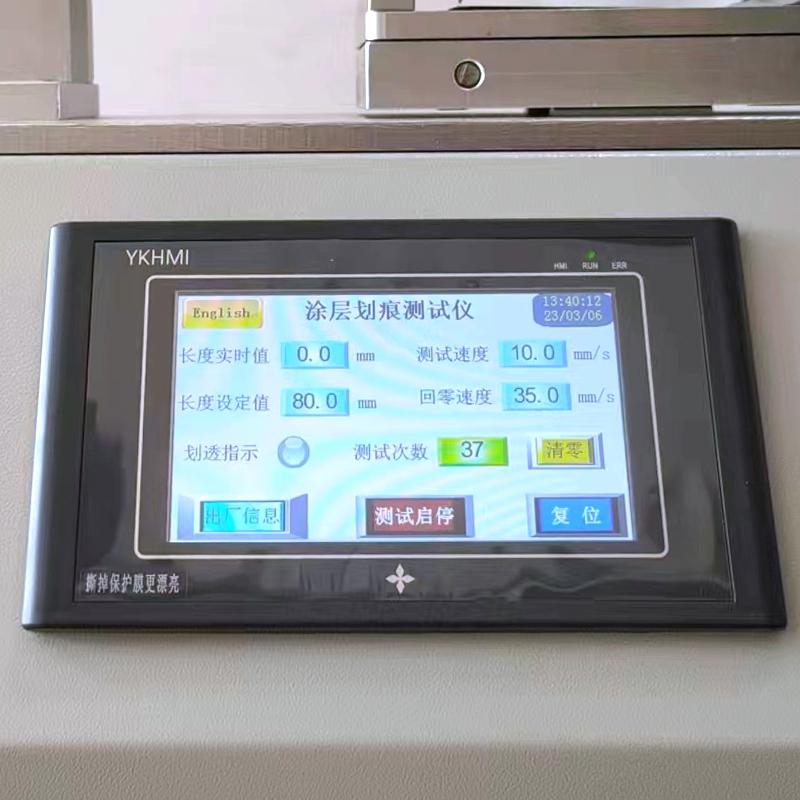
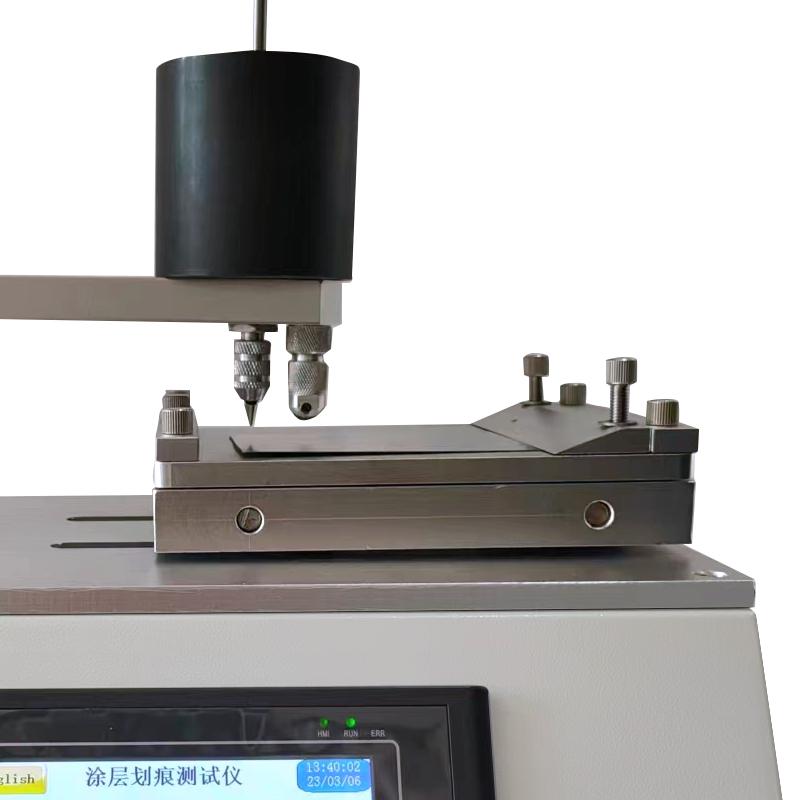
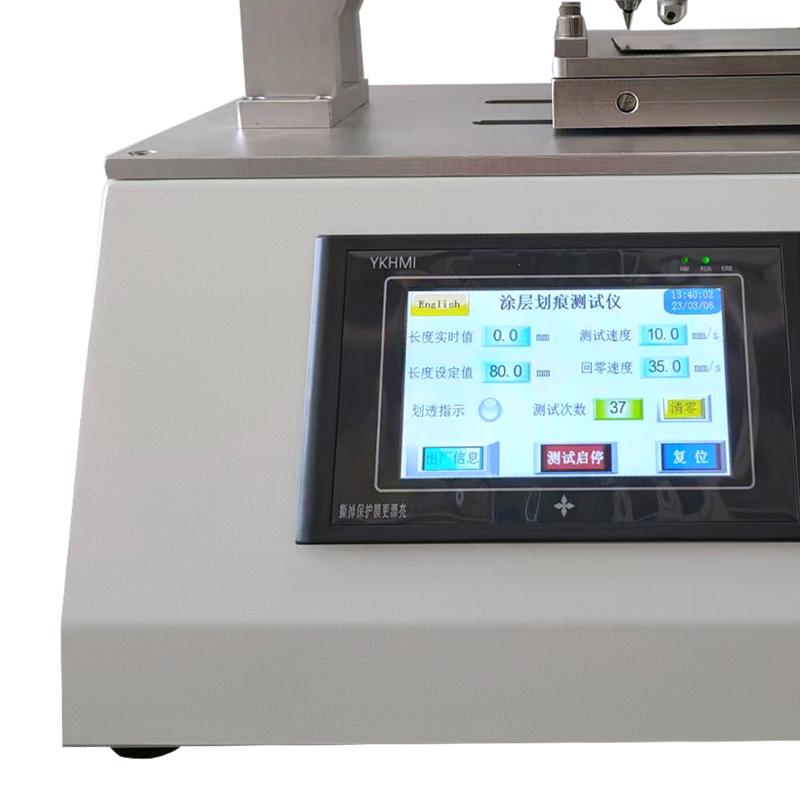
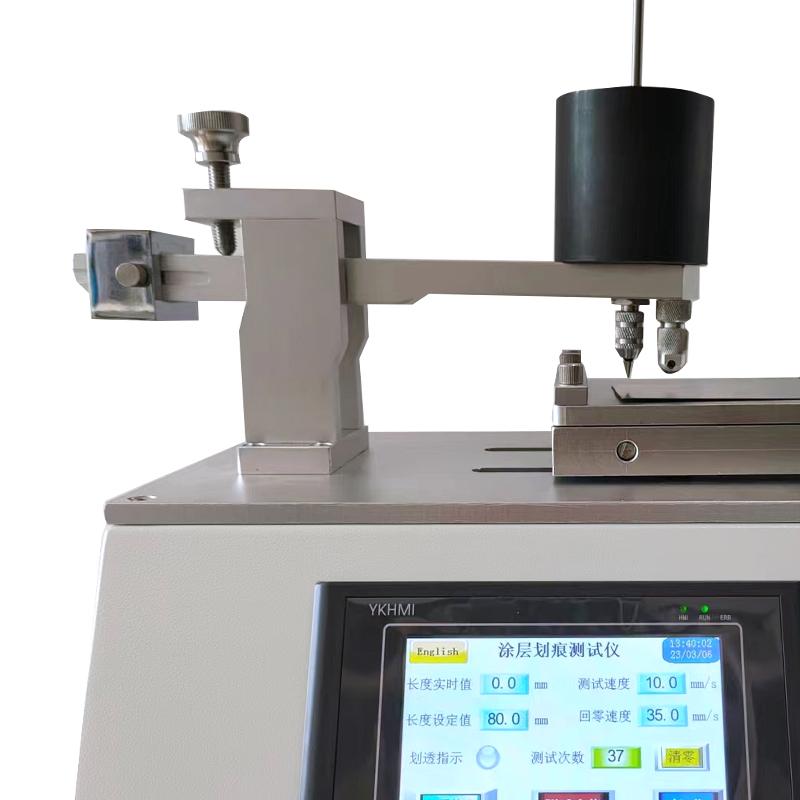

JINGKELIAN DHZ Digital Automatic Scratch Tester
SE DHZ
DHZ


JingKeLian DHZ Scratch TesterSPEC
JingKeLian DHZ Scratch TesterDetails
JingKeLian DHZ Scratch TesterPacking list

- SKU
- NB042184
- Scribe length
- ≥60mm
- Test bench traverse speed
- 0~40mm/s
- Scribe ball diameter
- 1mm
- Load (loading) range
- 0~4000g
- Top bar lower end tilt angle
- 10~15°
- minimum increment
- 50g
- Motor Power
- 30w
- Power supply Voltage
- 220V 50Hz
- Dimension
- 180*230*280mm
- instrument Weight
- 15kg

1. Purpose
Coating film strength, hardness, adhesion, etc. are important physical properties of the coating film, and their size directly affects the important performance of the coating film, such as: abrasion resistance; abrasive resistance; scratch resistance; impact resistance and The retention effect of the coating film and the difficulty of cleaning, etc., so the strength and hardness of the coating film are the necessary indicators to evaluate the performance of the coating. Using this instrument can conveniently and comprehensively evaluate the physical properties of the coating film such as strength, hardness, and adhesion. Layer strength, hardness, and adhesion.
This instrument is a special equipment developed for the implementation of GB9279, and it is a condition for the implementation of this national standard.
2. Principle
The instrument is controlled by a digital touch screen, easy to operate, automatic and flexible. The test length, test speed and return speed can be set arbitrarily within the scope of the instrument. It is mainly composed of a needle holder and a worktable. The needle on the needle holder is guaranteed to be vertical The ground acts on the coating film model (the model is fixed on the experimental table on the workbench and can be moved horizontally or vertically;).
3. Requirements for use
1. Coating film sample: prepared according to GB9271-88, the specification is: 120*50mm
2. Experimental environment: temperature 23±2°C, Relative Humidity: 50±5% (refer to GB9278-88)
4. How to use
A. to prepare
1. Prepare 120*50mm (0.2-8mm thick) smooth tinplate according to the requirements of GB1727-79 or prepare a paint film on the bottom plate according to the requirements of the exhibits. The instrument can place 120*200 test panels and various floors with 1-20 thickness.
2. Check the instrument
(1) Turn on the power supply (220V)
(2) Press the main switch (power switch) and then click the test switch until the test bench moves laterally (to the right) to the right end, press the reset button, and the test bench moves laterally (to the left) to the right end to stop. Note: Click the test button to stop during the running, and the test can only be continued after reset.
3. Insert a new stylus at the place where the stylus is installed. The stylus should be checked with a 30 times magnifying glass. There must be no scratches, rounds, rust spots and other defects. The height of the stylus installation should be appropriate.
4. Clamp the template into the sample holder of the test bench, with the coating film facing up, turn the longitudinal handle to move the test bench to the far end (the test bench and the worktable are flush) as the initial position.
5. Put the smallest weight (50g) or a slightly smaller load weight that is planned to break the coating film on the weight table.
B. to test
1. Press the test start-stop button, draw the needle across the sample board, and observe with your eyes whether it is scratched. If it is not scratched, press the switch to reset, so that the test bench returns to the left end, and then micro-adjusts the board (the drawn first It is enough that the two scratches do not overlap on the first scratch), and at the same time, it is necessary to replace the scratch needle with a new one, the inspection method is the same as before, and replace the heavier weight on the weight platform Everything is ready for the second scratch.
2. Repeat the above test until the coating film is scratched. You can also use a 10 times magnifying glass to observe whether the scratch scratches the coating film to expose the bottom plate. The scratch length of the scratched part should be greater than 20mm). At this time, the weight of the weight is the coating Scratch resistance of the film (measured by this method).
3. Use the measured load to repeat this test step on the original sample and a new sample. After the results are consistent, then determine the distance of scratching through the sample. The minimum load value is the scratch resistance value of this kind of coating film.
When the measured load values are different, the average value of the three load values is taken as the scratch resistance value of the coating film.
5. Maintenance
1. When using this instrument, strive to rotate flexibly, and pay attention to lubrication (oil should be injected between the rotating part and the non-rotating part and between the relative moving parts);
2. After using the instrument for a period of time, it is necessary to fully check the fasteners to prevent loosening;
3. When the instrument is not in use, pay attention to dustproof, moistureproof, corrosionproof, vibration and collision.
6. Accessories
1. A box of weights (one set): two pieces of 50g; two pieces of 100g; one piece of 200g; three pieces of 500g; two pieces of 1000g, or one piece of 2000.
2. Two magnifying glasses, one at 30 times and one at 10 times (self-provided)
3. A box of marking needles: 10 pieces.
- 1ISO FDIS 1518-2010《Paints and varnishes. Scratch test》
- 2 1518-2010《Paints and varnishes. Scratch test》
- 3ISO 1518-1-2023《Paints And Varnishes - Determination Of Scratch Resistance - Part 1: Constant-Loading Method》
- 4ISO 4628-8-2012《Paints and varnish coatings - Assessment of ageing - Number and size of defects and assessment of uniformly varying strength in Appearance - Part 8: Assessment of disbonding and corrosion around scratches》