
PINGXUAN kinematic viscosity Tester PXWSN-265c
 PXWSN-265c

PingXuan PXWSN-265c Kinematic viscosity TesterSPEC
PingXuan PXWSN-265c Kinematic viscosity TesterDetails
PingXuan PXWSN-265c Kinematic viscosity TesterPacking list

- SKU
- NB042252
- Temperature range
- RT+~100℃
- Power of stirring motor
- 6W
- Tank Volume
- Φ300*300mm
- opening diameter
- 65mmx4
- Fluctuation
- 0.05
- Resolution
- 0.01
- Power
- AC 220V±10% 50Hz
- Sample testing
- At the same time, four samples were tested at a time, a group of 4, respectively 0.5, 1.2, 1.0, 1.2
- Temperature sensor
- high-precision thermistor
- Power consumption of the whole machine
- Not more than 1800W
- Environment Relative Humidity
- ≤85%
- Environment Operating temperature
- -10℃~+35℃
- Rotation speed
- 1200rpm
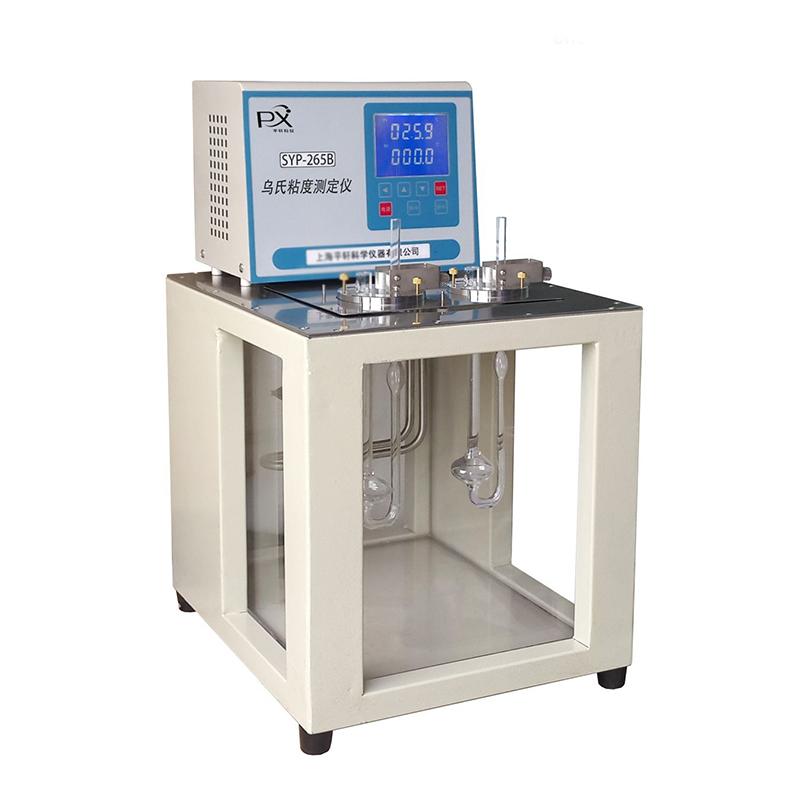
Introduction
Kinematic viscosity Tester This instrument is manufactured in compliance with the requirements stipulated in the People's Republic of CHINA industry standard SY/T 5651 "Technical Conditions for Petroleum Product Kinematic Viscosity Tester" and is suitable for use in accordance with the People's Republic of CHINA standard GB/T 265 "Petroleum Product Kinematic Viscosity Tester". According to the provisions of "Method for Calculation of Dynamic Viscosity", the kinematic viscosity value of liquid petroleum products (referring to Newtonian liquid) under a certain constant temperature condition is determined.
Main technical features
It adopts five temperature control modes of 20, 40, 50 and 80, and the temperature control accuracy reaches ±0.01℃.
Using imported acrylic glass, it has good thermal insulation performance and clear observation of the sample.
Adopting desktop and all-in-one design, the instrument has good integrity and is easy to use.
Using an electric stirring device, the temperature in the bathtub is even.
operating procedures
Place it on the workbench and adjust the four bottom corner screws so that the upper cover is in a horizontal position.
Install the power cord, sensor, and thermometer.
Add water to the bathtub so that the water surface is about 5cm from the upper end of the bathtub. If the temperature control point of 100℃ is used, glycerin can be added to the bathtub.
Turn on the power, the indicator light turns on, and the screen first displays the welcome interface: press the "Enter" key to enter.
Enter the parameter setting interface: After the cursor is fixed, you can press the value increase (â) or decrease (â) key to adjust the required value.
Enter the Water Bath heating prompt interface and wait for the interface without any key operations. When the temperature rises and falls to 0.05°C higher than the set temperature, it automatically switches to the next operation interface.
Entering the capillary placement prompt waiting interface means that the Water Bath has entered the constant temperature maintenance state.
Enter the static waiting interface, and a positive timing clock starting from zero will appear, with a maximum display time of hours to record the static time.
Precautions
The bath fluid in the bathtub should be free of impurities and floating objects to avoid clogging the test holes. New bath fluids often have bubbles when heated, which will have an impact on the test, especially if there are bubbles in the test holes, the impact is most serious. After placing the capillary tube, check whether there are air bubbles in the test hole. If there are bubbles, use a hose to blow them out.
Before use, it needs to be reliably grounded.
The time interval between restarting the instrument and using it is more than 15 minutes. When the instrument is turned on in the cold bath state, it will take 45 minutes before it can be used.
When using a full immersion thermometer to correct the temperature, the effective scale of the thermometer must not be exposed to the liquid surface of the constant temperature bath.
The instrument is not allowed to be stored or used in humid or corrosive gas environments.
When clamping the capillary tube, pay attention to the height of the upper opening to prevent water from entering the test tube.
- 1 0928-2016《Standard test method for apparent viscosity of asphalt emulsion residues by vacuum capillary viscometer》
- 2 0703-2020《Standard test method for measuring apparent viscosity at high-temperature and high-shear rate by multicell capillary viscometer》
- 3HG/T 4300-2012《Rubber.Measurement of rheological properties.Piston type capillary rheometer methods》
- 4JB/T 11945-2014《The technical conditions and test evaluation method for auto kinematic viscosity tester》
- 5 172-2021《Vacuum Capillary Viscometer of Asphalts》
- 6ASTM D2171/D2171M-2018《Standard Test Method for Viscosity of Asphalts by Vacuum Capillary Viscometer》
- 7SH/T 0557-1993《Viscosity determination of petroleum asphalt (vacuum capillary method)》
- 8 1799-2005《Petroleum products.calculation of viscosity index from kinematic viscosity》
- 9SH/T 《Specifications for Glass Capillary Viscometer》
- 10GB/T 1632.3-2010《Plastics - Determination of the viscosity of polymers in dilute solution using capillary viscometer - part3: Polyethylenes and polypropylenes》