
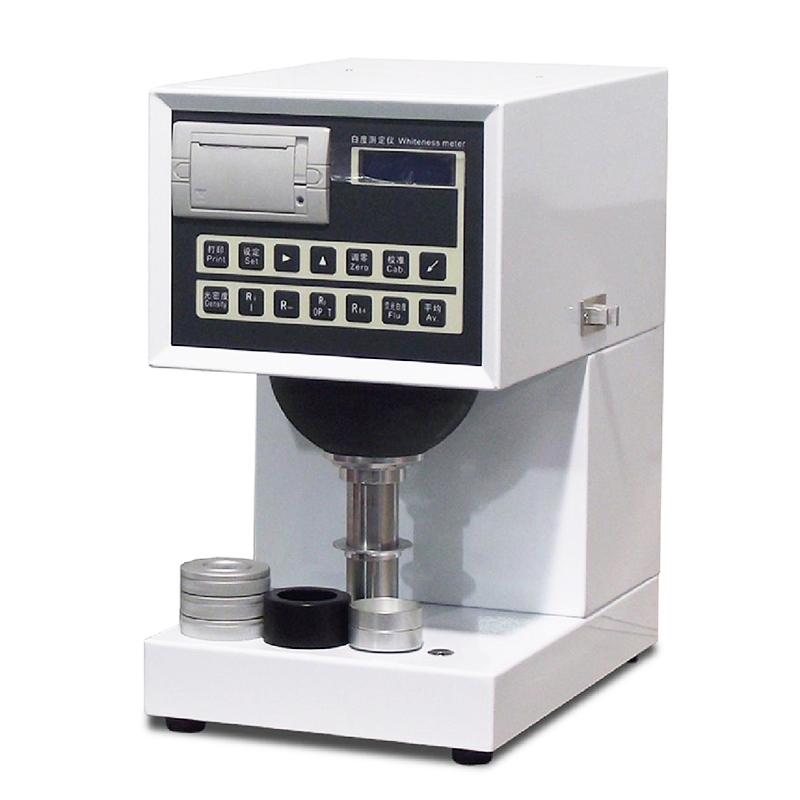
CHENCHI BD-48 paper Whiteness meter measurement aperture Φ30mm
SE BD-48
BD-48

LABCHEN BD-48 Whiteness MeterSPEC
LABCHEN BD-48 Whiteness MeterDetails
LABCHEN BD-48 Whiteness MeterPacking list

- SKU
- NB042688
- Light source
- D65 Light source
- Whiteness means
- R457 Blu-ray Whiteness
- Zero drift
- ≤0.1
- Repeatability Error
- ≤0.1
- Mirror reflection error
- ≤0.1
- Film thickness
- ≤40mm
- Operating Environment
- Temperature 0~40 ℃, Humidity ≤ 85%
- Illumination conditions
- d/o
- Measurement aperture
- F30mm
- Indication drift
- ≤0.1
- Error of indication
- ≤0.5
- Specimen size
- ≥ F30mm
- Dimensions
- 365×260×425mm
- Weight
- 11kg
Applications
It is mainly suitable for measuring the whiteness of various objects such as paper and cardboard, pulp and chemical fiber pulp, cotton and chemical fiber, textiles, plastics, ceramics, porcelain, starch, salt, white cement, china clay, and talcum powder. Optical properties such as opacity of thin sheet materials can also be measured.
Measure the blue light diffuse reflection factor (R457) of the sample, which is called "blue light whiteness" or "ISO whiteness" (ISO Brightness).
Analyze whether the sample material contains fluorescent whitening agent, and measure the fluorescent whiteness produced by fluorescent emission, that is, the whitening degree.
Measure the brightness stimulus value Y10 of the sample, that is, the green light diffuse reflection factor Ry, and the Y10 optical system conforms to GB3979-83 "Methods for Measuring Object Color".
Determine the opacity, transparency, light scattering coefficient and light absorption coefficient of the sample.
Determination of ink absorption values for paper and board.
Measure and digitally display whiteness, fluorescent (whitening) whiteness, opacity, etc., with a built-in micro-printer, which can directly print the test results.
Conforms to GB3978-83 "Standard Illumination Body and Illumination Observation Conditions", simulates D65 illumination body illumination, adopts d/o illumination observation geometric conditions, the diameter of the diffusion ball is 150mm, the diameter of the test hole is 30mm, and a light absorber is installed to eliminate the sample The effect of specular light. The peak wavelength of the spectral power distribution of the R457 whiteness optical system is 457nm, and the full width at half maximum is 44 nm.
Executive standard
GB7973, GB7974, ISO 2470, GB8940.1, GB8940.2, GB1840, GB2913, GB13025.2, GB1543, ISO2471, GB10339, GB/T5950