
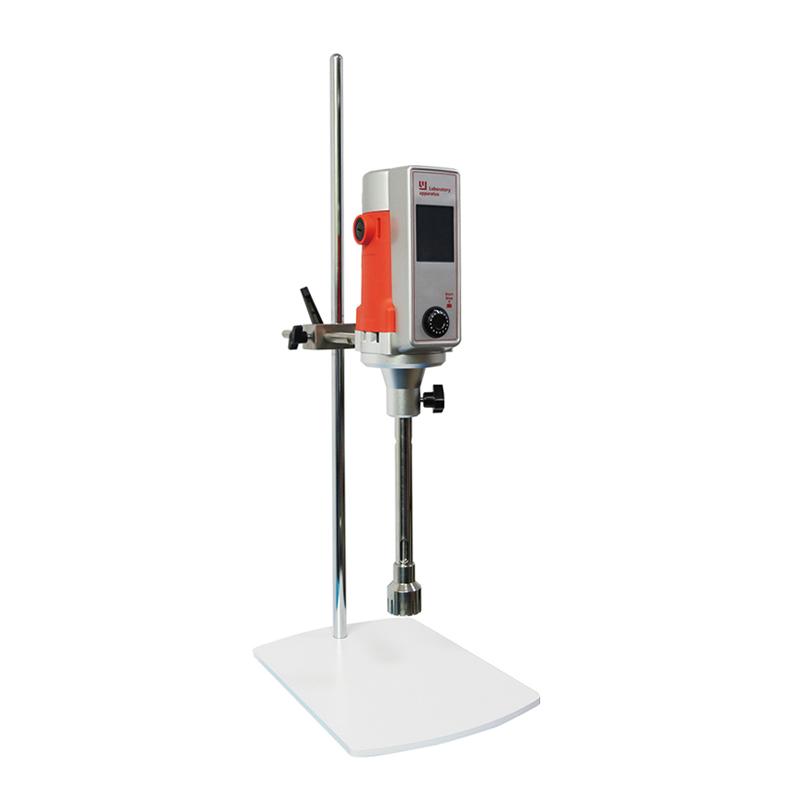
LANYU LYD500W-T Touch Homogenizer (220V)
SE LYD500W-T

LanYu LYD500W-T Touch Type Homogenizer (220V)SPEC
LanYu LYD500W-T Touch Type Homogenizer (220V)Details
LanYu LYD500W-T Touch Type Homogenizer (220V)Packing list

- SKU
- NB045694
What is a homogenizer
A homogenizer is a type of laboratory equipment used to mix, evenly disperse, emulsify, and pulverize samples, with high-speed movements and high pressures to process samples.
What are the applications of homogenizers
In cytology research, it is used for cell disruption and cell lysis to extract biomolecules such as DNA and RNA. In food processing, homogenizers are widely used to prepare dairy products, sauces, jams, etc., to improve the texture and taste of food. In addition, homogenizers can be used to mix solutions, disperse particles, and achieve uniform chemical reactions.
What are the characteristics of the homogenizer
The homogenizer is able to achieve a delicate and homogeneous effect on the sample through high-speed movement or high pressure, and is especially suitable for particle dissolution and substance mixing. The homogenizer has a variety of functions such as emulsification, dispersion, and grinding, which is suitable for the experimental needs of different fields, and provides efficient and versatile sample processing. Some homogenizers are equipped with high-pressure homogenization for difficult-to-homogenize samples, providing a more robust homogenization effect. Equipped with a digital display screen, real-time display of operating parameters, convenient for users to monitor and adjust. In terms of safety and stability, some homogenizers are often equipped with safety functions such as overload protection and overheat protection to ensure the safe operation of the equipment.
How to choose the right homogenizer
When choosing a homogenizer, it is necessary to choose the appropriate capacity homogenizer according to the volume of the experimental sample. Considering the hardness of the sample, select a homogenizer with the appropriate pressure and speed. Depending on the needs of the laboratory, choose a homogenizer with manual or automatic control. Consider the speed range to meet the needs of different experimental conditions. In terms of cleaning and maintenance, it is necessary to consider that the equipment is easy to clean and maintain, so as to ensure the hygiene of the experiment and the reliability of the equipment. In addition, it is necessary to select the power and configuration of the homogenizer according to the needs of the experiment to obtain the desired homogenization effect.
Parameters of the dispersed emulsification head:
| Specifications of the working head | 12G | 18G | 24G | 30G | 36G |
| Throughput (H2O) | 30~800ml | 50~1500ml | 80~5000ml | 100~8000ml | 150~13000ml |
| Suitable for maximum viscosity | 1000mPa.s | 2000mPa.s | 5000mPa.s | 6000mPa.s | 7000mPa.s |
| Use the highest temperature | 120℃ | 120℃ | 120℃ | 120℃ | 120℃ |
| Overall length | 215mm | 222mm | 225mm | 235mm | 238mm |
| Stator diameter | 12mm | 18mm | 24mm | 30mm | 36mm |
| Head Material | SS316 | SS316 | SS316 | SS 316 | SS316 |
| Bearing material | PTFE | PTFE | PTFE | PTFE | PTFE |
| Maximum linear speed of the rotor | 12m/s | 15m/s | 18m/s | 22m/s | 26m/s |
| Minimum immersion in liquid | 35mm | 45mm | 50mm | 60mm | 65mm |
| Maximum immersion height of liquid | 150mm | 160mm | 165mm | 170mm | 175mm |