
LANYU LYE500W-T (90G) Touch Mulser (220V)
SE LYE500W-T(90G)

LanYu LYE500W-T(90G) Touch Mulser (220V)SPEC
LanYu LYE500W-T(90G) Touch Mulser (220V)Details
LanYu LYE500W-T(90G) Touch Mulser (220V)Packing list

- SKU
- NB045698
- Rated Voltage
- AC220V
- Rated Frequency
- 50/60Hz
- Input Power
- 1200W
- output power
- 600W
- Rated torque
- 45N.cm
- Duty Cycle
- S1 (continuous)
- Operation control method
- Touch knob
- Speed range
- 1000~13000rpm
- Rotation speed Control mode
- stepless
- Rotation speed digital display
- TFT-LCD
- Timer Range
- 1~1000min
- Real-time torque Linear dispersion display
- Yes
- Real-time Current and Power Display
- Yes
- Real-time overload protection
- Yes
- Work head Max Torque
- 70N.cm
- Rotor maximum linear speed
- 22m/s
- Work head material
- SS304 stainless steel
- Working head diameter
- 90mm
- Minimum immersion liquid height
- 50mm
- Maximum immersion liquid height
- 236mm
- Stator standard configuration
- 5mm² 20mm² 50mm²
- Processing Capacity
- 800~60000ml
- Max. Processing Viscosity
- 8000mPa.s
- Environmental temperature
- Not more than 40 ℃
- Allowable Relative Humidity
- Not more than 80%
- Dimension
- 215x310x700mm
- Machine Weight
- 10kg
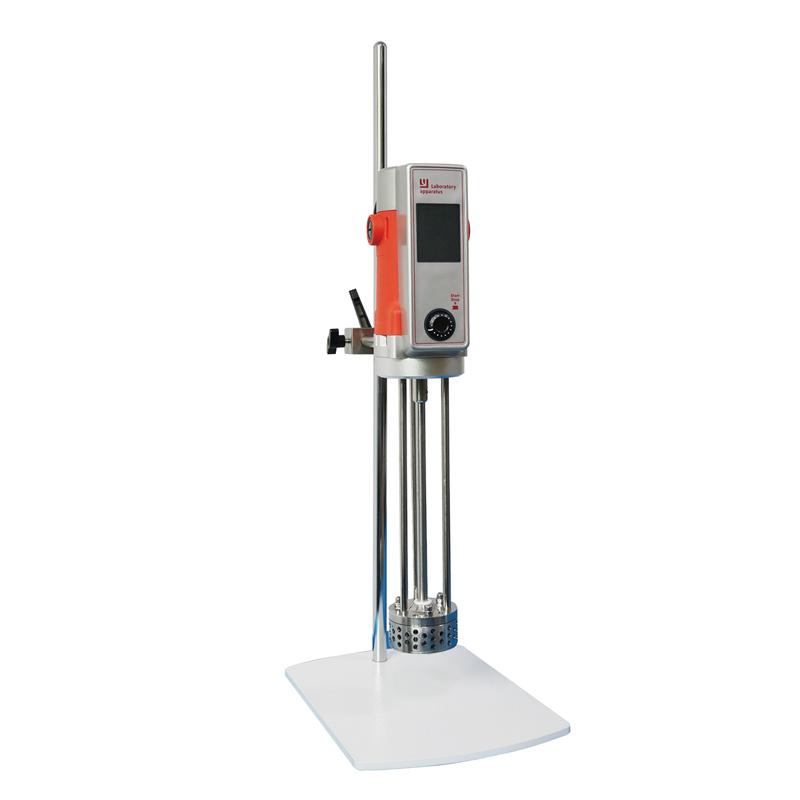
What is a laboratory emulsifier
Laboratory emulsifier is a device used to form a stable emulsion by mixing two immiscible liquids through high-speed stirring and the action of an emulsifying head.
What are the uses of laboratory emulsifiers?
Used in emulsified suspensions and used in food processing, such as the preparation of dairy products, sauces, salad dressings, etc. In chemical experiments, it is used to mix and emulsify incompatible liquids and promote reactions. Used to prepare lotions and cream products in cosmetics.
What are the characteristics of laboratory emulsifiers?
The laboratory emulsifier uses a high-speed rotating or high-frequency oscillating emulsifying head to fully mix incompatible liquids and form fine emulsified droplets to improve the emulsification effect. The equipment is designed to produce stable emulsions, ensuring that the mixture remains homogeneous over a longer period of time. Equipped with a digital display that provides real-time mixing parameters, such as speed, time, etc., making it easy for users to monitor and adjust. The emulsifier is suitable for experimental needs in different fields and can emulsify liquids of different volumes and types. Corrosion-resistant materials are usually used to adapt to the emulsification treatment of different samples. The equipment is simple in design, easy to clean and maintain, ensuring experimental hygiene and equipment reliability.
What issues should be considered when choosing a laboratory emulsifier?
Select an emulsifier with appropriate capacity based on the volume of the experimental sample. Select the degree and speed of emulsification according to experimental needs to meet the needs of different experimental conditions. Consider the specific needs of the laboratory and choose an emulsifier with manual or automatic control. Consider the speed range of the equipment to adapt to the emulsification needs of different samples. Choose a design that is easy to clean and maintain to ensure experimental hygiene and equipment reliability.