
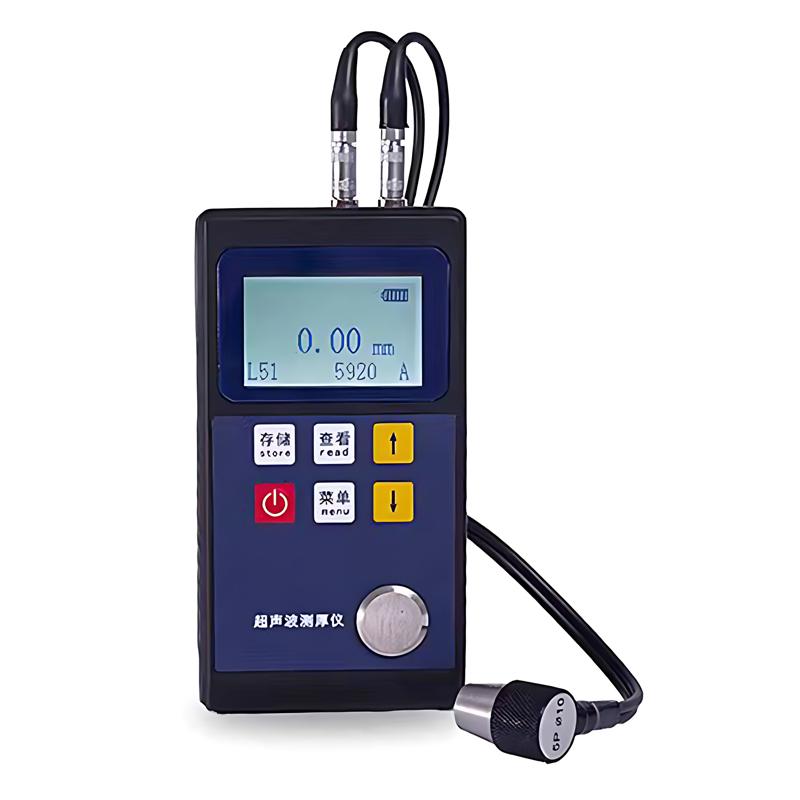
LEEB TT300 Ultrasonic Thickness Gauge Measurement range 1-250mm
SE TT300 (plastic housing)

Leeb TT300 (plastic housing) Ultrasonic Thickness GaugeSPEC
Leeb TT300 (plastic housing) Ultrasonic Thickness GaugeDetails
Leeb TT300 (plastic housing) Ultrasonic Thickness GaugePacking list

- SKU
- NB047100
- Measurement Range
- 0.75~ 350Mm (steel, determined by the probe); standard probe Measurement Range 1-250mm
- Display resolution
- 0.01mm
- Sound speed range
- 1000~9999m/s
- Storage
- 200 sets
- surface temperature
- -10~60℃
- error of indication
- +/- (1% H + 0.1) mm, H is the actual film thickness of the measured object
- Power Supply
- AAA type alkaline battery (2 pcs)
- operating time
- About 200 hours
- Host size
- 130X70X25mm
- Weight
- About 0.2kg (main engine)
- Standard configuration
- Host, L51 probe, AAA alkaline battery, coupling agent, PC communication
Introduction
The TT300 ultrasonic Thickness Gauge has a plastic housing and uses the ultrasonic measurement principle to measure the thickness of the material that allows the ultrasonic waves to propagate inside it at a constant speed and reflect it from the back of the body. The principle of ultrasonic thickness measurement is similar to that of light wave measurement. The ultrasonic pulses emitted by the probe reach the object to be measured and propagate through the object, and are reflected back to the probe when they reach the material interface, and the thickness of the material to be measured is determined by accurately measuring the time it takes for the ultrasonic waves to propagate through the material.
Scope of application
Another important aspect of this instrument is the ability to accurately measure sheets and machined parts, as well as the monitoring of pipes and pressure vessels in production equipment and the degree of thinning they have been corroded during use. It can be applied to petroleum, chemical industry, metallurgy, shipbuilding, aviation, aerospace and other fields.
It is suitable for measuring the thickness of metals (e.g. steel, cast iron, aluminum, copper, etc.), plastics, ceramics, glass, glass, fiberglass and other ultrasonic conductors.
Features
Automatic calibration of the zero point, which can be corrected for systematic errors:
The upper and lower limits can be set to exceed the alarm and data transmission;
RS232 interface, can be connected with PC;
Voltage prompt, automatic shutdown;
Large-screen LCD backlit display with adjustable contrast;
Measuring unit: Metric/Imperial optional; Has a snap mode;
Measured values can be stored and deleted;
The velocity of sound can be reversed according to the known thickness; Two-point calibration, which can improve high accuracy;
Metal housing, shielded from interference;
Suitable for measuring metals, plastics, ceramics, glass, and other ultrasonic conductors.
Comparison table of sound velocity of various materials
| material | Sound velocity (m/s) |
| aluminium | 6340--6400 |
| steel | 5920 |
| stainless steel | 5740 |
| brass | 4399 |
| copper | 4720 |
| iron | 5930 |
| cast iron | 4400--5820 |
| lead | 2400 |
| nylon | 2680 |
| silver | 3607 |
| gold | 3251 |
| zinc | 4170 |
| titanium | 5990 |
| tin | 2960 |
| Acrylic resin | 2760 |
| epoxy resin | 2540 |
| ice | 3988 |
| nickel | 5639 |
| Plexiglas | 2692 |
| polystyrene | 2337 |
| ceramics | 5842 |
| polyvinyl chloride | 2388 |
| quartz | 5639 |
| Vulcanized rubber | 2311 |
| polytetrafluoroethylene | 1422 |
| water | 1473 |
- 1Analysis of Factors Affecting the Accuracy of Ultrasonic Thickness Gauge
- 2Principle, Function, Application and Selection of Multifunctional Ultrasonic Thickness Gauge
- 3How does an ultrasonic Thickness Gauge work?
- 4Principle, Application and Selection of Ceramic Ultrasonic Thickness Gauge
- 5Principle of Portable Ultrasonic Thickness Gauge
- 6Principle, Application and Type Selection of Ultrasonic Thickness Gauge
- 7Principle, Application and Type Selection of Ultrasonic Thickness Gauge
- 8Measurement principle and influencing factors of high temperature ultrasonic Thickness Gauge
- 9The Principle, Application and Precautions of Copper Plate Ultrasonic Thickness Gauge
- 10Principle, Application and Type Selection of Ultrasonic Thickness Gauge