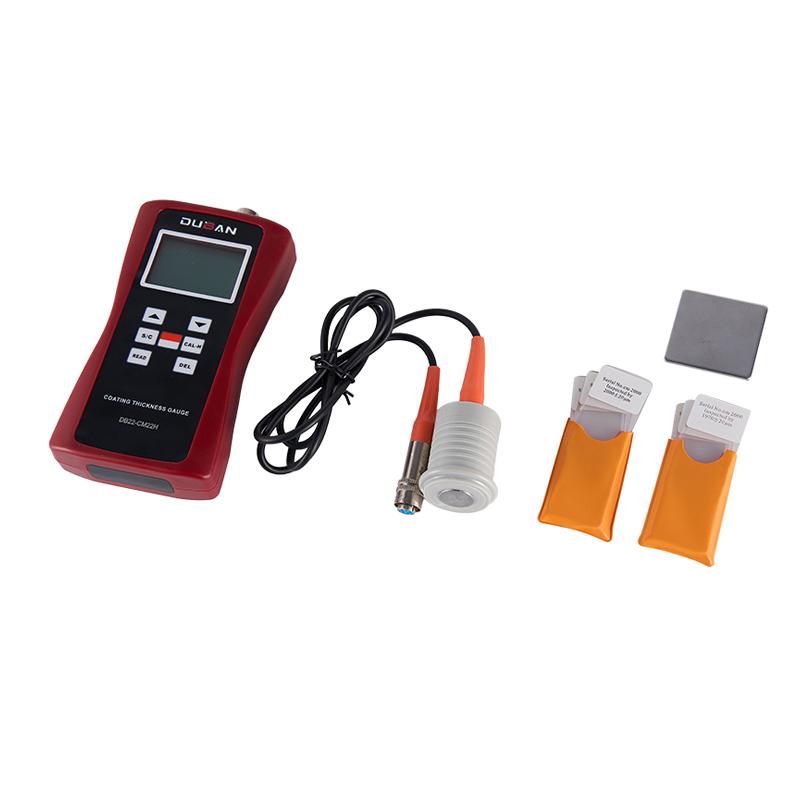
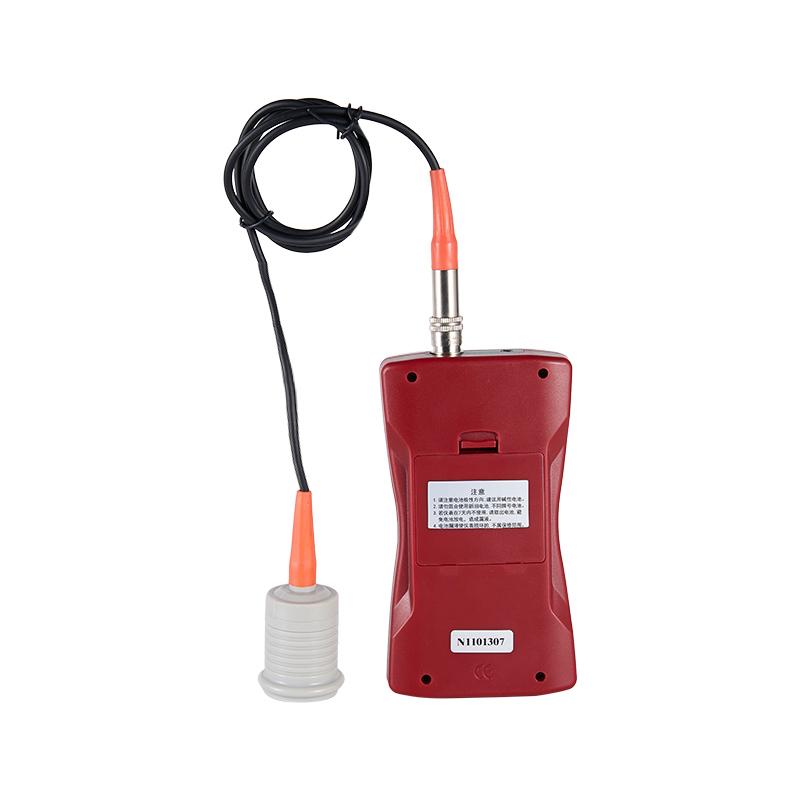
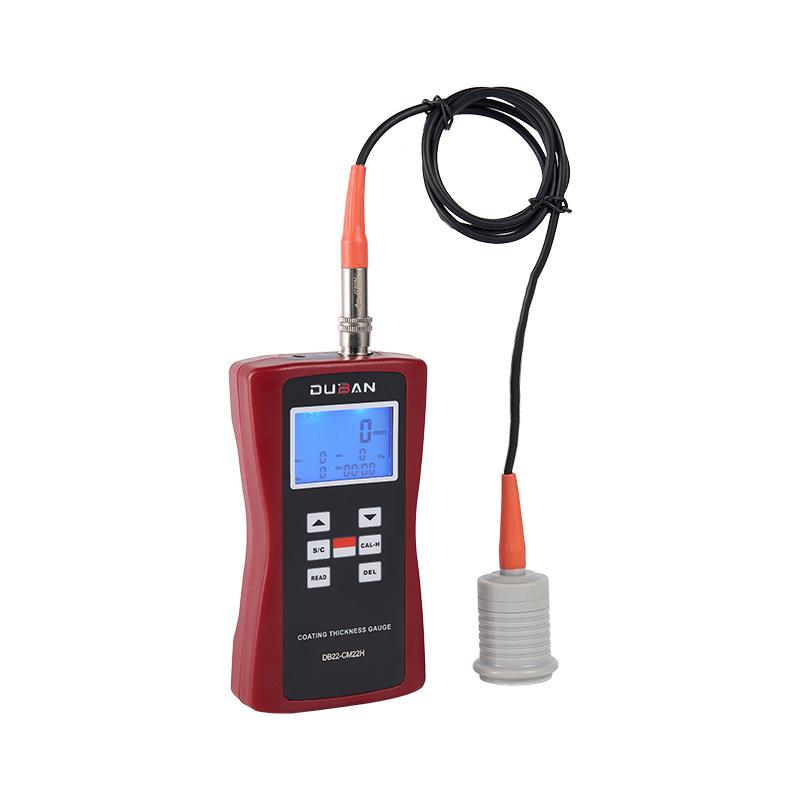
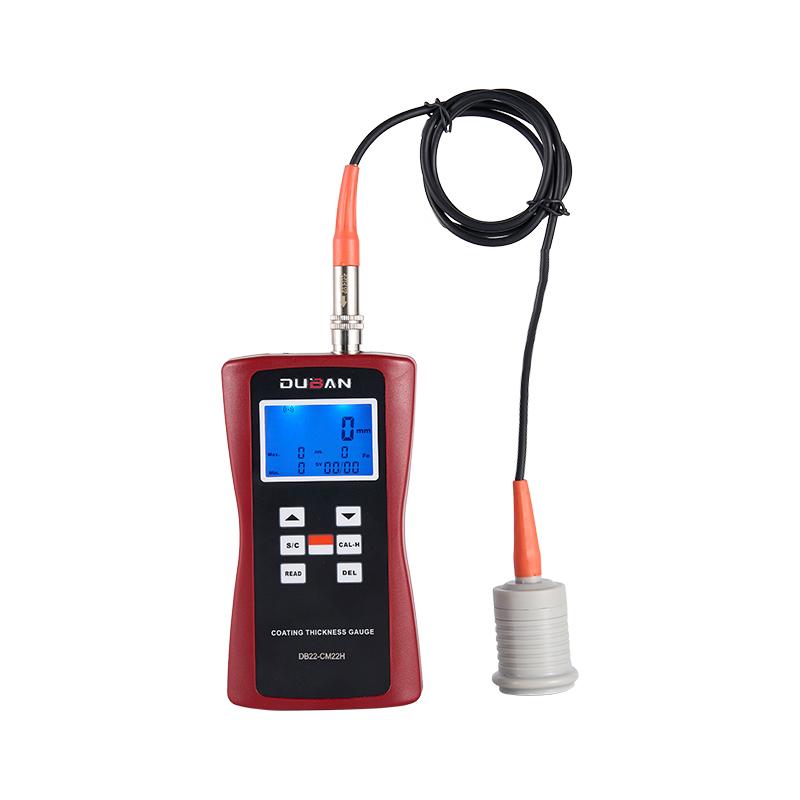
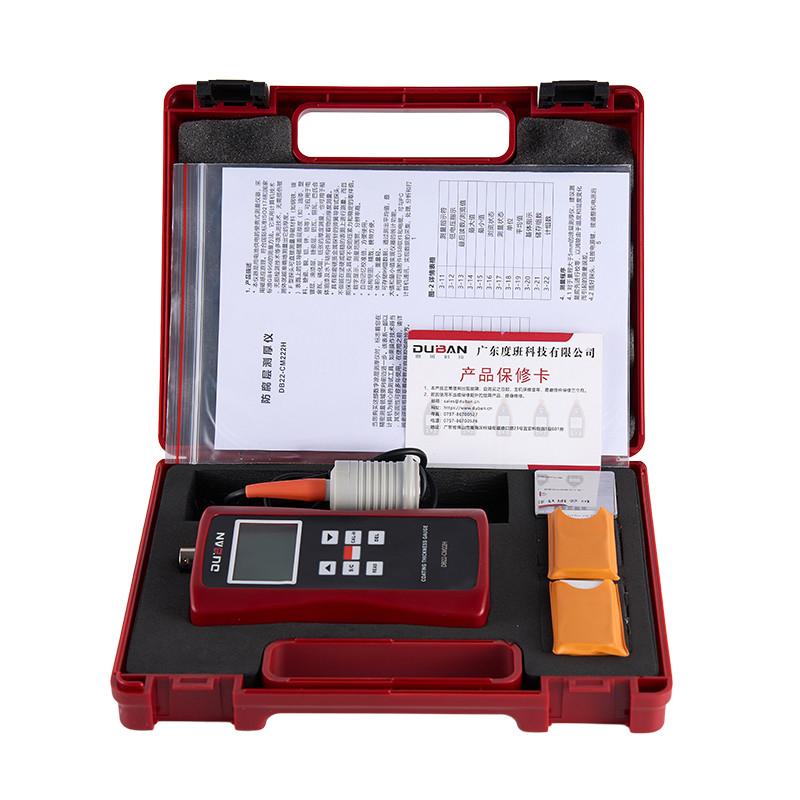

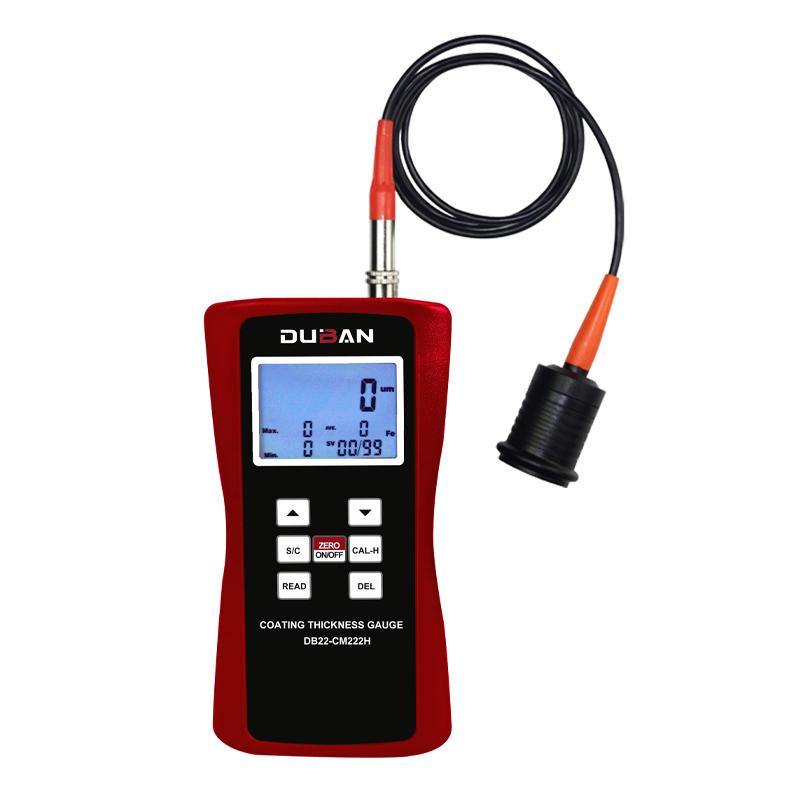
DUBAN DB22-CM222H Anti-corrosion layer Thickness Gauge
SE DB22-CM222H

Duban DB22-CM222H Anti-corrosion layer Thickness GaugeSPEC
Duban DB22-CM222H Anti-corrosion layer Thickness GaugeDetails
Duban DB22-CM222H Anti-corrosion layer Thickness GaugePacking list

- SKU
- NB047443
- display
- LCD backlight liquid crystal display
- resolution
- 0.01Mm (below 1.0mm)/0.1mm (above 1mm)
- Accuracy
- 1~ 3% n or 0.2mm
- Measurement range
- 0~12mm
- Measuring method
- F magnetic Induction
- Operating Environment
- Temperature -5~ 50 ℃ Humidity < 95RH
- Power Supply
- 14X1.5v AAA 7 batteries
- Host size
- 140mmx77mmx32 mm
Product Applications
Anti-corrosion layer Thickness Gauge is a portable measuring instrument, which can quickly, without damage, and accurately measure the thickness of coating and plating layers; It can be used both in the laboratory and in the engineering site; It is widely used in manufacturing, metal processing industry, chemical industry, commodity inspection and other testing fields; It is an instrument that needs to be used in the material protection profession.
The anti-corrosion layer Detector adopts the multi-frequency tube current method (also known as the AC current method, including the AC current attenuation method and the AC potential gradient method), under the premise of trenchlessness, by measuring the multi-frequency current in the pipeline and the leakage current in the soil at a certain point distance on the ground, it can quickly and economically find out the pipe section with anti-corrosion layer defects, and the A-frame can accurately locate the defect points of the anti-corrosion layer, and can evaluate the insulation performance of the anti-corrosion layer by classification, so as to scientifically, accurately, Economically test the comprehensive performance of the anti-corrosion layer and provide suggestions for the repair and maintenance of the anti-corrosion layer to ensure the integrity and integrity of the anti-corrosion layer.
The multi-frequency tube middle current method is a relatively mature anti-corrosion layer detection technology at home and abroad, and engineering practice has confirmed that DM is a reliable equipment for pipeline detection work such as finding and locating pipeline anti-corrosion layer defects, evaluating the insulation status of anti-corrosion layer, accepting the construction quality of anti-corrosion layer, and finding pipeline lap and short-circuit faults.
For oil theft clips in oil pipelines, metal Detectors can be used to assist in detection. The metal Detector is a magnetometer, which can detect the remanent magnetic field of magnetic metal, with the characteristics of ultra-high sensitivity, large bathymetry, automatic elimination of interference magnetic field, etc., and has obvious signal response to the oil (gas) clip, which is a reliable auxiliary tool for finding and locating the metal pipeline and the oil (gas) clip.
For the oil (gas) theft clip that has not been insulated and is in contact with the soil, due to the pipeline current leakage at the oil (gas) theft point, the pipeline current and leakage current can be measured along the pipeline with DM pipeline anti-corrosion layer Detector and A-frame first, find and locate the obvious pipeline current anomaly and leakage current anomaly, and then use a metal Detector to measure and compare the magnetic anomalies of each anomaly one by one, and determine and accurately locate the oil (gas) theft card after elimination and distinction. Regular inspection of pipeline anti-corrosion layer, and comparative analysis of time series of pipeline current detection data are helpful to timely detect abnormal pipeline current caused by oil (gas) clips.
For the stolen oil (gas) clips that have been insulated or are not in contact with the soil, the metal Detector can be used to directly find and locate the suspected pipe section or the pipe section with surface traces.
Features
It has the material that automatically recognizes the substrate to be measured.
There are two types of measurement options: single and continuous.
There is a buzzer prompt sound during operation, and the buzzer does not sound when continuous measurement.
It can store 99 sets of data; The statistical function of the instrument is realized by measuring the average, maximum and minimum values.
It uses "USB cable output" and "RS-232 cable output" to communicate with PC.
A Bluetooth™ Bluetooth data output option is available.
- 1 901-2021《Technical specification for the application of fireproof coatings for tunnels》
- 2 10254-2022《Green building materials evaluation fire retardant coating》
- 3GB 15442.1-1995《Classification and test methods for fire retardancy of finishing fire retardant paints--Classification for fire retardancy》
- 4GB 28375-2012《Fireproof coatings for concrete structure》
- 5GB 12441-2018《Finishing fire resistant coating》
- 6GB 14907-2018《Fire resistive coating for steel structure》
- 7ISO 4526-2004《Metallic Coatings - Electroplated Coatings Of Nickel For Engineering Purposes》
- 8GB/T 14907-2018《Fire resistive coating for steel structure》
- 9GB 14907-2002《Fire resistive coating for steel structure》
- 10GB 28374-2012《Fireproof coating for electric cable》