
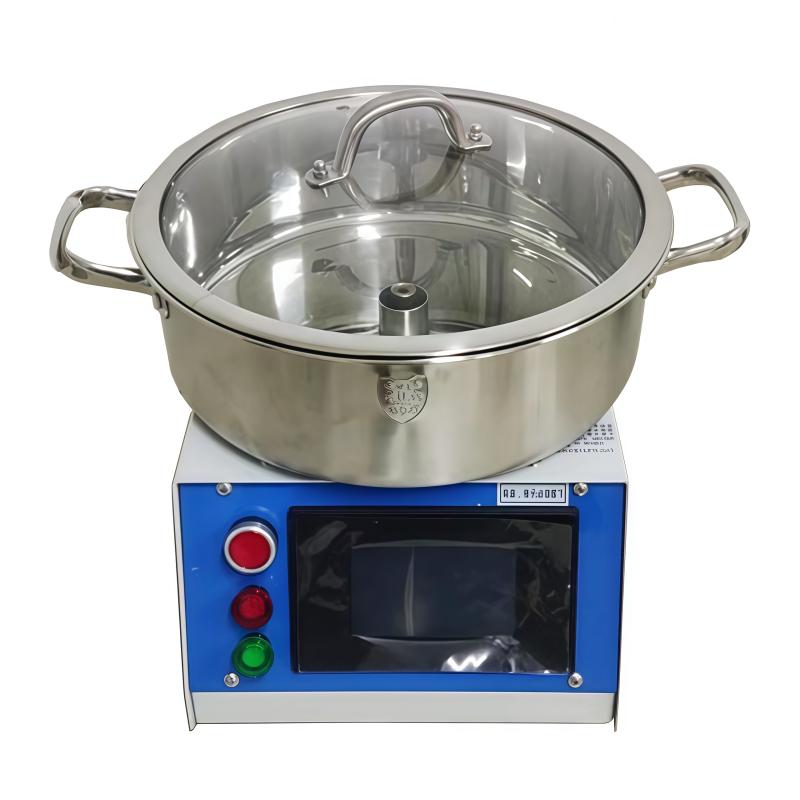
CHINA 12Ac-8 touch screen Spinning Coater Fixed Acceleration spinning coating
SE 12Ac-8

HuiNuo 12Ac-8 Spin CoaterSPEC
HuiNuo 12Ac-8 Spin CoaterDetails
HuiNuo 12Ac-8 Spin CoaterPacking list

- SKU
- NB047860
- Power Supply
- AC200-230V, single phase, 200W;
- loading diameter
- Negotiate;
- program control
- 1-5 paragraphs (edit pages), 12 groups;
- homogenizing time
- 3000S, resolution 0.1S;
- Speed range
- 100~4000rpm; 35cm pot (can be ordered 5000-7000 rpm)
- speed correction
- Rotation speed can be automatically corrected by selecting Kx practice run through A/K, and then go back to Kx to use
- Acceleration range
- No such function or 100-3000RPM/S range, resolution 1RPM/S;
- Dimension
- 250Mm (W) x420mm (D) x230mm (H) Height without pot;
- Weight
- Spin coater 14KG, optional vacuum pump 5KG;
- Vacuum input requirements
- 0.06-0. 09MPa, Vacuum Flow rate 40 liters/Min or more;
- Vacuum interface
- Comes with 6mm tube 1 meter
Introduction
A homogenizer is a device used to coat films, gluing liquids, or other liquid materials on the surface of a substrate, and its working principle is based on centrifugal force. Homogenizers have important applications in semiconductor manufacturing, optical coating, materials science and other fields, especially in the preparation of thin films, coating photoresists and other processes. The process parameters of the homogenizer include rotation speed, rotation time, viscosity of glue, dripping position, etc. These parameters affect the thickness, uniformity, and quality of the coating. Different applications and materials may require different process parameters.
The blending machine includes single-head, multi-head, single-speed, multi-speed and other series of products to meet the different needs of customers. The homogenizer is mainly used for photoresist coating, boron coating and other processes. 12AC Homogenizer is an experimental homogenizer with touch display, the acceleration can be adjusted digitally, the range is 100~4000rpm/s, the speed can be automatically corrected by A/K selection Kx trial operation, and a Vacuum Pump is optional.
Product Advantages:
The equipment has the characteristics of high homogenization efficiency and easy to use.
Its homogenizing speed and time are divided into multiple periods, and they are steplessly adjustable.
The electrical circuit is reliable, the motor runs smoothly, especially the motor torque is large, which is better than similar products.
The suction piece adopts a solenoid valve to control the air path, which is suitable for the process of the assembly line, and an air pump can work with several homogenizers at the same time, which improves the efficiency.
Features
Coating uniformity: Through centrifugal force, the glue homogenizer can evenly coat the surface of the substrate to achieve high-quality films or coatings. This uniformity is of critical importance for many applications, such as lithography.
Process controllability: Homogenizers often offer a wide range of parameter adjustment options, such as rotation speed, rotation time, coating position, etc. These parameters can be adjusted to the specific needs of the operator to achieve the desired coating effect and film thickness.
Wide range of applications: The homogenizer is not only suitable for the coating of photoresists, but also for coating other types of glues, liquid materials or solutions, such as polymer coatings, film preparation and other fields.
Rotation speed range: The rotation speed of the homogenizer usually has a wide range, from low speed to high speed can be adjusted to meet the needs of different coating thickness and uniformity.
Vacuum adsorption: To ensure that the substrate remains stable during the rotational coating process, the homogenizer is usually equipped with a vacuum adsorption system to ensure that the substrate is securely fixed to the tray.
Automatic control: Many blenders offer an automatic control option that allows for the automation of the coating process by programming preset coating parameters.
Operating Principle
The working principle of the homogenizer is to drop the glue on the rotating substrate, and then make the glue evenly distributed on the surface of the substrate through rotational motion to form a film or coating. The centrifugal force spreads the glue from the center to the outer boundary, resulting in a homogeneous coating. Parameters such as the rotation speed and time of the homogenizer and the viscosity of the glue affect the thickness and uniformity of the film or coating.