
Huicheng DSC-600L/-100~600 Differential Scanning Calorimeter -100 ℃~ 600 ℃
SE DSC-600L/-100~600

HuiCheng DSC-600L/-100~600 Differential Scanning CaloriMeterSPEC
HuiCheng DSC-600L/-100~600 Differential Scanning CaloriMeterDetails
HuiCheng DSC-600L/-100~600 Differential Scanning CaloriMeterPacking list

- SKU
- NB048380
- DSC range
- 0~±2000mW
- temperature range
- -100 ℃~ 600 ℃ liquidnitrogen refrigeration (semi-automatic pressurization)
- Timer frequency
- 16.6Hz
- Heating rate
- 0.1~100℃/min
- Cooling rate
- 0.1~50℃/min
- Temperature Accuracy
- 0.001℃
- Temperature Resolution
- 0.01℃
- Temperature Fluctuation
- ±0.01℃
- Temperature, repeability
- ±0.01℃
- DSC noise
- 0.001mW
- DSC resolution
- 0.01μW
- DSC Accuracy
- 0.001mW
- DSC sensitivity
- 0.001mW
- experimental mode
- FTC, STC mode can be set arbitrarily
- programmed temperature control
- Flexible setting of 12-step temperature control in all stages
- Temperature control method
- Heating, thermostatic, cooling
- scan type
- Heating, cooling, isothermal scanning
- atmosphere control
- The atmosphere of the two channels can be set freely, and the instrument can be automatically switched
- gas flow rate
- 0~200mL/min
- gas pressure
- 0.2Mpa
- display mode
- 24Bit color 7-inch LCD touch screen display
- Data Interface
- Standard USB port
- sampling rate
- 1~ 10Hz programmable setting
- Instrument calibrated
- The lower computer and the upper computer have multi-point temperature correction function at the same time
- parameter standard
- Equipped with standard materials, users can adjust the temperature and enthalpy by themselves
- Working Voltage
- AC220V/50Hz or custom
- working power
- 300W
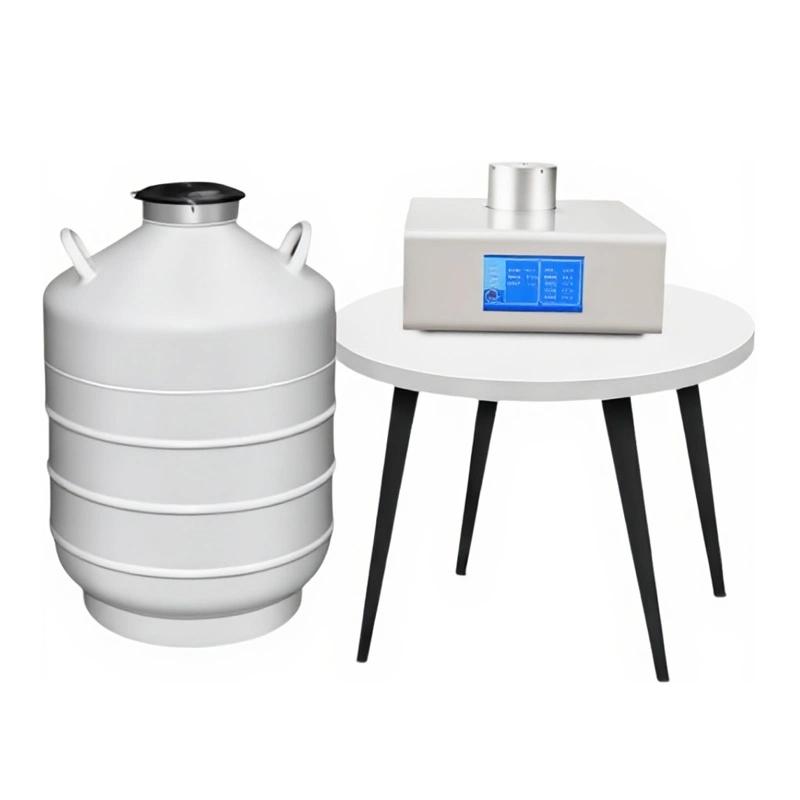
As a classical thermal analysis method that can control the thermal effect at program temperature, differential scanning calorimetry (DSC) has been widely used in various occasions such as research and development, process optimization, quality control and failure analysis in various fields of materials and chemistry. Using the DSC method, we are able to study the phase transition of inorganic materials, the melting and crystallization process of polymer materials, the polymorphism phenomenon of drugs, and the solid/liquid phase ratio of foods such as oils and fats.
Instrument Usage
Measure the physical and chemical changes related to heat, such as glass transition temperature, melting point, melting temperature, crystallization and crystallization heat, phase transition reaction heat, thermal stability of the product, curing/cross-linking, oxidation induction period, etc.
Features
The integrated design of the whole machine reduces signal loss and interference, greatly improves signal sensitivity and resolution, and can obtain a more stable baseline.
Equipped with imported high-frequency core control processor, the operation and processing speed is faster, and the control is more efficient.
The imported high-sensitivity sensor is adopted, which effectively improves the sensitivity and accuracy of DSC signal.
The independent atmosphere control can be intelligently set by software, and the instrument can automatically switch the gas circuit system, which makes the experimental efficiency higher.
The lower computer and the upper computer of the equipment system have multi-point temperature correction function at the same time, which meets the needs of different experimental occasions and improves the accuracy of temperature testing.
With two experimental modes of FTC and STC, the temperature control is more friendly and flexible, which can meet the needs of different experiments in different application scenarios, the temperature control of the experimental process is more accurate, and the analysis of sensor signals is more efficient.
The full temperature control system adopts the optimized dynamic PID algorithm, which greatly avoids the shortcomings of the traditional PID algorithm and improves the robustness of dual-mode temperature control.
The 12-step program temperature control setting makes the experimental methods more diverse.
The sampling frequency of the sensor signal can be set to 1~10Hz, the experimental method is more flexible, and the data is more controllable.
Dual temperature sensors are independent of each other to measure the furnace temperature and sample temperature separately at the same time.
The equipment system can do experiments on heating, cooling and isothermal related materials.
The instrument adopts USB two-way communication, supports self-recovery connection, intelligent software design, has the function of deducting the baseline, automatically plots the experimental process, and intelligently realizes the processing of various data, such as the calculation of enthalpy, glass transition temperature, oxidation induction period, melting point and crystallization of substances, etc.