

CHIJIU S312-120 Overhead Stirrer (frequency conversion speed regulation) motor Power 120W
 S312-120

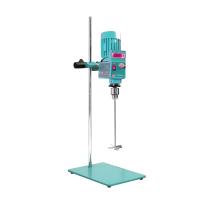
ChiJiu S312-120 Constant Speed StirrerSPEC
ChiJiu S312-120 Constant Speed StirrerDetails
ChiJiu S312-120 Constant Speed StirrerPacking list

- SKU
- NB005449
- Power supply Voltage
- 220V 50Hz/60Hz
- Power
- 120W
- Speed range
- 100~1400rpm
- Rotary collet clamping range
- Φ1.5~13mm

Description
S312-120 constant speed agitator adopts three-phase AC induction motor, frequency converter speed regulation, motor distance is not affected by speed, low temperature rise, large chassis, three columns.
Pictures

Instrument installation
1. Fix the three columns on the chassis with four pairs of M10 hexagon bolts and M10 hexagon nuts;
2. Install the motor bracket into the mounting hole of the upper slider;
3. Install the inverter box at the upper end of the long column and tighten the set screw;
4. Connect the plug on the motor with the socket under the inverter box, and when connecting, you need to align the position (concave and convex groove alignment), screw the outer ring of the plug clockwise, and hear a "click" sound, indicating that it has been pinned, (it needs to be unplugged counterclockwise).
5. Because the current of the inverter is very large at the moment of power-on, there is no power switch on the inverter box, and it is better to install the AC contactor or air switch in front of the power socket.
Directions for use
1. Before the stirrer is turned on the power supply, the knob on the inverter box should be adjusted counterclockwise to the minimum;
2. After the S312-120 constant speed agitator is connected to the power supply, "o" is displayed on the inverter box, press the green button, the display is displayed as "0.0", (press the red button to stop running), adjust the knob clockwise, the motor rotates from slow to fast, and the display window displays the frequency.
3. The stirring rod needs to be clamped on the chuck, and pay attention to its coaxiality.
4. The switch on the inverter box is for backup, and the agitator is not used.
Precautions
1. The power supply needs to be connected to a three-pin socket with protective grounding to ensure safety.
2. When inserting or unplugging the motor, the power supply needs to be cut off;
3. The agitator should be placed on a flat workbench;
4. The agitator runs for a long time at the lowest speed, and the motor is easy to heat, so try to avoid working for a long time at low speed.
5. If the number in the display window does not light up after the power is turned on, please check whether the fuse at the bottom of the inverter is broken, and replace it according to the original specifications.
6. This stirrer is not allowed to be reversed.
- 1Comparative Analysis of Mechanical Drive and Magnetic Drive Stirs
聂鹏飞 - 《磁力传动技术在脱硫侧进式搅拌器上的应用》
- 2Stirring device in emulsion paint Pigment and filler dispersion
- 3Novel Stir - Non-Splash Stir
- 4What are the types of commonly used laboratory equipment?
- 5Powerbasic Stirrer and Electromagnetic Stirrer
- 6Development process of graphic analysis magneticstirrer
- 7Preparation of Fire-retardant coating of bromocarbon alkyd resin cable
- 8Chijiu S312 Series Constant Speed Stir Operation Instructions