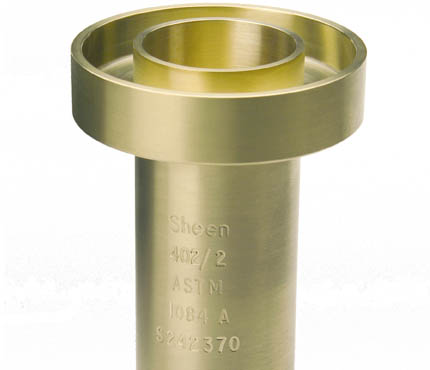
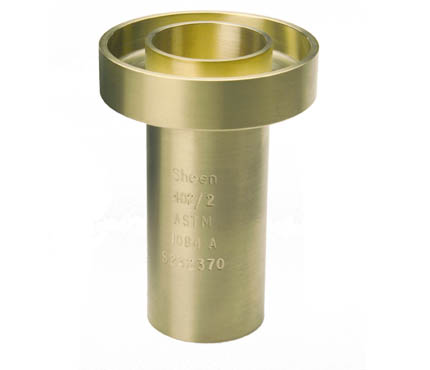
British Sheen Ref. 402/4 Viscosity Cup hard brass, standard palin cup, viscosity range 2000-15000
SE
SHEEN Ref.402/4 Viscosity cupSPEC
SHEEN Ref.402/4 Viscosity cupDetails
SHEEN Ref.402/4 Viscosity cupPacking list

- SKU
- NB000573
- Viscosity range
- 2000~15000cSt
- outflow time
- 30~100s
- flow hole diameter
- 6.35mm
- Cup body material
- Brass
- Filter material
- stainless steel
- Applicable standards
- ASTM D1084
- Certificate
- without
Introduction
sheen Ref.402/4 Viscosity Cup, also known as No. 4 Parlin cup, is made of fine hard brass with a stainless steel hole and is used for consistency measurements of cellulose paints or free-flowing adhesives. Parlin No. 4 is different from a traditional parlin cup in that the final flow time is determined at the volume point of 50 ml, rather than the blocking point where the fluid has just been discharged.
Specifications
| model | Ref.402/4 |
| hole diameter | 6.35mm |
| Viscosity range | 2000-15000 |
| Outflow time | 30-100s |
Palin Cup Principle
The Palin Cup was originally designed for rapid viscosity and consistency evaluation of products with Newtonian or near-Newtonian properties, providing a high degree of accuracy and repeatability depending on production quality. According to their early forms, although somewhat simple in design, today's parin cups are produced according to a number of international standards that have been developed over the years and specify not only the precise dimensional tolerances required in the process, but also their Records of data used and obtained. Based on our established experience in the manufacture of these types of products, the paint Viscosity Cups manufactured by Xinying Company are able to provide outstanding testing quality. These pallin cups are produced from selected high-grade materials, using the latest computerized machining technology, and under strict quality management conditions. Smooth, bright surface decoration makes the product easy to use and clean, ensuring a long working life.
Precautions for use
In order to ensure accurate measurement results, it is recommended to purchase at least 1 standard Palin cup with a calibration certificate. By comparing the results of measuring the parin cup and the standard parin cup measuring product standard product samples, a correction chart is drawn, so that the outflow time can be corrected through the chart to obtain correct test results.
The parin cup has a short channel length (i.e. cup wall material), so any change in the channel will have a significant impact on the outflow time. Therefore, you need to use appropriate fine brushes and solvents to clean the Viscosity Cup. Do not use other cleaning methods or cleaning tools that may cause scratches.
Product actual pictures