
LABO LB-R1000 Softness Tester 10-1000mN
SE LB-R1000

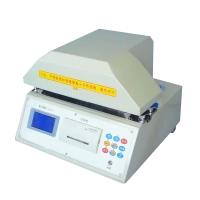

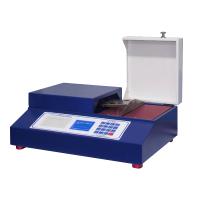
Labo LB-R1000 Softness TesterSPEC
Labo LB-R1000 Softness TesterDetails
Labo LB-R1000 Softness TesterPacking list

- SKU
- NB006495
- Measuring range
- 10 ~ 1000mN
- Indication resolution
- 1mN
- Error of indication
- ±1%
- Indication of variability
- ≤1%
- Accuracy
- ±1%
- Sexual repeability
- 1%
- Test speed
- 1.2±0.24mm/s
- Probe total travel
- 12±0.5mm
- Probe indentation depth
- 8+0.5mm
- Parallelism error on both sides of sample table Slit
- ≤0.05mm
- Probe alignment error
- ≤0.05mm
- Service life of Chinese measurement and control LCD
- About 50,000 hours
- Power
- AC220V 50Hz
- Dimensions
- 323 *281*302mm
- Net Weight
- 28Kg
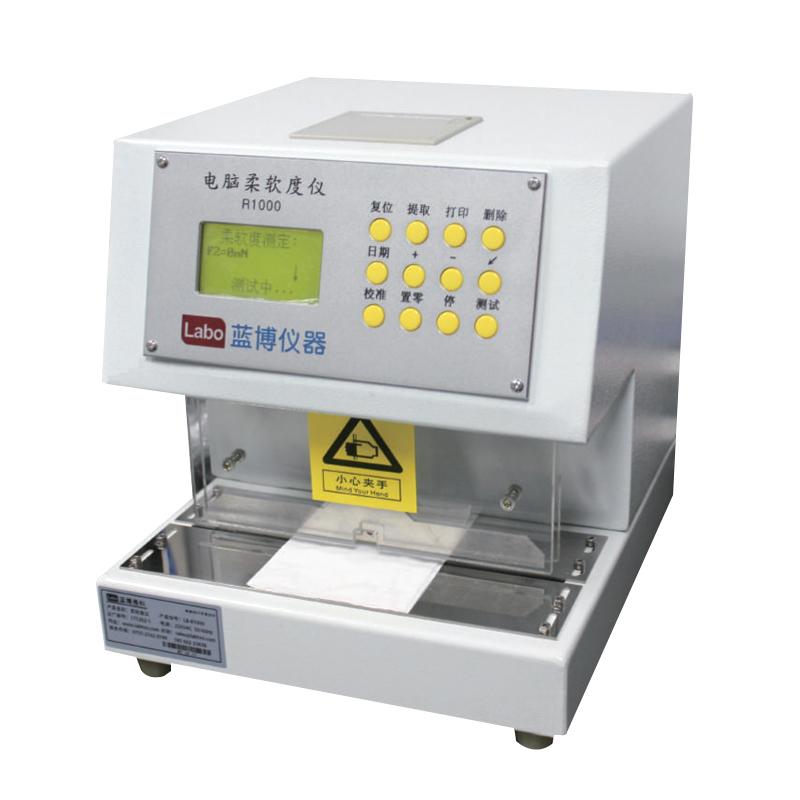
use
It is suitable for all kinds of wrinkled toilet paper, tissue paper and its derivative products, medical gauze and materials that require softness.
Under the specified test conditions, when the plate-shaped measuring head presses the sample into the slit to a certain depth, the sum of the bending resistance of the sample itself and the maximum vector of the friction force between the sample and the slit is called softness , expressed in millinewtons (mN), the smaller the softness, the softer the sample.
Standards
GB/T8942, T498SU, YC/T16
Features
High-precision load cells are used to ensure that the test accuracy error is within ±1%.
Stepper motor control, accurate and stable movement of the measuring head, good repeatability of measurement results.
LCD Chinese display, friendly man-machine interface operation, fully automatic completion of the test, automatic memory and display of test results, printer printing, reducing human error.
The built-in calibration program is convenient for the measurement and calibration department (third party) to calibrate the instrument. When calibrating, hang a weight on one end of the parallel bar and place the other end directly under the probe to calibrate the indication error.
The instrument is equipped with a special calibration device for softness.
Test description
Use sampling equipment to uniformly cut the standard sample from the sample, adjust the width of the slit according to the product standard, and check the width error and parallelism, place the sample on the instrument test bench, symmetrical to the slit, the multi-layer paper Take the method of stacking up and down, and then turn on the instrument for testing, and the plate-shaped measuring head starts to press down. After the test is completed, read the measurement result value, and 10 vertical and horizontal data should be measured respectively.
Note: Whether it is an embossed or unembossed sample, the samples should be uncovered and layered, and then overlapped together to test the softness;
For samples with too high softness, the bending width of the sample less than 100mm can be selected for testing, and the measurement results should be converted according to the proportional relationship, and indicated in the test report.