
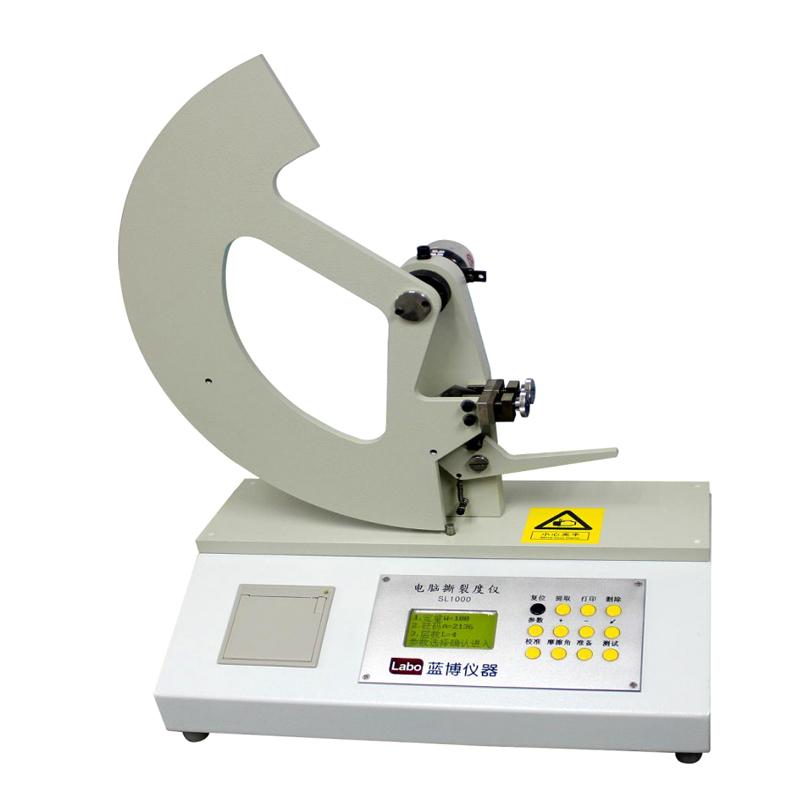
LABO LB-SL1000 Paper Tear Tester
SE LB-SL1000

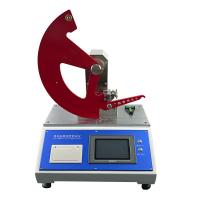
Labo LB-SL1000 Tear TesterSPEC
Labo LB-SL1000 Tear TesterDetails
Labo LB-SL1000 Tear TesterPacking list
- SKU
- NB006496
- Measuring range
- Light pendulum (50~6500) mN; heavy pendulum (500~10000) mN
- Resolution
- 0.1mN
- Error of indication
- ±1%
- Indication of variability
- ≤1%
- Tear arm
- 104±1mm
- Tear initial angle
- 27.5±0.5°
- Distance between paper jacks
- 2.8±0.3mm
- Specimen incision length
- 20±0.5mm
- Service life of Chinese measurement and control LCD
- About 50,000 hours
- Power
- AC220V ± 22V 50Hz 0.5A should be reliably grounded
- Dimensions
- 450*330*440mm
- Weight
- 20Kg
use
For testing the tear strength of sheet materials such as paper and plastic films, laminated films, textiles and nonwovens. The average value of force required to continue tearing a pre-notched sample to a certain length. (Measurement results are expressed according to the longitudinal or transverse direction of the initial incision of the sample, the unit is mN, the tear index is the tearing degree divided by the quantification of the sample, and the result is expressed in millinewton·square meter/gram mN·m2/g) The instrument is equipped with Optical rotary encoder to measure the swing angle position during tearing operation.
Standards
GB/T455, GB/T 16578.2 , ISO1974 , TAPPI T414 T496 , DIN EN 21974 , DIN EN ISO 6383-2 , DIN EN ISO13937-1
Features
The high-precision angle sensor is used to make the resolution reach 0.1mN, to ensure that the test accuracy error is within ±1%, and the user can use self-made weights to verify the correctness of the tearing Tester;
The accompanying weighing weights can be easily calibrated at any time, and the built-in pendulum shaft friction compensation device reduces the influence of friction on the test, making the results more accurate and stable;
LCD Chinese display, friendly man-machine interface operation, fully automatic test, with test data statistical processing function, micro-printer output, automatic pendulum release control and automatic memory and display of results, reducing human error, easy to operate, and accurate results stable and correct;
The instrument is equipped with special calibration weights and a built-in calibration program, which is convenient for the measurement and calibration department (third party) to calibrate the instrument. When calibrating, enter the calibration test program, screw the calibration weight into the calibration screw hole, and it can be easily performed. Indication error calibration.
- 1Paper tearing determination - Alimendorf method and instrument operation guide
- 2How to install a tear Tester in 5 easy steps?
- 3Tear Tester of paper strength
- 1GB/T 19787-2025《Encasement material, polyolefin thermal cissing film》
- 2GB/T 28210-2024《Thermal-sensitive paper》
- 3QB/T 1050-2012《Paper and board-tearing tester》
- 4GB/T 34722-2017《Surface decorated plywood and blockboard with paper impregnated thermosetting resins》
- 5GB/T 13519-2016《Polyethylene heat-shrinkable film for packaging applications》
- 6JJG (轻工)63-2000《Verification Regulation of Tear Tester for Paper and Board》
- 7JJG (轻工)63-2000《Tear Tester for Paper and Board》
- 8GB/T 455-2002《Paper and board--Determination of tearing resistance》