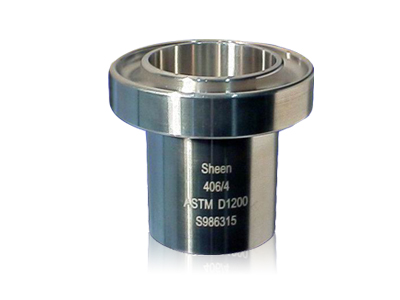
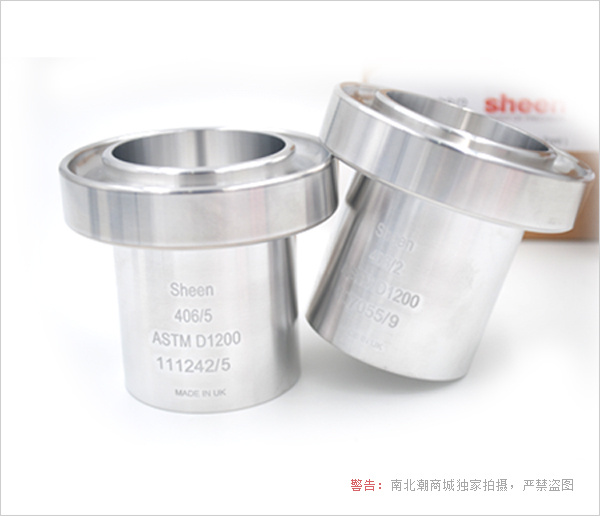
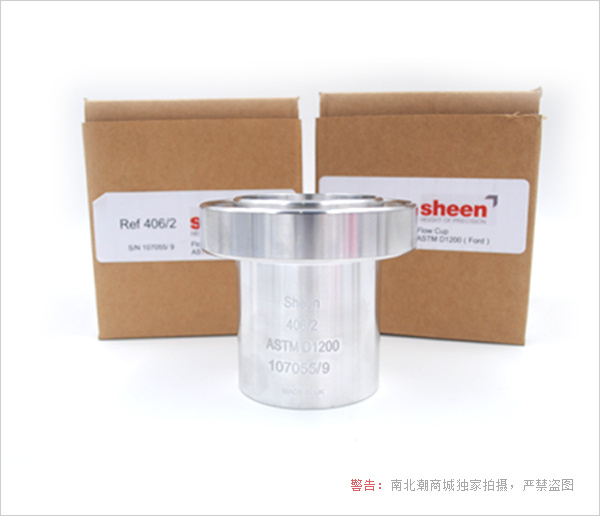
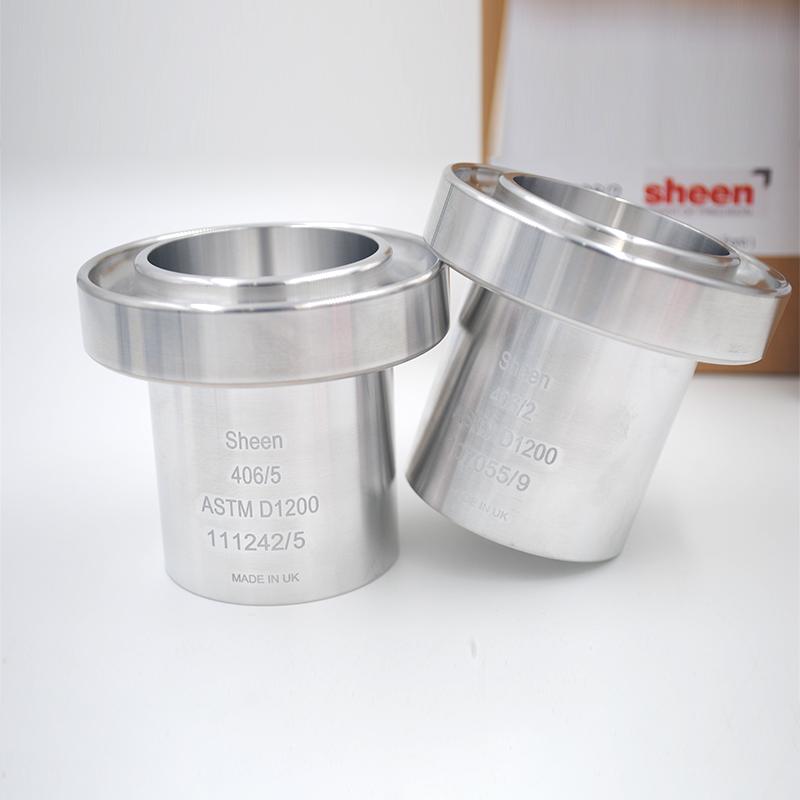
UK Sheen Ref. 406/5 Ford Viscosity Cup meets ASTM, BS, DIN, EN ISO standards
SE Ref.406/5

-
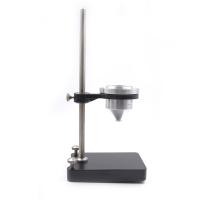 MODERNER FORD-5 No. 5 Ford Viscosity Cup for the determination of Newtonian fluids such as varnishes, paints, and paints
 -
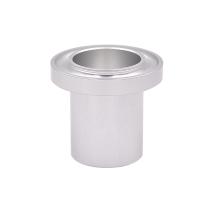 YONGLIDA FORD-5 Ford Viscosity Cup Flow Cup method$ 165.00SE
 -
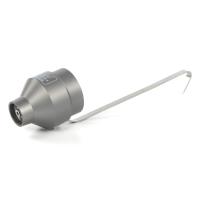 TQC VF2088 No. 5 Ford Viscosity Cup filter diameter is 5.8mm$ 276.00SE
 -
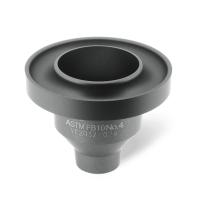 TQC No. 5 Ford Ford Viscosity Cup, model VF2033, filter aperture 5.2mm$ 482.00SE




SHEEN Ref.406/5 Ford Viscosity CupSPEC
SHEEN Ref.406/5 Ford Viscosity CupDetails
SHEEN Ref.406/5 Ford Viscosity CupPacking list
- SKU
- NB000099
- Viscosity range
- 25~120cSt
- outflow time
- 0~100s
- flow hole diameter
- 5.8mm
- Cup body material
- aluminum
- Filter material
- stainless steel
- Applicable standards
- ASTM、BS、DIN、EN ISO
- Ambient Temperature
- 23 +/- 1 ℃ or 25 +/- 1 ℃
Ford Cup Principle
The Ford Cup was originally designed for rapid viscosity and consistency evaluation of products with Newtonian or near-Newtonian properties, providing a high degree of accuracy and repeatability depending on production quality. According to its early form, although somewhat simple in design, today's Ford Cup, is produced according to a number of international standards that have been developed over the years and specify not only the precise dimensional tolerances required in the workmanship, but also their Records of data used and obtained. Based on our established experience in the manufacture of these types of products, the Ford Cup manufactured by Xinying Company is able to provide outstanding test quality. These Ford cups are produced from selected high-grade materials, using the latest computerized machining technology, and are produced under strict quality management conditions. Smooth, bright surface decoration makes the product easy to use and clean, ensuring a long working life.
To ensure better accuracy in your test results, it is highly recommended to regularly calibrate your Ford Cup, either through our own calibration department or using our standardized calibration oil.
Standards compliant
Comply with ASTM, BS, DIN, EN ISO standards
Standard application
Viscosity measures conditional viscosity. That is, it is the time for a certain amount of sample to flow out from a hole of a specified diameter at a first certain temperature, expressed in seconds (S). The outflow time can be converted into kinematic viscosity value centistokes (mm2/s)
t=0.053V+1.0
Or when tï¼23S, t=0.154V+11
23S⤠t<150S, t=0.223V+6.0
Calibration: First verify the correction coefficient K of each viscometer, which is defined as the ratio of the standard outflow time T and the measured outflow time t of the viscometer being calibrated under the same conditions, which is the correction coefficient K, K=T/t.
Features
Ford cups are made from good aluminum and have stainless steel nozzle insert blocks (depending on specs)
Production using high-precision computerized machining
Mirror polished and smooth surface treatment for high flow accuracy and easy maintenance
Strict quality and compliance checks
Note:
Does not include clamp Ford Viscosity Cup holder
Instructions
For detailed information, please check the relevant international standards: ASTM, BS, DIN, EN ISO standards
ãã1) Select the appropriate Viscosity Cup (please check the outflow time)
ãã2) Ensure that the Viscosity Cup and test fluid are at the required experimental temperature.
ãã3) Make sure there are no bubbles and debris in the fluid.
ãã4) Seal the outflow hole (you can use your hands), fill up the fluid, scrape the excess test fluid into the groove on the edge of the viscometer, and put the receiving cup in place.
ãã5) Release your hand from the outflow hole and start timing, ending when the first breakpoint appears in the fluid.
hour. The calculated time is the viscosity time corresponding to the test fluid (representing its conditional viscosity, in seconds).
ãã6) Fixed flow test method: The procedure is similar to item 5, but the stop time should be when 50ml of fluid flows out.
Precautions for use
Before testing, the Viscosity Cup needs to be wiped clean with gauze dipped in solvent, and dried with cold air. keep it clean
When there is no requirement, the sample temperature is generally 23±1℃ or 25±1℃
The test value cannot be greater than 3% of the average value
Comparing data, there are differences between devices
Product actual pictures