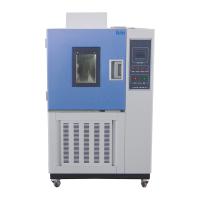
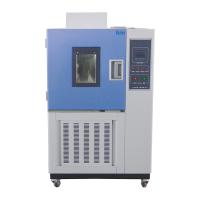
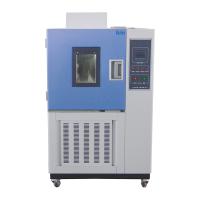
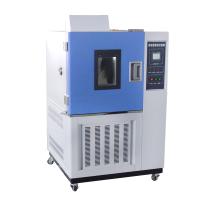
Constant humidity cabinet test equipment knowledge guide
Constant humidity and heat test equipment is used to detect the performance of machinery, instruments, electrical and electronic products in a constant temperature and high humidity environment, and to assess their moisture resistance through the adsorption/absorption of water vapor on the specimen, which is widely used in electronics, automobiles, aerospace and other fields, and is the key equipment for product reliability testing.
According to whether it has a cold source, the equipment is divided into two categories: those without a cold source (such as constant temperature and Humidity Chamber, temperature and humidity control box), with a narrow temperature and humidity range, and the main high temperature and high humidity test; With a cold source (low temperature constant temperature and Humidity Chamber), it has a wide range of temperature and humidity adjustment, can do high temperature and high humidity, low temperature and low humidity tests, and can also be used as a low temperature box, and users can choose according to the temperature and humidity range, accuracy, and studio size.

Structure and principle
(1) Core structure
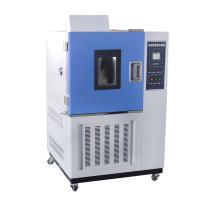
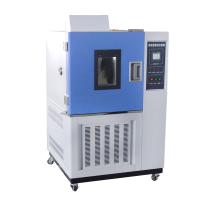
The constant temperature and Humidity Chamber consists of a main unit and an independent electrical control cabinet. The upper part of the main engine is a stainless steel working room, and the lower part is a refrigeration unit; The rear air conditioning room integrates a refrigeration evaporator, heater, humidification hole and axial flow fan, the fan drives air circulation and convection, and the double-layer partition blocks the cold and hot radiation. There are solenoid valves, expansion valves and other components behind the air conditioning room, and the box is equipped with test holes, observation windows and lights.
(2) The principle of temperature and humidity control
Temperature control: The sensor (Rt) collects signals and compares them with the set value, and outputs signals to control the heater or cooler to maintain a constant temperature. Humidity control: After the sensor (Rt₁) compares the signal, control the humidifier humidification or dehumidifier dehumidification, and the temperature of the dehumidifier tank is adjusted separately.
Humidity adjustment is a direct-reading instrument, the dry bulb temperature is divided into two ranges of 10~40°C and 40~80°C, and the humidity is read through the intersection of isotherms and isohumidity lines, the red pointer sets the dehumidification threshold, the green pointer sets the humidification threshold, and the middle screw corrects the zero position.
Usage specifications
(1) Technical indicators and verification
The equipment must comply with the GB/T 5170.5-2016 standard, which specifies 15 indicators such as temperature deviation and humidity uniformity, such as temperature measurement error ≤±0.2°C and humidity measurement error ≤±2% RH to ensure accurate test data.
(2) Steps to use
Preparation: Connect to a special power supply (red phase wire, blue middle wire, black ground), store bottled distilled water (tap water is prohibited), and install the hygrometer correctly.
Adjustment: first warm and preheat the specimen, and then gradually humidify and prevent condensation; The dehumidifier is used to replace the refrigerator in the low temperature and high humidity test, and the heater is controlled by the temperature and the humidifier is moisturized.
Monitoring: Before humidification, confirm that the temperature is close to the set value, the water level of the Water Tank is normal and the temperature is slightly low, check with the observation window during the test, and turn off the lights as needed.
Breakdowns and maintenance
1. Liquid level and pipeline: keep the distilled water in the storage bottle sufficient, clean the water pipe regularly, check the water pump and rubber pipe, and prevent the nozzle from clogging.
2. Component maintenance: clean the workshop and air conditioning room, clean the condensation/dust of the refrigeration unit, and check the insulation of the electrical cabinet lines.
3. Fault handling: humidity failure check nozzle and water pump; Check the heater, chiller, and sensor for temperature fluctuations, and refer to the manual for maintenance.
summary
The constant humidity and heat test equipment relies on scientific structure and precise temperature and humidity control to provide support for product temperature and humidity adaptability testing, and the two types of equipment are suitable for different scenarios. Operation and maintenance in accordance with GB/T 5170.5-2016 standards can not only ensure the stability of equipment, but also ensure the reliability of test results, which is an important tool for industrial production and quality inspection.
-
![BOZHEN GDHS41 Damping heat testing chamber]()
-
![BOZHEN GD/HS4050 Humidity Test Chamber]() BOZHEN GD/HS4050 Humidity Test Chamber$ 6960.00
BOZHEN GD/HS4050 Humidity Test Chamber$ 6960.00 -
![BOZHEN GD/HS4025 High and Low Temperature Constant Damping heat testing chamber]()
-
![BOZHEN GD/HS4010 High and Low Temperature Constant Damping heat testing chamber]()
-
![BOZHEN GD/HS4005 High and Low Temperature Constant Damping heat testing chamber]()
-
![BOZHEN HS1A Humidity chamber constant temperature and humidity detection box 0~100 ℃/1000L]()
-
![BOZHEN HS050A Humidity chamber 0~100 ℃/500L]()
-
![BOZHEN HS025A Humidity chamber 0~100 ℃/250L]()
-
![BOZHEN HS-010A Humidity chamber 0~100 ℃/100L]()