Detection of flexibility of anti-corrosive coatings on curved surfaces
Introduction
In various industrial protection fields, the protective layer coated on the surface of the substrate needs to withstand a variety of environmental stresses, among which the flexibility of the coating is one of the key indicators to evaluate its long-term durability. When coatings are applied to curved substrates such as pipes, connectors, and special-shaped structural parts, it is particularly important to evaluate whether they crack or peel off in the deformed state. As a classical detection device, the shaft rod tester provides a reliable method for quantitatively evaluating the flexibility of anti-corrosion coatings on curved surfaces by simulating the bending deformation of coatings under a fixed radius of curvature. This paper aims to systematically explain the principle, standard procedure, result evaluation and significance of the detection method in practical application.
Detection principle and equipment
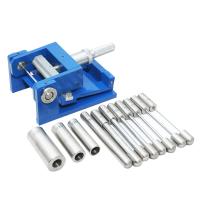
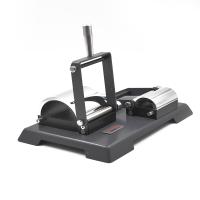
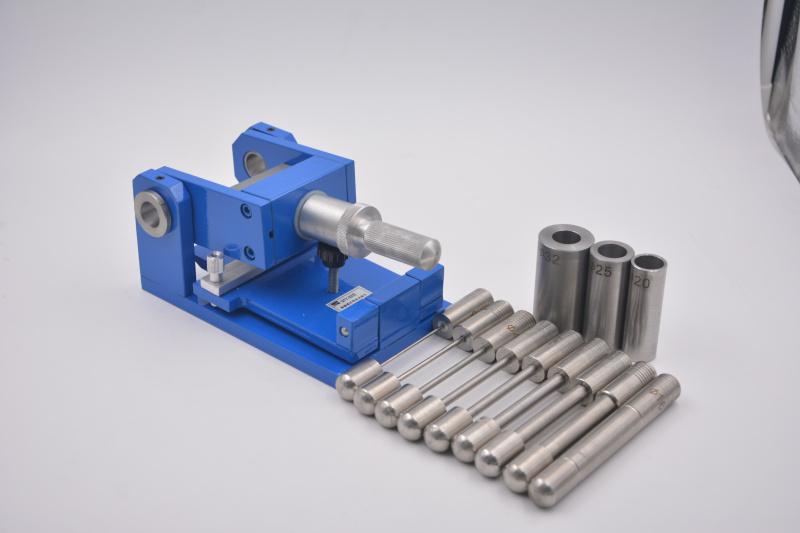
The core principle of the shaft rod tester is based on the strain difference between the coating and the substrate when they bend together. When a coated test plate is bent around a shaft rod with a specific diameter, the outer surface of the coating is subjected to tensile stress, while the inner surface is subjected to compressive stress. The flexibility of the coating is manifested in its ability to resist such stresses without cracking, peeling and other damage phenomena. The equipment usually consists of a set of precision shaft rods, bending devices and pressure rollers of different diameters. Shaft rod diameter sequences typically follow geometric progressions such as 1 mm, 2 mm, 3 mm, 4 mm, 5 mm, 6 mm, 8 mm, 10 mm, 12 mm, 16 mm, 20 mm, 25 mm, and 32 mm to cover different degree of bending requirements, from demanding to loose.
The maximum strain (ε) that the coating is subjected to when bending can be approximated by the following formula, which is applicable when the coating thickness (t) is much less than the diameter of the shaft rod (D):
ε = (t / D) × 100%
Among them, ε represents the tensile strain percentage of the fibers on the outer surface of the coating, t is the thickness of the dry film of the coating, and D is the diameter of the shaft rod. This formula clearly shows that the smaller the diameter of the shaft rod used, the greater the strain on the coating and the more demanding the flexibility is placed under the same coating thickness.
Standard testing procedures
The testing process is carried out in a standard temperature and humidity environment to ensure comparable results. First, the coating to be tested is evenly applied to a metal test plate of standard size and completely cured according to the specified conditions. Use a thickness gauge to measure the thickness of the coating dry film and record it. Subsequently, the shaft rod diameter that is similar to the estimated flexibility level is selected to begin the test. The test plate coating is placed outward and smoothly placed on top of the shaft rod to complete a 180-degree bend at a uniform speed within 1 to 2 seconds. The operation should be smooth and impact-free. Immediately after bending, observe the surface of the coating, especially the central part of the bending area, with the naked eye or at the specified magnification, to check for cracks, peeling, etc. If no failure occurs, the test is repeated with a smaller diameter rod until the minimum rod diameter is found that the coating is just right to be free of failure, which is the key data for evaluating the flexibility of the coating.
Result evaluation and grading
The evaluation of the test results is mainly based on whether the coating is damaged after bending and the type and degree of damage. Typically, the flexibility rating is characterized by the smallest shaft rod diameter that the coating can pass through. The smaller this diameter value, the better the flexibility of the coating. Some standard systems report results directly as "passed X mm shaft bar test" or graded according to the diameter range. The following is a common flexibility evaluation reference table:
| Minimum Passing Shaft Rod Diameter (mm) | Flexibility evaluation description |
|---|---|
| ≤ 2 | High flexibility for substrates where significant deformation may occur |
| > 2 and ≤ 6 | Good flexibility, suitable for general curved surfaces and base surfaces with slight deformation |
| > 6 and ≤ 10 | Medium flexibility for fixed surfaces with a large radius of curvature |
| >10 | Limited flexibility, recommended for flat or near-flat base surfaces |
In addition to qualitative observation, some advanced evaluation methods quantify cracks with the help of magnifying glasses or microscopes, such as measuring the length and width of cracks or calculating the number of cracks per unit area, to obtain more granular performance data.
Influencing factors and significance
The flexibility of the coating is influenced by various factors. The chemical structure of the resin system is an intrinsic determinant, for example, certain polymer segments provide better elasticity. Pigment volume concentration, choice of additives, and amount of addition can also significantly alter the mechanical properties of the coating. In addition, coating thickness is a key variable, and coatings that are too thick tend to be subjected to greater absolute strain when bent, making them more prone to cracking. Curing conditions, such as drying time and temperature, can also affect the final network structure of the coating, which in turn affects its flexibility and adhesion.
In practical applications, this detection has multiple implications. For coating developers, it is an important basis for optimizing formulations and screening resins and additives. For quality control and procurement departments, it is a critical access test to verify that the coated product meets the construction requirements of a specific curved substrate. For engineering designers and maintenance personnel, understanding the flexibility data of coatings can help predict their long-term performance under conditions such as thermal expansion and contraction, mechanical vibration, or slight shock, so as to select the right protection system to extend the service life of the facility.
Conclusion
The shaft rod tester detection method has become the basic and effective means to evaluate the flexibility of anti-corrosion coatings on curved surfaces due to its simple equipment, convenient operation and intuitive and reliable results. Through standardized testing and scientific evaluation, quantitative indicators of the coating's resistance to bending and deformation can be obtained. This index is correlated with the adhesion, impact resistance and other properties of the coating, and together constitutes a comprehensive dimension for evaluating the mechanical integrity of the coating system. In the industrial field that pursues long-term protection, incorporating this test into product specifications and acceptance standards has practical guiding value for ensuring the quality of coating and ensuring the protective effect.
References
International Organization for Standardization. Colored paints and varnishes - bending test (tapered shaft).
American Society for Testing and Materials. Standard test method for determining the flexibility of coatings using a mandrel bending tester.
National Standardization Administration of China. Determination of paint film flexibility.
Mechanical Properties Testing Technology of Protective Coating Materials. Transactions of the Chinese Society of Materials Engineering.
-
![JINGKELIAN QTY-32-III Film Bending tester cylindrical mandrel bending test machine, film flexibility]()
-
![HuiNuo QTB putty flexibility Tester, in line with GB1748 standard]()
-
![TRUIT TR 5240 Putty film flexibility Tester GB/T1748 standard]()
-
![TRUIT TR 5230 Film flexibility Tester]()
-
![China QTB putty flexibility tester GB1748]()
-
![JFL QTB putty flexibility tester]() JFL QTB putty flexibility tester$ 231.00
-
![YONGLIDA WZJ-II bending machine T-type bending test machine, bending angle < 45 ° Travel ≥ 10mm]()
-
![QTX film Flexibility Tester YONGLIDA shaft rod length is 35mm]()
-
![MODERNER QTX film Flexibility Tester national standard GB1731]()